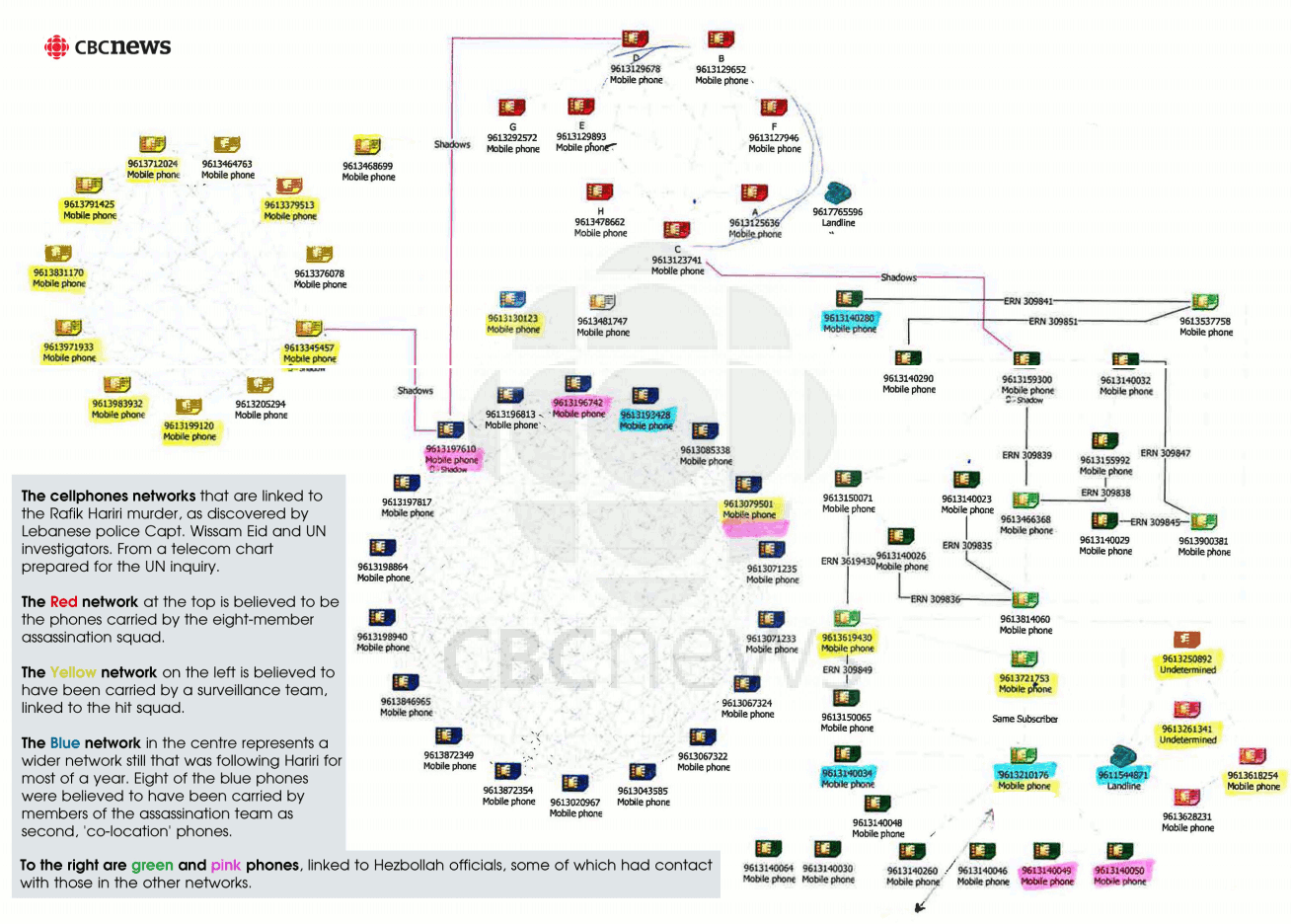
The alleged confidential document obtained by CBC news which connects Hizbullah to the Hariri crime. Click to enlarge. (h/t BeirutSpring.com)
I imagine that any regular reader of this blog has already heard about Neil Macdonald’s special report on the Hariri assassination for CBC news. It’s a must read, if only because it will be all anyone will talk about in Lebanon for the next few weeks. You can also see the brief video report on the story that appeared on Canadian television yesterday here.
This is the third “scoop” about the Hariri investigation in a series of articles dating back to August 2006, when Georges Malbrunot published a story in Le Figaro that first hinted at the possibility of Hizbullah’s involvement. The infamous report by Erich Follath in Der Spiegel three years later added more details to Malbrunot’s revelation that telecommunications data was being used to track Hariri’s hit team.
Macdonald’s report builds on the two earlier stories but also provides some new (and surprising) information:
- The UN didn’t make much headway on the investigation until late 2007.
- Captain Wissam Eid — a Lebanese police officer investigating the crime who was killed in 2008 by a car bomb — had made huge strides towards cracking the case all on his own by using telecommunications data (i.e. signal intelligence) and submitted a report to the UN, only to have it shoved into a drawer for over a year.
- Eid was killed a week after the UN rediscovered the report and re-connected with him, which suggests that he was being watched by Hariri’s killers.
- Several senior officials in the investigation suspect that Col. Wissam al-Hassan (the head of the Internal Security Forces’ Information Branch and close confidante of Saad al-Hariri) had former knowledge of the plot to kill Hariri Sr., and they have evidence that he was in close communication with members of Hizbullah on the night before the murder.
- Apparently the UN is demanding that CBC news return the confidential documents that Macdonald secured, and is refusing to comment on the story.
There’s a lot to say about this report and I’m sure it will generate a lively discussion, but I’ll confine myself to just a few observations for now:
First, can we tentatively assume that Malbrunot’s source back in 2006 was either Wissam Eid himself or his boss Samer Shehadeh, since the article came out before the UN “discovered” Eid’s report in 2007? Perhaps they hoped to send a message to The Hague to look into this material that had been ignored thus far.
Secondly, where did Macdonald get all of his information? Is the STL leaking like a sieve, or are his sources all former disgruntled officials who are dissatisfied with the direction of the investigation? The detailed information about Wissam Eid is particularly interesting, and leads one to suspect that Samer Shehadeh (Eid’s former boss who was targeted unsuccessfully by a car bomb and is now based in Quebec) might have been one of Macdonald’s sources, but this is pure speculation.
Thirdly, the material about Wissam al-Hassan is clearly the most disturbing and complicating element in this whole report. It’s an accusation that makes everybody’s life more difficult. Given al-Hassan’s close ties to Saad Hariri, no one in March 14 is going to be happy with these claims, and the Americans were apparently very uncomfortable with them. It also causes problems for Hizbullah and its allies: how can the opposition embrace the revelation about al-Hassan’s alleged culpability while disavowing the rest of the report? Finally, the Syrians, too, will not be happy with this leak, as Wissam al-Hassan was Hariri Sr.’s main channel to Rustom Ghazzali (former Syrian head of intelligence and de facto viceroy in Lebanon), which puts Damascus back under the spotlight. My guess is that what we’re likely to see is a lot of tiptoeing by Lebanese politicians with respect to this new story.
While I believe that a healthy dose of skepticism about all STL matters is certainly warranted, let us imagine for a moment that Macdonald’s report is based on solid sources. If you thought (like I did) that the prospect of Hariri sending the army to arrest members of Hizbullah was about as fantastical a scenario as anyone could imagine, we now stand corrected. No, the most fantastical scenario is the one where Hariri sends the army to arrest members of Hizbullah and his own intelligence chief for the murder of his father. And unless another Western newspaper reveals in a year that it was none other than Saad himself who ordered the crime, I think the Hariri affair’s irony index has hit an all-time high.
For other reactions to the story see: Beirut Spring, Friday Lunch Club, Angry Arab… [I’ll keep adding them as they appear.]


 Qifa Nabki
Israel is more than likely capable of forging any telephone record it wants, given their spies high up in telephone companies…i.e. Akbar Palace calls AIG at 1400 hours on 11/22/2010 and they “talk” for 5 hours. 🙂
Posted by Nasser V | November 22, 2010, 7:06 pmAs requested, I’ll repost this from the bottom of the previous discussion…
A few technical comments on the information discussed in the CBC report (which includes the network SIGINT analysis “map” upon which much of the case is based).
1) The phone records would be extraordinarily difficult to fake: mobile phones send location signals out to surrounding towers constantly, whether in use or not. To fake that constant communication over all of Beirut over a period of months would border on the impossible, especially since many of the phones would also be generating their normal traffic.
2) It is clear that a lot of people did not realize the danger of colocated phones until recently, hence the sloppiness in Hizbullah communication security.
3) The evidence could be pretty strong for the immediate trigger and surveillance teams: a closed network that is located at the assassination site and then goes silent really has no other plausible explanation, and if those individuals can be identified through colocation I suspect it would stand up in any reasonable court. It becomes more problematic, however, the further one moves away from that circle.
I’ll also add another thought, not included in my previous post. I assume now that the metadata on Lebanese mobile calls for 2005 is now in STL possession, and they continue to pour through it. As they do, it is possible that additional connections will emerge—possibly reaching higher and higher into Hizbullah. This (admittedly, among many other factors) helps explain why Nasrallah spurned Hariri’s offer of a “rogue element” escape hatch, fearing that it wouldn’t end the risk of increasingly more senior indictments.
Also, on a more amusing note—I imagine everyone in Lebanon is currently going through their phonebooks to see if they know any of those telephone numbers. I also predict a sudden surge in discarded SIM cards.
Posted by Rex Brynen | November 22, 2010, 7:06 pmIf WAH is really implicated as the report says and is linked to the killers (HA according to CBC) it sheds a new light on all the Israeli spies arrested at the different telcos in the last few months.
Did they know what what coming? WAH and his guys made most of the arrests. It’s the first time ISF intelligence arrests israeli spies, it usually is the army intelligence’s role.
So if all of the above is true, WAH moved to mediatize the arrest of potential israeli spies at telco companies to show that everything coming out of the telecom companies cannot be trusted because it has all been infiltrated by Israelis. STL’s proofs being all based on telco info, the accusations are therefore moot. Were the arrests the first element of HA’s defense?
Posted by alex | November 22, 2010, 7:07 pmAlex,
That occurred to me as well… But it’s all predicated on the solidity of the Macdonald report.
Posted by Qifa Nabki | November 22, 2010, 7:09 pmAbsolutely. It’s pure speculation at this point.
It seems at least some of the report is based on facts. The STL did not claim it was all fabricated. The condemned the publication of confidential reports. Which means at least some of the stuff leaked is authentic.
Posted by alex | November 22, 2010, 7:19 pmalex,
That is exactly true as I mentioned in the prior thread. That also explains Nasrallah’s comical spin a month ago that HA operatives were tracking an Israeli spy at the Hariri assassination spot.
The total report will be on CBC today on the National @ 9:00 EST. Let’s watch the report on the National to gain further details.
It seems the silence of HA is deafening!
Posted by danny | November 22, 2010, 7:19 pm…and STL has sent a letter to CBC asking them to return the documents! They would not if they were fake!
Posted by danny | November 22, 2010, 7:20 pmLet the thing die the undignified death it deserves, already! Just so that little souls don’t jump all over this line, it’s the STL that is intended!
Posted by Gpc | November 22, 2010, 7:29 pmSo it all makes sense now.. Saad killed his own father!
How fitting that the very fist comment to this post is yet another “The Israelis can easily fake this.”
Funny how the naysayers will see what they want to see no matter the proof. Actually “Funny” is not the right word. “Disgusting”, “Idiotic”, “Close-minded”, and many other such words come to mind.
Why even bother having any kind of discussion, really. Israel did it. Nasser V said so. It must be true. Logic? Proof? Evidence? What’s all that bullshit mean? We don’t believe in such nonesense here! This is Lebanon! The laws of physics do NOT apply (because omnipotent Israel has made it so by manipulating the space-time continuum. Yes. They can do that too!)…
Sickening.
Posted by Bad Vilbel | November 22, 2010, 7:38 pmRex,
Would it not be possible to alter the actual record or document or data mine? Instead of fake, why not forge? Is the record not alterable?
Thanks
Posted by Nasser V | November 22, 2010, 7:39 pmNasser,
EVERYTHING is fakeable, I suppose. Specially if you insist on believing it to be so.
Let’s see…Here’s a few that come to mind.
I bet Elvis is still alive.
Also, Rafik Hariri is not dead. He now lives in Tel Aviv. That whole explosion you saw on TV was faked.
Also, the 2006 war was fake as well. The 1200 dead lebanese are all alive and well. Their “bodies” were faked using elaborate crash-test dummies and their death certificates and autopsy reports were forged.
Oh yeah. Hassan Nassrallah doesn’t really exist. Ever wonder why he never appears in public? All those tv news conferences are made by an Israeli actor named Shlomo.
Really, this is all one big fake.
Posted by Bad Vilbel | November 22, 2010, 7:46 pmIn theory, it could be faked. However, the data would consist of information on exactly where each phone was every few minutes of every day over a year or more, as well as who it called (which could then be cross-checked against the other phone)… multiplied by how many phones were involved in the investigation. The amount of data required to fake this in a way that was not detectable could run to the millions and millions of data points—plus you would have to access and modify the record of multiple mobile phone providers, all without digital fingerprints.
In short, it seems far, far more plausible that the data is real than the data is fake.
Posted by Rex Brynen | November 22, 2010, 7:50 pmRex,
You know quite well that the Israelis are capable of doing that…come on!
*sarcasm*
Posted by Bad Vilbel | November 22, 2010, 7:51 pmI’m glad there is another Alex now .. I can still appear to be active without having to write anything!
Qifa Nabki,
I will watch the full report tonight at 9 Eastern time. But my initial impression is that this is also not
Jamil elSayyed asked some time ago “Tell me why was Wissam Hassan not next to Hariri that day”?
The way the CBC (or the UN report) portrayed him as a probable HA agent is … conspiracy theory. But of course only Arabs are not allowed to engage in conspiracy theory formulation.
Posted by Alex | November 22, 2010, 8:03 pmBV, space-time is not continuous, it is quantized.
Posted by Honest Patriot | November 22, 2010, 8:25 pmYou know BV, your comment is not appreciated. Nor is it helpful in anyway! If you find it so far-fetched and unbelievable that this data could be faked, knowing of the spies in the Lebanese telecom industry as well as the definite Israeli conspiracy against Hezbollah, than you are the lunatic. I was inquiring information from someone who seems a lot more informed than I.
Rex, thanks for the response. It now sounds near impossible that those records could be forged. May I ask where you acquired this expertise? I tried doing some Google searches on the plausibility of faking phone records, but came up empty-handed not surprisingly.
Posted by Nasser V | November 22, 2010, 8:38 pm1. what does “shadow” stand for in the phone map?
2. what is the likelihood some of these phones are clones of real ones? and can the cloning likelihood undermine the prosecution’s case?
Posted by rm | November 22, 2010, 8:41 pmNasser V.
I apologize. It wasn’t personal. It just irritates me to no end when instead of a ratinal discussion, the first comment is immediately “I’m sure Israel faked it.”
My tone was inappropriate. And I apologize.
But seriously guys, if you want to be taken seriously (and this is not addressed at Nasser in particular), we have to stop with the crackpot conspiracy theories and start looking at logic, rational thinking, facts and evidence.
I said before, I don’t know who killed Hariri. And I certainly don’t know that this report proves anything (it really doesn’t). But the “Israel clearly has the ability to fake anything” mentality which i see over and over really starts getting old after some time. My “lunatic” rantings about Nassrallah being a fake, or Hariri being alive in Tel Aviv sound no different to a rational mind than these “Israel clearly did it.” assertions. You might think they’re different, i assure, you they’re not. In the rest of the world, well logic and facts are appreciated, random pronouncements like that are laughed at.
And yes, I do find it far-fetched that this data could be faked for the exact same reason Rex explained. Telephone records, logs, towers, across multiple networks, involving countless numbers are not all that easy to fake.
But then again, people don’t seem to care about what’s easy to fake or hard to fake, once they’ve made up their mind.
When Hassan Nassrallah shows us a bunch of video footage from the 90s, apparently, that PROVES that Israel killed Hariri (sarcasm again). For all I know, that video was faked too. No?
But when someone provides lists of actual phone numbers and call logs and whathaveyou, then we immediately assume Israel faked it.
Kinda convenient how our rational seems to go out the window depending on what we are predisposed to believe. No?
Posted by Bad Vilbel | November 22, 2010, 8:49 pmAnd apologies for the horrible spelling/grammar in the above post. I must slow down a bit before posting again…
Posted by Bad Vilbel | November 22, 2010, 8:51 pmIs CBC on any US cable or dish network? and would it conflict with Seinfeld reruns or Family guy ?
Posted by V | November 22, 2010, 9:04 pmNasser,
Two questions:
1. Do you a list of so called spies? Their whereabouts? Trials?
2. Don’t you ever wonder how come the ISF/LAF has become so proficient and mossad so sloppy to have soooo many spies apprehended by the super efficient merry men of Lebanese intelligence bureau?
Don’t you for one moment realise that these”spies” along with the daily misinformation about so called “false witnesses” are just an amateurish attempt to blur the picture?
Posted by danny | November 22, 2010, 10:02 pmV – The Canadian Broadcasting Company is probably available on Dish. Also if you’re near the Canadian boarder you get it for free like me. Though it is a useless channel for everything except Red Wings games.
BV – Apology accepted, I definitely see what you’re saying. I would like to point out just a minor thing though. The first post said Israel was likely capable of faking phone records, something I’m not so sure is true anymore; however, there were no certainties involved. I did not say the words “I’m sure,” so I don’t know why it’s in quotes. Nor did I call you a lunatic. I lurk often and I respect you and your arguments.
danny – I’m referring to the spies that were known to exist in the Lebanese telecom industry. I believe some spies (maybe not the ones discovered in the telecom industry) have admitted their guilt and I don’t understand how you could write their discovery off as misinformation.
As I understand it, the ISF acquired some new technology which made their discovery and capture possibly. This would not be the first case of the Mossad being sloppy – just a few years ago they captured a farmer named Hassan Nasrallah – though the spies are probably not in the Mossad, just informants. You also do not know how many spies are in Lebanon, so how can you say the ISF/LAF is proficient? The fact is they could still be WAY behind Israeli intelligence.
Finally, if I’m not mistaken, the false witnesses are a matter of fact – so I’m not sure how you can not view it as a serious issue (are you not curious who was behind them? or were they acting alone in your opinion?) and write it off as misinformation.
Posted by Nasser V | November 22, 2010, 11:08 pmActually, the broadcast version doesn’t really have anything that’s not already in the print version. The video is now on the CBC website.
Posted by Rex Brynen | November 22, 2010, 11:19 pmHere’s the link that works,
http://www.cbc.ca/world/story/2010/11/19/f-rfa-macdonald-lebanon-hariri.html
Posted by anonymous | November 22, 2010, 11:27 pmNasser, Thank you.
I am far from the Canadian borders however we get a lot of Canadian tourists here in the south “eh”
I watched the piece online and the only thing that stuck was the comment by the DC guy that the Hizb will get away with it after all.
So I’m back to Seinfeld reruns on TBS
Posted by V | November 22, 2010, 11:31 pmI have reread the Der Speigel account about the STL investigation. Guess what? The CBC is not identical but very close to the Der Speigel story which appeared, coincidentally almost exactly 18 months ago, on May 23 2009. So what has the Prosecutor done in 18 months? If this account is accurate not much.
It is one thing to suspect or maybe feel certain that a party has committed a crime but a completely different thing proving it. Bellemare has not issued the indictments yet probably for a reason. He feels that the case is not strong enough. If all what he has got is a record of who called whom even if the callers were shadowing the former PM then I don’t think that is sufficient evidence that would get a conviction. It might be admisable but it sure is not damning. When was the last time that someone was thrown in jail for having been in the same area travelled by a victim. Unless they can produce telephone conversations then this case is weak, the way it is portrayed in the press.
The G men always new that Al Capone was the criminal but they could not prove any of it.
In this case the court of public opinion is more important than the judicial courts. If the evidence presented is plausible then HA would suffer a major blow irrespective of whether a court of law will issue a guilty verdict based on nothing else but a record of telephone calls. I hope that the prosecutor has more evidence up his sleeve. Five years is long enough for any trail to become cold. It is time that the prosecutor plays his cards no matter what he is holding. Enough is enough.
Posted by Ghassan Karam | November 23, 2010, 12:35 amV.
By any chance, was Stephen Hadley the “DC guy” who claimed that HA will skate ?
GK says:
“Bellemare has not issued the indictments yet probably for a reason. He feels that the case is not strong enough.”
Agreed. This piece of phantasmagoria is a hit piece on Bellemare & Co and an emotive bid to indict HA before it becomes bleedin’ obvious that there is no case:
“He had, though, gone cap-in-hand to Washington, looking for help from its intelligence agencies. There, he met with Bush’s national security adviser, Stephen Hadley, and with then secretary of state Condoleezza Rice.
But he was rebuffed. Bellemare had not been Washington’s choice for the job and U.S. officials did not hold him in terribly high regard.”
Lots of stuff here is from sources familiar to those of us who began tracking them during the runup to Iraq. This bit made me perk right up:
“Also, former U.S. officials, some of whom were in the Oval Office when then president George W. Bush vented his frustration with the commission’s apparent incompetence, maintain that Hassan is in fact a bitter enemy of Hezbollah, and casting suspicion on him merely plays into the group’s hands.”
O’ shades of Ahmed Chalabi. Do they believe that al_Hassan is their asset and that HA would agree? How droll.
Posted by lally | November 23, 2010, 1:22 amLally,
Negative it was J. Scott Carpenter. former Foggy Bottom type.
Posted by V | November 23, 2010, 2:19 amBroken link to beirutspring.com 😉
Posted by mas | November 23, 2010, 4:38 amAll links to further reactions are broken actually. My guess is that there’s a false witness giving you these broken links in order to undermine the credibility of your blog.
Posted by mas | November 23, 2010, 4:43 amAll the links are broken qifa. You have to put an : between http and // so that it looks like this: http://
🙂
Posted by bech | November 23, 2010, 5:24 amIn case you guys missed this>/a> the other day:
A telecoms employee arrested on suspicion of spying for Israel was released Thursday, the state-run National News Agency reported.
Milad Eid, who worked for the state’s fixed-line operator Ogero, was arrested in August on suspicion of collaborating with Israel. Lebanon has already charged two employees working for state-owned mobile telecoms firm Alfa with spying for Israel.
Posted by sean | November 23, 2010, 5:48 amIn case you guys missed this the other day:
A telecoms employee arrested on suspicion of spying for Israel was released Thursday, the state-run National News Agency reported.
Milad Eid, who worked for the state’s fixed-line operator Ogero, was arrested in August on suspicion of collaborating with Israel. Lebanon has already charged two employees working for state-owned mobile telecoms firm Alfa with spying for Israel.
Posted by sean | November 23, 2010, 5:50 amMarhaba.
Great site, great work!
A niggle: links in the above all link to “http://http://etc” ..
Keep it up .. wa shukran
Posted by C Khoury | November 23, 2010, 6:38 amThanks for the note about the links guys. WordPress sucks on a Mac.
Posted by Qifa Nabki | November 23, 2010, 7:23 amLest we forget, the early admission analyzed by SyriaComment.com:
http://faculty-staff.ou.edu/L/Joshua.M.Landis-1/syriablog/2006/01/who-killed-hariri-pushed-against-wall.htm
Posted by Honest Patriot | November 23, 2010, 7:27 amHere’s a suggestion. We are all wasting our time discussing (actually talking across one another) the nature of the evidence and the relative guilt of this or that group.
Working on the assumption that irrespective of guilt, HA are either being “encouraged” to blink first or are actually going to be indicted, perhaps we should be more concerened with the end game because this is not it.
This is just the opening salvoes.
Regardless of what you think of conspiracy theories, I think we can all agree that a good range of nations and people would like to see HA disarmed (esp. since many of you ladies and gentlemen are of that ilk).
So the question we should really be discussing is not whether or not they are guilty as I don’t think anyone is ever going to be convinced either way, but what happens if they are found guilty and do not (as they will not) comply.
Will the UNSC enforce sanctions on Lebanon and what will the consequences be? In fact, what kind of sanction could be imposed legally since the govt. will be seen to at least be attempting to co-operate?
And if the sanctions don’t work? Is this a last non-violent resort to weaken HA? If it is can there be any question that violence will soon follow?
If I am correct (and you all know I always am), the indictments will not be issued until after Jan 1 so that a special session of Parliament will be required.
Plenty will happen in between but the end consequences, will most likely become apparent around April/May.
So the end game is afoot. Its not going to be pretty, and y’all are probably going to get througn a few keyboards in the meantime.
Posted by usedtopost | November 23, 2010, 7:57 amYou’re probably right, Mo/UTP.
The other lens through which I see things is that I elevate the fate-changing assassination of Rafiq Hariri, and those that followed as part of pressure and cover-up, to be a determining factor in whether there will be a truly independent Lebanon or whether it will simply be yet another Arab country mired for ever in incompetence, intrigue, and desperation.
There are likely two choices for the endgame:
(1) complete victory by HA and hence full domination of the Lebanese politics as a slow but definitive slide towards becoming a satellite of Wilayat-Al-Faqih takes place in parallel with an accelerated migration of those who have the means to other countries, mostly Western countries, but also some to Gulf states or other destinations where they may have relatives such as Australia or Brazil.
Many will stay and be showcased as the model of successful minority in a sea of Iran devotees.
(2) Rising conflict from true patriots like Wissam Eid refusing to submit to the inevitable power of HA and its maneuvers and willing to sacrifice their life for the cause of an independent Lebanon. This will lead to an armed “invasion” by HA to control as much of Lebanon as it can wield, coupled with many battles with some regiments of the LAF, resulting in the end in a solution with HA domination. This will prompt a massive attack by Israel that will take Lebanon to the stone ages and obliterate HA definitively. Syria and Iran will stand idle like the cowards or bumbling incompetents they have always shown themselves to be when it comes to fighting Israel. A long occupation by Israel will ensue, the outcome of which will be dependent on how politics over the next 50 years evolve.
Posted by Honest Patriot | November 23, 2010, 8:42 amThere are a third and fourth option:
(3) Accommodation will be accepted as was done in 1990, and will be followed by a period of peace but with Iran/Syria domination of Lebanon through HA. There will be effectively no independent Lebanon although it will remain so “on the books.”
(4) The patriots will succeed in countering the media brainwashing of HA and create enough popular support that the Army will stay united and pose an overwhelming threat to HA through support from the International community, the UN, the US, and certain Arab countries such as Saudi Arabia, Kuweit, etc., that HA will be forced into giving up its arms and becoming a purely political movement/party. Unlikely, but possible, and of course desirable by many.
Posted by Honest Patriot | November 23, 2010, 8:47 amHP,
Just out of interest, you left Lebanon during the war right? And you haven’t been back?
Posted by usedtopost | November 23, 2010, 8:54 amSorry to cut off discussion so early, but I thought you’d be interested in reading two good critiques of the CBC report, which I’ve put into a new post. Cheers!
Posted by Qifa Nabki | November 23, 2010, 9:14 amutp, left in ’81, back for brief visits only three times, ’91, ’97, ’09. My sister still lives there and she is an FPM/HA supporter and convinced of conspiracies to implicate HA. She thinks that my take is fully colored by what she estimates is filtered news in the U.S.
I tend to think the opposite, but all in good and otherwise intrinsically neutral dispositions on both our sides.
I’m curious who you suspect might be behind the Hariri assassination if not Syria/HA along the lines of the 2006 justification that I posted above, originating from an interview with SHN analyzed by Prof. Landis on syriacomment.com
Is it, in your opinion, reasonable to assume that such an elaborate scheme could be mounted, unnoticed by Syrian and HA intelligence in 2005?
Posted by Honest Patriot | November 23, 2010, 9:39 amHP,
Forgot to mention why I asked, which is that your mindset reminds me of freinds on both sides of the Green Line after the civil war ended. Both refused to go near the other side based on fears that they were convinced to be true no matter how much I tried to reason otherwise. I had to frogmarch my Christian friends into the car to go to “West Beirut” and meet my fearful Muslim friends. Maybe I will just have to frogmarch you to Haret Hreik before I can convince you that Lebanon is never going to be an Islamic Republic (although if you stop watching Fox that will help:)
Who do I suspect? Well, in murder there has to be motive, opportunity and means right?
So while HA had the last two I have yet to read a decent motive pt forward.
Also, at the time Hariri was very much returning to the Syrian fold after the fall out over Lahoud, so I do not understand the motive there either. Plus, the Syrians controlled enough of Lebanon and the governing elite to have got rid of him in a far cleaner method.
To answer your second question first, could this have been done without either noticing? Why not? For starters, if I can take you back to Lebanon pre-2005, the Syrians made a massive point of having very minimal presence in largely Christian areas. Drive through Jounieh or Kaslik in that time and you would have been hard pressed to believe there were any Syrians in Lebanon. HA, for obvious reasons would’nt have had too many operatives in such areas, nor would they have in the North (where according tho the report the phones were originally bought).
So there was room to operate. Secondly, I dont think HA and Syrian intelligence are omnipotent. To put it the way you put it, there could never have been any political assasination anywhere in the world without collaboration from the governing powers.
Who was behind it? This for me is a puzzler. I am as you know convinced it was not HA; The Syrians were an obvious choice but as I said I dont see the motivation. A Salafist or Al Qaida group like FAI was a possibility but the lack of credit taking presents itself as a problem. And of course theres our freindly neighbourhood psycopaths with their own motivations.
But each could have done it as a black flag op. and I do not think we will ever find out.
Posted by usedtopost | November 23, 2010, 10:01 amMy friend utp/Mo, I don’t think I(at least I hope I don’t) would count among those who refused to go to West Beirut. See, I crossed the green line and stayed on campus at AUB while completing my BS, two years of MS, and teaching at IC. In the summer, I commuted. During my visits to Lebanon I go with my sister to the Dahiyeh shopping as she proudly flexes her shopping/saving prowess by getting the best value for here buck in there. And while I occasionally watch Fox News for entertainment, they are as much on my “S” list as any hollow-minded propagandist can be.
So, my inclinations and penchants to maintain a suspicion about a long-term hidden agenda (or not-so-hidden) of Wilayat-Al-Faqih and about reasonably guessed motives for both HA and Syria to eliminate Hariri are due to something else. I’d like to think it’s objectively looking at facts but I know you’ll disagree with this characterization.
The motives I see are Hariri’s support for UN resolution 1559 and his clear intention to see it through on all fronts, sooner or later. I’m not sure his apparent rapprochement of Syria was believed by the Syrians, witness the tough exchange reported between him and Pres. Basha Al-Assad prior to his assassination. For HA, even though SHN related a conversation where Hariri told him that order and peace are more important than disarming HA, it was no secret that Hariri wanted to see HA disarmed, the government strengthened and was going to see it through eventually. Herein I think lies the motive. Hariri extremely strong and with a strong following internally and in the Arab countries. Syria and HA each wanting to maintain the status quo of Syrian presence in Lebanon and of HA weapons. Hariri had to go. Again, I refer you to the piece in Syriacomment.com from 2006 that I quoted above. Pretty convincing, I think.
In any case, for many people, including, the death of Hariri represented the death of a dream, of a glimmer of hope that Lebanon could pull itself together and rise again. Regardless of the jealous accusations about him enriching himself, the fact is that he left a cushy life and invested his fortune in making Beirut and Lebanon rise again, until “they” killed him. Hopefully the “they” will be identified, despite what appear to be grim prospects that such identification would be definitive.
Best,
Posted by Honest Patriot | November 23, 2010, 10:25 amDon’t listen to QN! WordPress does not suck on a mac..
Posted by Mustapha | November 23, 2010, 10:31 amutp, HP
You seem to miss the fact that SHN believed and has hinted that Hariri Senior was an American agent (and pro Middle East Peace with Israel).
Hariri was banking on it !
Posted by PeterinDubai | November 23, 2010, 10:59 amThe CBC report, while not exhaustive and not without is errors and approximations, is nevertheless a good piece of investigative work. Those who do not want to believe in Hizbullah’s involvement will not do so irrespective of the evidence that is accumulating. They will claim the evidence was faked by Israel, the CIA, etc. This is beyond rational reasoning.
One aspect that seems to have completely disappeared is the Al Medina Bank’s pillaging by its chairman, his daughter (who was arrested in Brazil carryng a false passport) and allegedly Bashar Al Assad’s younger brother Maher, a possible role by Rustom Al Ghazzali, etc. Though Wissam Al Hassan is or was no friend of Hizbollah, he was Ghazzali’s alter ego as pointed out by Qifa Naqbi. Of course Syria had additional, concurring reasons to have Harriri disposed of by Hizbollah. I wish this aspect has not been swept under the carpet.
Posted by Giles R DeMourot | November 24, 2010, 4:39 am“Rex, thanks for the response. It now sounds near impossible that those records could be forged.”
Chump change. NSA has had the capability to execute such forgeries- and far beyond them- for years.
Too bad this level of ‘investigation’, western agitprop and pursuit havent gone into finding the WMDs or Osama Bin Laden. Like 911, Israel and its US puppet have benefitted far more from Hariri death than Hezbollah-Syria or any false flag terrorists.
Posted by Myla2 | November 26, 2010, 6:25 am