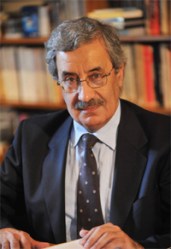
 For a period of a couple months, the cabinet formation was help up by a dispute about the appointment of Gebran Bassil — Michel Aoun’s son-in-law — as Telecommunications Minister. Aoun wanted him re-appointed; Saad Hariri did not. Eventually, a compromise was reached: the FPM was allowed to keep the Telecommunications Ministry as long as Bassil did not head it.
While it seems that the deal allowed both parties to save face, I can’t help but wonder whether the entire operation was an elaborate (and ingenious) bait-and-switch on Michel Aoun’s part.
Why? Consider the outcome. Gebran Bassil ended up landing a different prestigious ministry (Energy and Water) which, like Telecommunications, is a candidate for privatization and desperately in need of high-profile reform. Meanwhile, the Telecommunications Ministry is going to be skippered by Dr. Charbel Nahas, a deeply learned economist and a vociferous critic of Hariri & Co.’s management of the country’s finances.
Nahas, who was educated in France and spent twelve years teaching at the Lebanese University in addition to working in the private sector, has published widely in the areas of urban and physical planning, banking and economics, social anthropology and history (see his website for more information). The leftists love him and can scarcely believe that he has been appointed as a minister; indeed, he wasn’t even among the names being floated earlier in the summer, which deepens my conviction that Aoun deliberately planned to whip him out him as a “compromise candidate” at the opportune moment.
Dr. Nahas’s diverse background leads me to wonder whether the FPM is planning to use him as a kind of shadow Finance Minister, or at least as the point man to challenge the policies of the Finance Ministry — which has been in the hands of the Hariri family since 1992. Nahas would be ideally suited for this job, if his publications are any indication. See, for example, the text of an argument presented before the Constitutional Court, delightfully titled (in rhymed Arabic prose, according to the custom of classical literature) The Noble Petitioner’s Guide to the Secret of Wondrous Accounting. The text criticizes a law which allocated “the proceeds of privatization, the foreseen primary surplus in the budget, and the proceeds of the sale of future public revenues (hidden under the title of securitization)” to servicing Lebanon’s huge public debt. This formula, Nahas notes, is no different from “the formulas of the Public Debt Funds that the colonial powers imposed on the Ottoman Empire or on Egypt or on China in the XIXth century.” In Lebanon, however, it is not a foreign power that is doing the imposing, but rather a corrupt political elite that is in bed with the country’s creditors. You get the idea.
As an impressionistic little confirmation of my suspicions regarding Nahas’s real purpose in this cabinet, consider the fact he wasted no time in calling for a review of the Lebanese economic system, in the context of the first ministerial meeting to discuss the cabinet statement. “Yes, Mr. Telecommunications Minister, we’ll definitely look into that…”
A couple of days ago, Angry Arab wrote:
I expect this brilliant economist (and I only heard positive things about him) to be the star of the new cabinet, and the most persistent critic of the Hariri apparatus. He is fiercely opposed to the Hariri disastrous policies, and is determined to combat the corruption of Hariri’s plans. Nahhas as a choice is a punishment for the Hariri movement: they wanted to excluded Jubran Basil from the Ministry of Telecommunication because he was defiant and assertive, so `Awn brought in somebody who will prove to be more defiant and more persistent.
Ms. Tee, over at B-side Beirut has this to say:
The Free Patriotic Movement has chosen no other than economist, activist, and intellectual Sharbil Nahhas for the post of Minister of Telecommunications. To those of you not familiar with Sharbil Nahhas, his website (trilingual) gives a good idea of his qualifications. Nahhas is a reformer in spirit with a fundamental critique and understanding of our sectarian system. Over the past two decades, Nahhas has put together several proposals, such as a strategy for social development and a law proposal for a pension scheme, that, needless to say, never made it through the system. As the inside man, there is reason to hope a little.
Will Nahas be the reformer that everyone is waiting for? Time will tell. I’m particularly interested in observing how the FPM is going to negotiate the political shoals with its ally, Hezbollah, when the issue of privatization and other economic reforms come up.
A final note while we’re on the subject of reform: the new issue of the Arab Reform Bulletin is online. Have a good weekend.


 Qifa Nabki
Thanks for this analysis. I think either Nahas or Kanaan is also head of the finance committee in Parliament. Sounds like FPM is trying to position itself to put up a real opposition to the finance ministry instead of just blowing in the wind. Remains to be seen. it also remains to be seen what their idea of reform really means. New blood is always promising.
Posted by Sam | November 13, 2009, 4:08 pmStill reading up on Nahas. However, the idea of a Communist in a ministry that is so vital to the economy is not so encouraging. The fact that one of his claims to fame is his opposition to Harriri senior’s economic plans as the Angry Arab claims then this does not bode well for a harmonious economic working group within the government.
Posted by MM | November 13, 2009, 4:19 pmMM
I doubt that Nahhas is still a communist. Isn’t being a communist during one’s youth a rite of passage? 🙂
Posted by Qifa Nabki | November 13, 2009, 4:30 pmI am just curious about what kind of a metric is applied when one is described in glowing terms as “deeply learned” well published and “brilliant”?
From what I have seen most of the so called publications are in daily newspapers that rarely turn down a submission in addition to a few presentations at conferences of peripheral importance.
Was there a single significant publication in a peer refereed journal or a presentation at a conference of substance.
I am not in a position to pass any judgment on the intellectual abilities of Dr. Nahas but looking at his web cite leaves me cold. I do not see the signs of brilliance that QN and the Angry Arab attribute to him.
I sure hope that he is a genius because the cabinet can sure use ministers with merit but being strongly opposed to the economic plans of Rafic Hariri is not a sufficient condition to bestow these glowing judgments.
Posted by ghassan karam | November 13, 2009, 6:32 pmAh come on, did you check out his detailed CV? How many of the other appointed ministers’ come close to it? The thing is that he doesn’t just voice opposition to Hariri’s economic plans, but rather that he also proposes several well researched alternatives. With the backing of the FPM (mainly), he could shift the country’s economic policies from a state of fait accompli into a subject of debate.
Off topic: QN I read your manaqish story on angry arab and decided to give it a try.. I ended up getting a zaatar manousheh with a little extra vegetables. What gives?! Maybe I didn’t say it right… 🙂
Posted by mas | November 13, 2009, 8:07 pmLOL
I’ve tried it too. Apparently they were busted at some point when a darakeh from Maghfar 7beish tried it as well. 😉
Ghassan, I don’t know Dr. Nahhas personally, but I find his record impressive. He has been a consultant for various U.N. and World Bank projects. He has a lengthy publication record — yes it’s local, but the LCPS is nothing to sniff at: they publish important work on Lebanon.
At any rate, there’s no question that it’s a step up.
Posted by Qifa Nabki | November 13, 2009, 8:46 pmI do not want to make a big issue of this. It would be good if all of them are competent. I have read around 4-5 of the “publications” and they were far from being impressive including the papaers for the UNDP. Contributions to the UNDP are not exactly a sign of genius especially on the local level. I am willing to bet that Elias Saba, Elie Salem and many other ex cabinet ministers had a much more impressive record without being called labeled genii.
I believe that Raya Hassan was the head of the UNDP in Lebanon and so I imagine that he worked for her:-) Obviously I wish him well.
Posted by ghassan karam | November 13, 2009, 9:12 pm“Dr. Nahas’s diverse background leads me to wonder whether the FPM is planning to use him as a kind of shadow Finance Minister, or at least as the point man to challenge the policies of the Finance Ministry.”
Well QN, that is a very good attempt on your part to put a positive spin on Awn’s puppeteering to Hezb and Syria. Are you kidding us here? Why did Jubran visit Damascus just before the cabinet was announced? And now, you want us to believe Awn planned this all along? Have you been appointed by FPM as a PR officer recently? How much do they pay? I can probably come up with equally if not better spin than this. I go with the Red Indian Maronite for now to describe Awn and Co. and that includes Nahhas and Jubran despite their so-called ‘brilliance’.
You may wonder why I copied that sentence from your article at the beginning of my comment. It is very simple. You and AA (As’ad Abu Khalil) want us to believe that a ‘brilliant economist’ will be able to unlock the dungeons of the Saudi treasury to which only Hariri has the key? Come on man. Take it easy on our intelligence. Here is a question to you and AA since you both are aware of the strategies used by the colonial powers against the Ottomans and Egypt. What happens to Lebanon if the creditors pull the plug on Lebanon’s debt and the Saudis refuse to bail out? Awn and Nahhas will open their own pockets and save the country?
Posted by mike | November 13, 2009, 10:53 pmWhat’s wrong with a communist in a ministry vital to the economy? It’s not like capitalists or neoliberalists have much to show for. This isn’t the US where calling people communist is supposed to scare everyone away.
Posted by Sam | November 14, 2009, 2:31 amHmmm… We’ll have to wait and see regarding Nahas. Given the provocative, often improperly sourced, and undiplomatic statements of Assad Abu Khalil, I find his supportive evidence a detraction. Assad is looking for a critic to Hariri more than anything else. We already had that in Bassil.
If what you say is correct, and Nahas is the shadow finance minister, we’ll have to await the outcome of his performance. Unfortunately for the opposition, the Ministry of Finance has the best record of transparency of the Lebanese cabinet ministries. It might be too late for Nahas to make any difference (the contracts and allocated funds occurred long ago). If he tries to use his ministry to counter finance, it will be very easy to criticize his ineffective ministry, which is in need of massive reform.
Hopefully, Lebanon will create a mobile telecommunications system that is affordable and profitable according to international norms, while also creating massive national internet penetration comparable to international standards. Unfortunately, in this area, I believe Nahas will fail. For some reason, decent telecommunications in Lebanon appears to be impossible.
Posted by Charles | November 14, 2009, 3:34 amElias,
As alluded to in previous messages, Mr. Elias Saba never fully gave up his Communist proclivities, despite being appointed Finance Minister under Omar Karami’s corrupt, inept government in 2004.
Sure, professors like Assad Abu Khalil will proclaim Saba’s virtues, as they did (by word of mouth directly to me – no I don’t have a print version. Saba is related to a prominent Lebanese/Palestinian professor through marriage), but that doesn’t mean he has actual credibility to run a ministry.
Plenty of former Communists and current Communists have ethical views that would greatly benefit society. However, they are not serving in this government.
Posted by Charles | November 14, 2009, 3:45 amHE Dr Charbel Nahas is the right man in the right place. You will be witnesses to his exceptional capabilities. Lebanon deserves of such a high quality dedicated Minister.
Posted by Michel P. Jazzar | November 14, 2009, 5:22 amThe appointment of someone like Dr. Nahas is one of the real pluses in this Cabinet.
Whether he will be able to succeed with the anticipated reform project remains to be seen however. Pessimistically, he would require the support of his mentor’s (Aoun) allies, primarily Hizbullah. I believe Ibrahim Al Amine wrote in Al Akhbar a couple days ago asking whether the Hizb has the political will to pursue/support a reformist policy. I personally tend to believe that the Hizb will, to a certain extent that is, and that we will see a drive towards reform starting with matters financial/economic and ending with reform in the administrative realm (a member of the Hizb is mandated within the government with development of administrative affairs). There will be quite a tug of war if/when the reform initiatives get proposed, and somehow the current political alliances might be subjected to a measure of change as a result.
There is no problem, as far as I am concerned, with a communist of former communist running a portfolio, so long as his energy and initiatives are directed towards a better more socially orientated the system.
Opposing Hariri’s financial and economic vision and practices over the past 12 years or so is by now means a pre-requisite for any public office, nor should it be. That said, it certainly bodes well and increase the level of optimism in a ‘better’ future when a government start probing, seriously, into the state of Lebanese economic and financial affairs and ask probing questions that aim to reform and not for retribution, rather justice. Lebanon has shamefully failed to bring corruption and undue profiteering to task.
QN
This is the second time I read (…and there could be more occasions) that you serve as a PR apparatus for someone else, with Syria a common denominator. Both posts I read emanate from like minded contributors; the first alleges that you are helping Syria by questioning the credibility of aspects of the arms-freighter allegedly going from Syria to Hizbullah, and recently the post in this thread.
Although I enjoy most of your posts and I find them quite informative with sometimes well supported analysis, I at times do disagree on certain basic ideas you ascribe to. However, in no measure did I get the impression that you were propagating one side over another; your personal political convictions and allegiances notwithstanding.
Regards
Posted by Question Marks | November 14, 2009, 7:14 amQuestion Marks,
Thanks for the vote of confidence.
Mike,
I don’t do anyone’s PR. Try taking a spin in the Orange Room, where they accuse me of being a Hariri flunky. 🙂
As for the Saudi treasury, I personally am not in favor of promoting Lebanon as a perennial parasite on Saudi largesse. If that’s your idea of a fiscal policy, you’re entitled to your opinion. Me, I think we can come up with some other ideas.
Posted by Qifa Nabki | November 14, 2009, 8:33 amO’ QN, is that all?
You didn’t explain to me why Jubran visited Damascus just before he all of a sudden had to become Energy and Water Minister? We all thought that he was a telecommunication ‘genius’: “yisslamili 3youno w3oumro ma ykoun fi wizarat.”
And also, how does this visit not make one conclude that you’re making a positive spin on Awn’s ‘pupeteering’ as in saying ” elaborate (and ingenious) bait-and-switch on Michel Aoun’s part.”? You don’t just brush this aside based on a “vote of confidence” from a Hezb member. Did someone make a comment on QN long ago that the green light has to come from Tehran for the government to form? So the green light came and Hezb got sick of Jubran and his telecom genius. It still all sounds like a coordinated PR from ‘like-minded’ individuals. So, now I’m pleading for my ‘like-minded’ commentator to come to my rescue. Help.
So, you have in mind different fiscal ideas and you don’t like to see Lebanon” a perennial parasite on Saudi largesse”. What exactly would you like to see that the Ottomans and the Egyptians were not able to see?
I’ll offer you a hint that will make AIG very happy: settle the 400,000 refugees in Lebanon through a deal between Awn and Hariri in return for a debt right off.
The Christians of Awn would bite (on the basis of humane treatment blah, blah, blah, but in fact they would have no other option) but Hezb would go haywire. What would happen to current political alignments as well as to internal military balance in terms of sects having Para military organizations?
And ‘genius’ Awn thought he could use some other sect’s militia to prop him up to Baabda. Telecom and Energy ministries have completely different addresses I believe. However, Hariri did become a PM and Red Indian Awn couldn’t do much about it. I believe you or other more diehard FPM PR’s need to do a lot of positive spinning on this to face save Awn. Lak wli 3ala aamti.
Posted by mike | November 14, 2009, 10:57 amMike
Ok. 🙂
I’ve tried to find an argument in your post that I can respond to, but I don’t detect one. You seem to be suggesting that the appointment of Nahhas came from Damascus. How do you know? Do you have evidence? As long as you don’t, then your theory is just a theory, just like mine.
Posted by Qifa Nabki | November 14, 2009, 11:38 amSo what am I supposed to do now. Smile and pretend there was no argument.
That is a brilliant way to save face, QN.
I didn’t even mention Nahhas.
May be you should ponder over why Jubran visited Damascus?
I can think of some answers:
1) Hezb/Amal axis told Awn you’re on your own and we are not going to hold kirmal 3youn jubran.
2) Jubran insists on becoming none but telecom minister. He tells his dad in law I am not going to work in a career other than what I spent years in college for.
3) Awn tells Jubran to go and market himself with the Syrians and find out the best deal he can get from the source. We have no more room to maneuvre, son.
I am sure there are other answers. But that should give you some food for thought. Come on man, you’re a genius.
If I don’t have an argument, then please explain to me your fiscal ideas. You didn’t even touch on this. Do we have to grudgingly reconcile with AIG? What can Awn and Co. do to help us save face and not do that?(smile) What would Lebanon look like post refugee settlement? Good fiscal outlook, I could say that for sure. How about political alignments? When, if ever, will Awn set foot in Baabda?
Finally how long will this cabinet last?
Posted by mike | November 14, 2009, 11:58 amMike,
The topic of this post is Charbel Nahas’s appointment as Telecommunications Minister.
You came along and took issue with my theory that Nahas’s appointment was a deliberate bait-and-switch by Aoun.
I am not completely sold on this theory, which is why I wrote: “I can’t but help wonder whether…”
Now as for Bassil’s visit to Damascus, I don’t understand how it is connected with the topic of the post. I myself wrote last week that I thought the opposition was getting tired of the whole charade, suggesting that some pressure may have been put on Aoun to just go ahead and accept the Energy deal.
Does this make Aoun a puppet? Do you believe that March 14 is composed entirely of puppets? I think that the reality is more complicated than that.
As for “fiscal ideas” I’m sorry but I don’t understand your point about refugees and AIG and God knows what else. You’re being very cryptic.
My basic point is that it would be helpful to have a corrective to the Hariri administration’s policies for Lebanon over the past 17 years. This is the subject for an entire post or even several posts, and we’ll be dealing with them over the next few weeks inshallah.
Posted by Qifa Nabki | November 14, 2009, 12:13 pm“What’s wrong with a communist in a ministry vital to the economy? It’s not like capitalists or neoliberalists have much to show for. This isn’t the US where calling people communist is supposed to scare everyone away.”
There are a few serious flaws wit the above scenario Sam. No self respecting communist will agree to serve as a cabinet minister in a “capitalist” society where he will be expected to promote ideas and beliefs that are anathema to everything that he holds to be important.
Let us assume that you are right that “”capitalists and neoliberals” do not have much to show” ; which is impossible to support; then are you suggesting that all the faults of the capitalist system will be corrected if the Lebanese cabinet is to include among its members a minister whose contributions to his self proclaimed field are at best marginal and do not reflect any meaningful committment to any of Marx’ ideas.
And last but not least “this is not the United States where calling someone a communist is expected to scare everyone away” is so much out of place and irrelevant to whether Dr. Nahas is a genius that is about to save Lebanon that it doesn’t warrant an answer. Yes the US had its problems with the McCarthy era but the dialectics leads us to expect a backlash to take place doesn’t it? Actually a serious Marxist would have expected such a backlash to take place.
Those who live in glass homes do not throw stones. I have always been bewildered by our ability to be critical of others but to overlook the aberations in our midst. Remember that in Lebanon Walid Bey is the sole owner of the “Progressive Socialist Party” and a national unity government combines both believers in the republic as well as some whose proclaimed allegiances lie beyond its borders.
It does matter a great deal whether a communist is to join a capitalist government because if this happens then it is a reflection of the bankruptcy of the so-called communist in question.
As an aside let me say that I have finished reading everything that I could read on Dr. Nahas web site and one thing is certian, he is neither a communist nor a sympathizer, hell he isn’t even a utopian socialist.
Posted by ghassan karam | November 14, 2009, 12:22 pmGhassan,
What is he? 🙂
Posted by Qifa Nabki | November 14, 2009, 12:32 pmHehehe, mike when will your blockbuster hit the movies?
Do you think that there might be a small chance that Bassil’s condolences visit to Buthayna Shaaban in Damascus whose mother passed away was… well, a condolences visit?
Also, Bassil is a civil engineer, telecoms is not what he studied in college.
Why does Lebanon’s only hope in economic revival have to be in somebody bailing the country out at the expense of enormous compromises? In my opinion, the whole hype about Nahhas is not that he’s “a genius” but that he could generate alternative ideas that would place the possible policies in the public sphere.
Posted by mas | November 14, 2009, 12:59 pmAre you baiting me, QN? Read the stories in the AlAkhbar, what passes for studies about Sour, the notes about fiscal policy, the pension plan written for the FPM … and you get the clear image of a typical middle of the road mainstream economist with a slight penchant to be guided by a few ideas tojust to the left of center. Mr. Nahas is no radical revolutionary that has brilliant ideas and that is equipped with new theories and or models that will change the world. I have never been a big fan of Elias Saba and the other crop of AUB professors that joined the cabinets in the late 60’s and early 70’s. But in all fairness each of then had a CV that is at least equal if not exceedingly better than this one. Elias, I have no idea about your future career plans, but I imagine that the academe is one of them. Do you know of any professor who taught for 12 years and spent a decade in consulting that has a slimmer resume. Most of the people that I know would not include on their CV have of the stuff that many seem to be impressed by in this case. A presentation at the Safadi Foundation, A pension plan written for the FPM ( maybe that was part of the downpayment for the job?).
As I said before I do not know the man and I do wish him well. I believe that he is qualified for the job. But please let us not present him as a Superman who is on a mission to transform the Lebanese society.
Let me share an anecdote with you; and the whole world for that matter. I still remeber with embarrassment the day that the ex Finance minister Zarour made a power point presentation to his colleagues. When he finished all of them stood up and gave him a standing ovation for his mastery of technology and his ability to be at the cutting edge of digital presentations. Some of his colleagues actually made such statements to the press. That was around two years ago. I rest my case.
Posted by ghassan karam | November 14, 2009, 1:02 pmGhassan (#17),
Correct me if I got it wrong, do you mean that the only way a communist should take part in government is if the country’s whole system changes to communism? Can’t he take part in the government and push for a more socialist agenda from within (especially when you have a government that is so non-uniform)? Take for example France, which is not a communist country, yet the French communist party did participate in governments on several occasions.
Posted by mas | November 14, 2009, 1:07 pmWas I cryptic QN with regards to fiscal policy? May be, but that could also have been on purpose. I was expecting clarifications from you because you seem to have the ideas and the great faith in Nahhas’ brilliance. I do accept your explanation of the spin you tried to put on Awn’s pupeteering as a theory.
With regards to fiscal policy, here it is in a nut shell (dream on mas, I too felt sorry for Buthaina’s plight):
Lebanon has only one option to come up with a sound fiscal policy and this option largely depends on Hariri and Co. not on some ex-communist Dr. of economy appointed in a largely capitalist cabinet as some people observed:
Absorb the refugees as full citizens of Lebanon in return for a write-off of the public debt that soon will become non-serviceable. Do you see now how that will make AIG happy? Since I do not intend to make him happy, can Awn and Nahhas come up with a solution to my predicament?
Posted by mike | November 14, 2009, 1:29 pmGhassan, I agree with some of what you said but about communists in a capitalist system, I don’t think that it’s black/white. I don’t know anything about Nahhas and I haven’t taken the time to read all his stuff like you did. All I’m saying is that if he were a communist then i don’t see anything wrong with that. And I don’t see anything wrong with trying to bring about some type of communist-like social reforms within a capitalist system to move things away from a neoliberal and corrupt system to some other form of capitalism.
As for neoliberalism there are plenty of examples of where it has gone wrong. Lebanon is one, Russia is another, and arguably, privatization only works when you have a strong not-too-corrupt government to ensure the proper behavior of the private market. But we’re getting off topic. I’m just saying that we don’t have to be against someone because they are communist as if that is like saying they are a terrorist (which was the reason I referenced the US).
Posted by Sam | November 14, 2009, 2:14 pmGhassan said:
“Elias, I have no idea about your future career plans, but I imagine that the academe is one of them. Do you know of any professor who taught for 12 years and spent a decade in consulting that has a slimmer resume.”
Wait a second. You mean I won’t be able to get tenure just by writing this blog?
Hmmm, may have to suspend all blogging for at least the next 8 years. 😉
Mike,
Your idea of paying off the public debt by naturalizing the Palestinians in exchange for billions of dollars from an unnamed grateful benefactor is truly brilliant. I hope, for Lebanon’s sake, that Minister Rayya Hassan is reading this comment section.
Posted by Qifa Nabki | November 14, 2009, 2:37 pm“Those who live in glass homes do not throw stones. I have always been bewildered by our ability to be critical of others but to overlook the aberations in our midst.”
…but Ghassan, this statement very much applies to you as well.
Regarding your critical evaluation of Dr. Nahas’s CV, website, and writings; point well taken. I agree with you that “he is qualified for the job”, but that he should not be presented “as a Superman who is on a mission to transform the Lebanese society”. As a minister ascribed to the C&R bloc, I’d like to add that his mission is to do the best he can to contribute to the transformation towards a better economy and a better Lebanon.
On a related note, the FPM has an open policy for welcoming the receipt of suggestions on qualified Lebanese in all disciplines. Our parliament bloc and the party leadership would then consider the potential for nominating/appointing some of them for gov and public office jobs including the ministerial portfolios ascribed to us. No requirements for FPM membership or affiliation as long as the proposed individuals do not work against the party’s Charter.
Having said that, please feel free to forward to us the CVs of any “super-qualified” Lebanese individuals you know or those you’d like to see in such posts.
Who knows? a few yrs from now, your CV might land among them (perhaps, I might fwd it). Man, I believe you’ll have strong chances if you get some field experience in Lebanon vs. working abroad. Improving those students’ evaluations a notch would also help 🙂
Have a nice weekend.
Posted by PN | November 14, 2009, 6:25 pm…and Oh, QN:
if it were not for some of the folks at the Orange Room perceiving you as “a Hariri flunky”, would have gladly nominated you for ministry of social affairs.
yallah, it ended up with the Kataeb anyways. Maybe, in the next round 🙂
Can you imagine you & GK in the same cabinet? It can only get better if WL were to come on board as minister of education.
GOD! might have just disclosed some of the names for the 2020 Lebanese cabinet.
Posted by PN | November 14, 2009, 7:15 pmPn,
This thread has obviously worn itself thin. Remember that this is not about me or about super qualified people academically. Actually, as you well know it is very rare for a politician to be tops in her field. Being super smart is not a qualification for the job.
So you have googled my name and read student evaluations in an open forum. Do you know how that works and the value attached to it? Don’t jump to silly conclusions and please let us not use these silly side shows to distract from what is/was being said.
BTW, I do not think highly of most politicians and so it is one class that I do not aspire to join at any cost/benefit.
Posted by ghassan karam | November 14, 2009, 7:32 pmPN
Judging from Mike’s responses in this comment, I think I’ve satisfied my end of our little agreement, haven’t I? Ok, it’s not a Qnion post, but baseeta no?
🙂
Ghassan, if you think this thread has worn itself thin, you should see the discussion I’m having over at the Orange Room at the moment. 🙂
Posted by Qifa Nabki | November 14, 2009, 7:45 pmI am sure I’m not privy to any backroom deals with other commentators. But really QN, you should read for your namesake about his assessment of Awn’s pupeteering and so-called achievements:
http://www.14march.org/news-details.php?nid=MTc3MTk0
That’s pathetic…
I feel sorry for Lebanon. I’m sure now it’ll become home for the Palestinians.
I’m also afraid there’ll not even be compensations.
So we stupidly fought for 30 years to go back to square one. Thank you Degaule Lubnan!
Shou kal? Dr. in Economy? I like the CV part that was brought up by some people. Thanks for time spent on research. Nobody could have done it without you.
He is not even FPM. So what did Awn actually achieve for FPM?
I’m really surprised that some diehard FPM’s like the one you make backroom deals with, QN, can keep herself upbeat all the way to 2020.
Let the argument get even thinner…
What’s the big deal?
Posted by mike | November 14, 2009, 10:54 pmGhassan (26):
“Remember that this is not about me or about super qualified people academically… Being super smart is not a qualification for the job.”
Exactly my point in response to your previous comments about Dr. Nahas’ s academic & publication record…etc.
And yes, I did Google you & went over your students’ evaluations, but that was almost a yr ago when I started following your online writings particularly the ones pertaining to your area of expertise. My comments that you perceived as “silly conclusions” were intended as a complement more than as a distraction.
“Do you know how that works and the value attached to it?” In fact, yes I do.
Mike (28):
Cheer up! Neither QN nor I are the type of people who make backroom deals.
Apparently, your memory has failed you one more time. A while back, QN promised me a “supporting” Qnion peace on this very medium. As a matter of fact, it was in response to one of your posts.
QN:
Judging from Mike’s responses in this comment, I think I’ve satisfied my end of our little agreement, haven’t I? Ok, it’s not a Qnion post, but baseeta no?
I’m really surprised that some diehard FPM’s like the one you make backroom deals with, QN, can keep herself upbeat all the way to 2020.
Posted by PN | November 14, 2009, 11:59 pmOups! please, excuse my cut & paste error.
QN: indeed, you’ve satisfied your end.
Posted by PN | November 15, 2009, 12:03 amMike said:
“Let the argument get even thinner…”
I’m sure the argument is plenty thicker over at your preferred news source. 🙂
Why not go preach to the choir over there if we disappoint so much ya habib albi?
Posted by Qifa Nabki | November 15, 2009, 9:03 amQN,
Where do you sense disappointment in my comments? Actually, I’m enjoying the whole show. I know the argument is pretty thick as it should.
What’s the sense of preaching to the believer? You lost me here. What is it exactly that you want me to do with regards to this particular choir? Be straightforwad and fear none.
Posted by mike | November 15, 2009, 10:59 amJedi Master Mike. You’re a character. 🙂
Posted by Qifa Nabki | November 15, 2009, 3:26 pmSo what’s your point again?
I have to play dumb now.
Posted by mike | November 15, 2009, 4:24 pmMike 13,
You stated “…based on a “vote of confidence” from a Hezb member…”.
Is it a deft skill or the simple matter of clairvoyance that is bestowed upon you!
I ought to apologise for my sarcasm, and I do, to the majority of readers. But what can one do when faced with intransigence and a one track mind that fishes around not for a cohesive argument but to impose what I deem to be outlandish pre-conceived ideas, and arguing’s for argument sake.
Mike, no one can accuse you of being a PR person. This task requires a measure of decorum. Is everyone who disagrees with you should be given a label of a political thought that you disagree with.
I am not sure whether you are FOR settling the Palestinians in Lebanon or against it. I couldn’t tell, really. Do not fret however. If the relevant regional and international powers could make this objective a reality when Lebanon was either too weak or a satellite, albeit briefly, it certainly will not materialise in the near future with major and capable political parties at the helm in Lebanon.
On a related note, and at the risk of continuing to deviate from the original subject of the post, I would like to acknowledge the fact that you tagged me as a member of Hizbullah. Let me tell you my compatriot that what seems to you as an accusation is an honour that I cannot claim for myself. However, if you intended to say that I sympathise with that party’s core political national concepts of resistance and steadfastness against aggressors, then my fellow Lebanese I am guilty as Charged!
Regards
Posted by Question Marks | November 15, 2009, 4:45 pmQuestion Marks said:
“I sympathize with that party’s (Hezbollah)core political national concepts of resistance and steadfastness against aggressors, then my fellow Lebanese I am guilty as Charged!”
As you probably know, I have been a strong opponent of Hezbollah for years despite the fact that I am invariably the most to the left of center in most conferences/discussions/seminars… I like the way that you have phrased your position. ” yoiu sympathize with the core political concepts of resistance and steadfastness arainst the aggressors” don’t we all? or maybe I should say shouldn’t we all? But you see that is the difficulty in supporting HA. One can be in total support of resistance once resistance is called for but against a group that claims to be doing Gods work. I cannot trust those who get their inspiration from a storybased on the false prmise of a grand designer. But what is more important to me is the fact that this same group that espouses resistance against aggressors does not have allegiance to the state in which they are resisting. Obviously this also lead to the real world issue of being part of something and yet opposed to it. This just cannot be. Hezbollah cannot lead an existense in spite of the government and yet be part of it and they cannot claim to have an allegiance to the Grand Ayatollah and yet to Lebanon. I believe that literalist will not be able to accept the whole notion of sovereign states. Hezbollah can espouse resistance and steadfastness , as they should but they also need to be willing to renounce their allegiance to a higher calling when they expect to be part of a ruling coalition. I have no problems whatsoecer when Hezbollah or any other party for that matter champions the rights of the poor and the dispossessed. I do have a problem , and a major one, when a party claims to be concerned with social justice but acts as agents of a foreign government. If the current set up is rotten , which it is, then let us change it through the ballot box and not through the ownership of larger weapons cache and foreign funding.
Posted by ghassan karam | November 15, 2009, 7:41 pmGhassan,
In principle I don’t disagree with your last post. But, I sense we are great at criticizing but not so great at offering an alternative to Hizballah with regards to resistance and steadfastness. So how to play this game without also clipping ones wings? How to be against Hizballah without sounding, as you do (and I’m sorry about this), in an intellectual world detached from reality? I say this as a supposed “intellectual”.
The ballot box can often times just be an illusion for the powerful to make the masses feel like they actually have power. it isn’t the panacea to all our problems.
I don’t know if Hizballah has less allegiance to Lebanon than any of the other parties. This goes back to what Lebanon is supposed to mean to people. I’m all for detaching resistance from God, but when it was so back in the 70s and 80s, people called on detaching resistance from Communism. So what to do? America would like resistance in a nicely packaged, TV friendly format that is served with the clipped wings I was talking about. Sometimes we inadvertently can play into this game…that would be my warning to your position and a total stray from the topic of this thread on Nahhas 😉
Posted by Sam | November 15, 2009, 9:23 pmWell Question Marks, we’re back at it again. It has been a long time. I’m not going to apologize from the readers because my comment is off topic. You’ve already done so, and you know it is off topic. I am obliged to respond to you and I cannot avoid going off topic in this case.
I really wouldn’t have needed to refer to you at all in my comment 13 which was specifically directed to QN had you not injected yourself into the discussion unnecessarily. Just to remind you the part about QN doing PR in your comment even looked like an annex and it seemed like it wasn’t meant to be part of your comment. Go back and read it and refresh your memory. You just couldn’t resist the temptation. Right? As every one knows, and you in particular, QN is a very articulate person who is very capable of handling any thing thrown at him. So, the question is: did you have to come to his defense or even remind him? You chose to do so. So now it becomes fair game.
It is not my objective to argue with you and show you that QN was actually engaged in a PR effort. Whether he intended it as a Qnion or a full QN post, that is up to him and it doesn’t make a difference. I think he and I eventually came to a conclusion on this without any need for an input from your end.
Now you come back to me with a complaint about certain perceived qualities (they’re good qualities by the way except that you made it clear that you’re being sarcastic – kind of venting primitive vengeance and you think that you know what decorum is) that you think I possess. What kind of response are you expecting from me? A nice thank you perhaps? Did I refer to you in any other comment when you were silent after your original 11? And just to remind you, we are now in comment 38. What took you so long? What is actually pricking you under the arms? Is it my opposition to Hezb which I made clear on many occasions? Or is it my position on the Palestinians in Lebanon?
I cannot add more to what Ghassan said about Hezb except the following: anyone who fails to condemn what Hezb did on May 7 has no right to claim or feel any honor in any set of core beliefs that he ascribes to a paramilitary organization that is in a state of complete servitude to the despotic and anti-democratic regime of the Iranian theocracy, and is in a state of total opposition to the higher interests of the Lebanese State. Such person must feel ashamed of even associating with such group or group(s). Please do not come back to me on this by arguing that Seniora did this or Seniora did that. Then I’ll have a very good reason to accuse you that you’re arguing for argument’s sake. I dealt with this issue way, way back in this same forum. And you would be the last one in this case I would consider to have the right to talk about decorum. Seniora has the full right to do whatever he wants as a PM under the constitution.
As for the Palestinians, yes I’m for their absorption into Lebanon as full citizens after proper compensations are made. When and if that happens, Hezb will have no say in the matter. Take my word for it. Are we clear on this as we have been all along on Hezb? I do not like confusion. I hope I satisfied now all your curiosities regarding where I stand. Please feel free to poke as much as you like. I am an open book.
On the other hand, I can only laugh when you convince yourself and your like minded Hezb supporters that somehow Hezb or FPM etc… have taken the helm in Lebanon. This is in your dreams. What capable political parties are you dreaming about? Perhaps you need to read some more in order to wake up and know how far off you are from reality:
http://www.nowlebanon.com/Arabic/NewsArticleDetails.aspx?ID=126281
Take care and see you again.
Posted by mike | November 15, 2009, 10:54 pmMike (38):
Glad to know that you finally came across something to cheer you up.
Please, keep on laughing and not to worry, we’ll keep on dreaming till 2020 wa ma ba3da ba3da 2020.
Have a nice week everyone.
Posted by PN | November 16, 2009, 2:53 amOK, whatever makes you glad…
Posted by mike | November 16, 2009, 3:08 amMike 38
True to form, you practiced what seems to be your favourite hobby: that of politico-social racism. You further went on made a great number of statements that really beg serious questions about whether you are contributing to this post (and other perhaps) as an endeavour to communicate with and understand others or a way to blow off political steam irrespective of the validity and sometimes importance of topics discussed.
I do not believe that contributing to a post is “injecting” oneself “unnecessarily”, as you put it. I further believe that this is a public post that all with ideas to contribute can do so without being subjected to innuendos.
I never mentioned you by name. My contribution intended to reflect on a worrying trend that seems to be prevalent in this and other posts about PR and spin. I stand wholeheartedly with my assessment of QN, irrespective whether I agree or disagree with his analysis; at least it is coherent.
Unlike you, I do not have proverbial crystal ball handy to enlighten me as to whether Lebanon under a new government will achieve the minimum of what is required. But looking at the current domestic security situation, the support the government enjoys regionally and internationally, the unambiguous support for Hariri Government; all this I see as an observer a pre-requisite for a cabinet that will have some space to operate towards a specific goal that will be declared soon.
Again, your ‘crystal-balling’ tells you that the Palestinians will be settled in Lebanon come what may, and irrespective of the ‘wishes’ of the hosts and guests alike. Who am I to argue with your crystal ball! But will hazard a caution: settling Palestinians in Lebanon is good for neither party and could actually have disastrous repercussions to our country. What we need to do in Lebanon is have a serious re-think as to the Palestinians’ social and humane conditions with a view to improving it.
I will not come back to you about anything Saniora did or didn’t do. He is a spent force now, on the peripheral of Lebanese politics and will not have heads of state and lesser officials clamouring to him whenever he is deemed to be weak. Even his position as Head of Mustakbal Parliamentary block is of no real effect as his ultimate boss PM Hariri calls the shots. Saniora did what is required of him and did it well, to the detriment of Lebanon I feel.
It is good of you to refer to Ghassan (34). To me he utters sense from a non-sectarian left wing (dare I say communist) perspective. He is entitled to his opinion, and he did that eloquently. It is difficult for me also to reconcile worldly political events with religious jurisprudence. Yet, there might come a day when elements of those opposites will move in harmony. The only grievance I have about the Hizb is that apart from the National Defence Brigades, he so far failed to make universal the resistance and steadfastness in the face of the one real enemy to the south and all encompassing Lebanese affair, rather than sustain its social and sectarian character.
Lebanon has witnesses much more barbaric civil skirmishes and even war since 1958. May 7, with its regrettable yet ‘limited’ bloodletting and societal displacement that ensued helped in many ways: It saved Lebanon a sectarian civil war that has been in the planning for sometime; it created a government that might otherwise have never seen the light of day; it made the political environment conducive for electing a President for the country after months of haggling; it lessened the tensions and the probability of a civil unrest at a potentially disastrous level by convincing one of the proponents namely MP Jumblatt that reconciliation is the order of the day. Last but not least, it led to the creation of a government that all seem to agree with. This fact alone is better than having a government in limbo.
Hizbulla, according to my observations, is not against the state as such, rather he is against a state that he feels represent a threat to his core political ideals. Let us remember that the Hizb was part of government under Hariri senior and Saniora. But the Hizb doesn’t compromise for the sake of a cabinet seat here or a membership of a parliamentary committee there.
I do not try to “convince” myself of anything when it comes to politics, rather sober observation rules the day for me. My assessment is as follows: A government headed by the most popular Sunni person, supported by the largest Maronite (Christian) block in Parliament, with the Major Druze leader playing the role of a positive advisor and with the Shiite constituency willing to be active participants. Now, to me this sounds like quite a formidable government, on paper at least, Charbel Nahas or no.
Regards
Posted by Question Marks | November 16, 2009, 5:52 amQuestion Marks,
“A government headed by the most popular Sunni person, supported by the largest Maronite (Christian) block in Parliament, with the Major Druze leader playing the role of a positive advisor and with the Shiite constituency willing to be active participants. Now, to me this sounds like quite a formidable government, on paper at least, Charbel Nahas or no.”
You are so wrong. You have fallen trap to the sick political system enforced by Hezbollah’s arms. The level of sectarian alienation is higher than ever before due to this notion that you seem so proud of. The emergence of the sects – and the parties that hold exclusive rights to talk in the name of those sects- as a necessary pathway to the creation of public institutions and even the formation of individual opinions is nothing to be proud of.
Our situation today and the way this Government was formed both represent the lowest point of self-respect we have achieved as a “nation”.
This alienation resulted directy from Hezbollah’s arms which forced the Quadruple Alliance, which was in itself the main driving force to Hezbollah’s exclusivity of Shia representation. This in turn led to the melting of the hopes and dreams of those that marched on March 14 2005 as each sect followed Shiites’ lead and aligned itself behind its zaims.
The marginalization of the constitution, the lack of trust in justice and the rule of law, the lack of trust in the democratic system as a means to improvement, are all a result of Hezbollah’s maneuvaring and March 14s failures over the past few years.
But you’re proud that Mhanna, Moussawi, Itani, and Areedhi can sit on the same table.
Posted by Purple Monkey | November 16, 2009, 7:48 amSo Question Marks what else do you expect? I couldn’t be any clearer than I was in my previous comment. Why should you be so concerned about what you perceive as ‘trends’ and you think that such trends are undesirable in these forums? Why shouldn’t someone question a posted article as a piece of PR? What’s wrong with someone raising such questions? What makes you think that accusing someone of making PR lacks decorum? You’re the only one who seems to think so. Are we living in Iran where state police probe the internet for the ‘right content’? Does QN himself object to such questions?
Who claimed to have a crystal ball? Do you really read or just skim through the words. Go back and read again. Please understand well what was said. Watch out for big IF’s and WHEN’s. Where do you sense that my call to settle the Palestinians is based on sectarianism? What is your proof that settling the Palestinians will be disastrous to Lebanon? They are already in Lebanon. So we are already living in your perceived disaster. What could be worst? We’ve already gone through and paid for it – 30 years of stupid fighting. Who would want to fight again? Imagine Canada, Australia and the US would do the same to all the migrants as we are doing to the refugees. Would there be Canada, US, Australia as we know them now? We are basically creating a third class of non-citizen residents, even if you go ahead and implement your so-called humane treatment to your implied ‘undesirables’ (I would say that is racist on your part, don’t you think?). And you think Ghassan had a more noble incentive for settling them than I do? You’re wrong. I have the better incentive. Here it is:
Currently, no one in Lebanon is interested in fully implementing Taif. Settling the Palestinians after proper compensation to the Lebanese State will force the various groups to rethink the meaning and value of citizenship and provide a powerful motive to fully implement Taif. I do not think that anyone would jump to arms and start a new war to protect the ‘Lebanese purity’ of the State when that happens as you seem to imply. The Palestinians are already part of the fabric of the Lebanese society. The general thinking is for Lebanon to first secularize and then absorb the Palestinians. This is not going to happen. The Lebanese have no incentive at the moment or even in the foreseeable future to do so. The formation of this government proves my point. Fiscal constraints created by the huge public debt will create the incentive to absorb the Palestinians in return for compensations which will set the stage for Taif to become fully implemented. What would you like to see in Lebanon: Cantoons (i.e. multiple mini state Lebanons which we currently have) or decentralized government, bicameral chambers, etc…?
The Lebanese are now very comfortable in the sectarian fortresses they have created. This is not what Taef envisioned. Decentralization is not creating cantoons. We are at the lowest level of civil governance as Purple explained specifically due to the indespicable acts of Hezb on May 7 and its continuing threats of the use of force and the failure of M14 to stand up to its ideals. The acts of May 7 entrenched sectarianism and created these fortresses. Any one who does not see this and seeks to wrongly justify these acts as you did (you basically copied verbatim Hezbollah’s explanations) lacks reason and is not worthy to of any consideration. May 7 acts need to be condemned with the loudest voice in order for any one to be considered a true and constructive participant in a democratic society. These acts cannot become a source of honor or pride, neither in absolute nor in relative terms, to any one who believes in democratic governance. Hezbollah is an anti-democratic organization and is a greater threat to the Lebanese State than the presence of the refugees.
Posted by mike | November 16, 2009, 10:35 amPurple Monkey (42)
So much of what you said is so true, especially when you alluded to the corrupt nature of our system in all manners of speaking: legal, administrative, financial, and economic; and the list go on.
Alas, this is the same system that Lebanese lived under since the inception of the entity, with the sole exception of a few years when Lebanon had a quasi-military system of government run by former Army Chief and President Foua’d Shehab. It is really ironic that Lebanon’s so-called golden age happened under the auspices of military intelligence and not so-called democracy.
Pride has nothing to do with it, my friend. It is rather wishing to view the glass as half full.
You may well be correct when you say that sectarian alienation is rife in this little-big country of ours. But do you really believe that if the developments didn’t materialise the way it did –no ideal by any stretch, I hasten to add- we would have 16 (or be it 17, 18!) sects living an absolute harmony, freedom will become universal, immigration will stop be a drain on our social structure and the debt disappears?.
I can understand your frustration. If I were a sympathiser of M14 oratory I would be confused as well and as frustrated too. I believe part of the prevailing problem is that the rhetoric in question went way too far to be realistic. The
Our political system is by no means perfect; far from it. It suffers fundamental pitfalls that erupt into the unsavoury and worse at almost every juncture. History tells us that and more.
That said, far from being proud of our system, I believe it is the fault of Lebanese and no one else for the debacles we experience periodically like clock-work. We cannot agree on the character of our nation, we always look outside to impose our will inside, or at least try to; we look upon this country as an asset for immediate or short term gratification rather than a nation for future generation.
My optimism, albeit too premature in the eyes of some, no doubt, is based on commitments by some notable politicians to the concept of reform. I am prepared to give them a chance; I have no other choice, really, except give up on my country, something I am still not ready to do, nor will I ever do I think.
Regards
Posted by Question Marks | November 16, 2009, 11:27 amSee QN, at the end of the day any political post ends in a debate about Hizbullah – and rightfully so 98% of the time I might add.
The only thing I can add is an observation.
No Lebanese militia, no matter how many or how big are/were its guns survived for long in Lebanon after it used its guns to kill other Lebanese (no matter what the pretense was). Rest assured Hizballah is no different. May 7 was the beginning of the end.
Posted by MM | November 16, 2009, 8:21 pmAre there 2 Mikes here and am not aware of this?!! wasnt Mike having a heated argument with AIG against settling the Palestinians in Lebanon !!!!!!!!!!!!!!!!!
Posted by V | November 16, 2009, 9:14 pmMM,
Correct! Any rationalization of the May 7th events (the “glorious day according to Hassan Nassrallah)to say the least is transparent and assinine regardless of how well it’s paraphrased!
Posted by danny | November 17, 2009, 7:23 amMinister Charbel NAHAS’ trilingual website is: http://www.charbelnahas.org
His CV is on–> http://www.charbelnahas.org/cv_eng.php?lang=en
Relevant…
Posted by Michel P. Jazzar | November 23, 2009, 3:34 pm