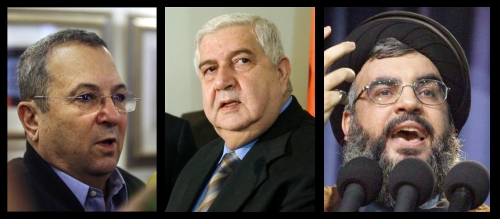
What began as an apparent mistranslation of Ehud Barak’s remarks regarding Israel’s peace negotiations with Syria has snowballed into the clearest possible articulation of a new strategic posture by Syria and Hezbollah towards Israel.
Let’s rewind the tape to last week.
On February 1st, Ehud Barak made some remarks at an IDF gathering, saying something to the effect that if Syria and Israel did not resume peace negotiations in the near future, sooner or later the two countries would find themselves at war. It was a potshot aimed at Netanyahu and his hawkish cohort, who have refused to pick up where Olmert left off with Bashar al-Assad in late 2008.
Two days later, Syria’s Foreign Minister Walid al-Mouallem responded to Barak’s remarks, reading them as a declaration of war:
“One day you threaten Gaza, next day you threaten Lebanon, later Iran and now Syria,” Mouallem said at the news conference with his Spanish counterpart.
“Don’t test, you Israelis, the determination of Syria. You know that war this time would move to your cities. Come to your senses and choose the road of peace. This path is clear,” Mouallem warned.
Of course, we all know what happened next. The following day, Avigdor Lieberman donned his bouncer’s outfit and announced at a business conference that “Assad should know that if he attacks, he will not only lose the war. Neither he nor his family will remain in power.”
And so it goes. Washington has sought to calm the waters, in light of the fact that a new U.S. ambassador to Syria is supposed to be appointed imminently. But Nasrallah’s speech this evening will ensure that the flare-up will continue to be stoked in the press for at least another week or so. Here’s the takeaway:
في لبنان بنية تحتية وفي فلسطين أيضاً، نحن لدينا مطار ونصف وهم لديهم مطارات، نحن لدينا بعض محطات الكهرباء وهم لديهم محطات كبرى، لديهم مصاف للنفط ونحن بعض المصاف، البنية التحتية في اسرائيل أهم من البنية التحتية لدينا، أقول اليوم لهم ما يلي، ويمكنهم التأكد من هذه المعطيات: إذا ضربتم مطار الشهيد رفيق الحريري الدولي في بيروت سنضرب مطار بن غوريون في تل أبيب. إذا ضربتم موانئنا سنقصف موانئكم، وإذا ضربتم مصافي النفط عندنا أو قصفتم مصانعنا سنقصف مصانعكم ومصافي نفطكم. أنا اليوم، في ذكرى السيد عباس والشيخ راغب والحاج عماد أعلن وأقبل هذا التحدي نحن في لبنان شعب ومقاومة وجيش وطني قادرون بقوة لأن نحمي بلدنا ولسنا بحاجة لأحد في هذا العالم ليحمي لبنان
“In Lebanon there is infrastructure, and in [occupied] Palestine as well. We have an airport and they have airports. We have power plants and they have very large ones. They have oil refineries and we do too. The infrastructure in Israel is much more advanced than ours. Today, I hereby tell them the following, and they can be assured of it: If you strike Rafiq al-Hariri International Airport in Beirut, we will strike Ben Gurion Airport in Tel Aviv. If you strike our ports, we will strike your ports. And if you strike our refineries or our factories we will strike your factories and your refineries. Today, in the memory of Sayyed Abbas and Shaykh Raghib and al-Hajj Imad, I announce and accept this challenge. We, in Lebanon, as a people and a resistance and a national army are capable [of this] because we protect our country and we don’t need anyone in the world to protect Lebanon.”
There you have it. The rules have officially changed. Prior to 2000, Israel and Hezbollah operated according to an unspoken set of “tit-for-tat” conventions. The July 2006 war and the Gaza war that followed it changed the rulebook, ushering in the new “Boss Has Gone Mad” strategy, with all of its attendant carnage.
Tonight, Nasrallah articulated Hezbollah’s response. Coupled with al-Mouallem’s vow to take the war to Israel’s cities, it seems we are finally getting an inkling of how a catastrophic war between the three countries might unfold.
Why now? Was this all really prompted by a misunderstanding of Barak’s remarks? I somehow doubt it. Messages between Israel and Syria rarely get lost in translation. More likely, to me, are the following scenarios: (a) Syria is trying to push the peace talks back onto the Obama administration’s radar screen, after more than a year of complete stagnation and frustration on such matters; or (b) Syria may be worried that the U.S. and Israel are getting closer to a strike on Iran, given the recent concordance with Russia, China, and Europe to target the Revolutionary Guards.
Then again, it may simply have been a case of crossed wires. Your thoughts?


 Qifa Nabki
QN –
I vote for “crossed wires”.
Posted by Akbar Palace | February 16, 2010, 5:22 pmLook at it in a more positive way Elias
“We, in Lebanon, as a people and a resistance and a national army are capable [of this] because we protect our country and we don’t need anyone in the world to protect Lebanon.”
So there you have it … Nasrallah is telling Israel “don’t worry, Mouallem’s statement is no reason to be alarmed, in case you hit Lebanon, Syria will not automatically need to fight you”
But seriously … I just hope that the Arabs continue to be very careful to stick to their current conditional talk “IF ISRAEL DECIDES TO HIT US THEN …”
The experience of the 1967 war, when Nasser wanted to look tough in the Arab world, the experience of the 1982 Lebanon invasion, and the 2003 Iraq war show that Israel and neocon friends can easily find a nice excuse to go to war.
This time I doubt they will though… assuming there is enough common sense in their heads.
Posted by Alex | February 16, 2010, 5:25 pmThe louder the rhetorics the less it is likely that anything will happen.
Barking dogs don’t bite.
Posted by i | February 16, 2010, 5:38 pmSorry, but unless I am misreading you, I don’t see how this is not more tit-for-tat. Bigger tit, bigger tat, yes, but otherwise I dont understand how this is a rule change.
You may recall that during the first couple of days after HA snatched the two soldiers, HA (possibly Nasrallah, cannot remember) said HA would only fire rockets into Israel IF the IDF went after “civilian” targets. Again, a kind of restatement of the rules.
So how have the ROEs changed? I don’t get it.
One thing that has changed is that there are presumably no longer Syrian radar installations in Lebanon — a favorite target for the Israelis (although I believe they did hit some target near the Syrian border in 2006?) for Syrian messaging.
So what’s the big dif? Haifa, and beyond Haifa, and beyond what’s beyond Haifa … More of the same … or is this a qnion piece?
Posted by david | February 16, 2010, 5:55 pmDavid,
You’re quite right. Bigger tit, bigger tat. (Hereby upping my traffic from Google searches by an order of magnitude).
But seriously, I do think this constitutes a new order. Otherwise Nasrallah would not have been so precise and dramatic about it. “Haifa and beyond Haifa” is pretty vague: it has the same flavor as “we have many surprises”.
By stating in no uncertain terms that Hezbollah would strike airport for airport, refinery for refinery, factory for factory… that’s a big deal. It means not only that they have the intention, but also the capability for fairly precise targeting. That’s different from “beyond Haifa”.
Posted by Qifa Nabki | February 16, 2010, 6:03 pmConvenient prompt for Nasrallah to flout Lebanon’s SRBM capability (care of the Islamic Republic) and its projected means of deterrence.
Posted by Mark Pyruz | February 16, 2010, 6:13 pmI would have thought it was a case of crossed wires, but all the indicators since 2006 show that a war is in the pipeline. Assasinations, airstrikes and intimidation have been aimed at deterrance, or at crippling the capability of Hezbullah to fight, of Syria to coordinate or of Iran to interfere from a distance. The carrot for “peace” is always there, but so is the stick. This latest row only confirms that it is the stick which is the preferred option and we should not expect otherwise.
Also, I would not share the view that these comments state any particularly new strategy. Perhaps it is the first time they have been stated on such clear terms, but it became clear following the 2006 war that a more effective response against Israeli infrastructure and civilians, and a method of denying air control to the Israeli Air Force, will be needed in order to make the military option increasingly painful for Israel. I think there is a strategic decision which has been made to make war painful for the average Israeli, something that only Arab civilians have had to endure in the last few conflicts.
Posted by Maysaloon | February 16, 2010, 6:15 pmWhy dont the Israelis and Syrians settle matters in a dignified way like the Turks and Qataris.
Mouallem v. Liebermann, steel-cage grudge match. LBC could get the rights, and whoever wins, the Golan.
Posted by david | February 16, 2010, 6:17 pmSheesh, it was the US ambassador, my bad. All the same … two men enter, one man leave.
Posted by david | February 16, 2010, 6:24 pmThat’s not really a fair fight. Lieberman has crowd-control (and face-control) skills. But I guess Mouallem has a significant size advantage. Plus he’d look pretty frightening in a skintight wrestler’s costume.
Bashar vs. Bibi?
Posted by Qifa Nabki | February 16, 2010, 6:30 pmHe’s threatened to strike Israeli cities before, so that’s nothing new. I wouldn’t call this speech game-changing.
And Hizbollah’s missiles are notoriously inaccurate. What’s the chance anything will actually arrive in Tel Aviv?!
Neten vs Bashar? Neten would fail to turn up. Instead he’d send a hit squad of 12 men and women carrying British, Irish and German passports.
Posted by Sasa | February 16, 2010, 6:44 pmI think it is game-changing because now, if another war were to break out, whether the resistance wins or loses will be judged with Nasrallah’s new words in mind. The Israelis will attack Beirut’s airport. And if Hezbollah does not attack the Israeli airport back in a similar magnitude, people will think Hezbollah is all talk and no walk. Nasrallah does not make promises he can’t keep; he does not like to be embarrassed. I wonder what new capabilities the resistance has.
Posted by Nasser Victor | February 16, 2010, 6:58 pmAs usual, Nasrallah’s speeches are for internal consumption. He is trying to convince Lebanese that the “resistance” can protect Lebanon’s infrastructure and that perhaps they can perform some military action without putting Lebanon’s infrastructure in danger. In fact, contrary to making new rules, Nasrallah is trying to return to the old rules pre-2006 in which he had much more room for action. He wants to be able to retaliate against Israel in case Israel attacks Iran without inflicting total war on Lebanon.
This will not be successful. Israel is not playing that game anymore. There are only 2 options:
1) A quiet border
2) Total war
Nothing in between.
Israel is very happy with option 1 as it has been in the last 3 years. Of course, Nasrallah isn’t as the status quo is in Israel’s advantage. But if Nasrallah miscalculates under Iranian pressure, I think it is unlikely that Lebanon as a state will survive the next war.
What to do? This is the middle east. We only learn things the hard way.
Posted by AIG | February 16, 2010, 8:05 pmWhat is tragic about all of this is that one individual and the militia that he presides over feel that it is normal and even patriotic to take dictatorial unilateral actions on the behalf of a nation. What is even sadder is that no one of authority in said nation has the spine to stand up and object.
Mr. Nasrallah has no business making decisions of war and peace on behalf of 4.2 million people.
To understand the rationale of Nasrallah one needs go no further than the traditional Tragedy of The Commons. That is the example where costs are shared by everyone but gains are totally private. A destructive war could take back Lebanon decades but the cost of the billions suffered by the Hezb will be relatively miniscule. If the war does not turn out to be a cake walk for Israel then again Lebanon as a nation will carry the cost and the Sayed will boast one more time of a Divine Victory .
The Lebanese people should fill Freedom Square and not to commemorate Rafic Hariri but to demand accountability from their public officials by starting a major campaign that will call all of these clowns out of office. It is up to us to tell them, all of them that they are public servants and that the age of individual bravados and dictatorial rule is over. If we fail to act , as a people, then we desereve every bit of misery that is going to be visited upon us.
Posted by ghassan karam | February 16, 2010, 11:09 pmCan we at least call Hezbollah what they really are: The Lebanese Mercenaries of Iran & Syria or LMI&S. The Sayyed keeps Failing to understand that the real Majority do not care for his Bull Shit.
Posted by Lebanese | February 17, 2010, 2:49 amTrue story: Back in the last days of Idi Amin’s rule, he was occupying part of Tanzania that he had taken after invading his neighbor in retaliation for unsuccessful attacks by Ugandan rebels (led by Obote) that Nyerere was giving refuge to in Tanzania.
To make a long story short, when the Tanzanians counterattacked and started to overtake Ugandan and Libyan forces with the help of Obote’s rebels, Idi Amin proposed to settle the dispute with a boxing match. He said that he would get Mohammad Ali to be the referee. It’s even funnier when you know that Amin was a golden glove boxing champ, and Nyerere was a spindly socialist. In the end, Nyerere declined the offer and overthrew the regime in Kampala.
Posted by sean | February 17, 2010, 3:05 amThat’s great Ghassan, and I’m with you. The problem is that so many people are lost in their mindset. Try persuading your average Syrian why Hezbollah shouldn’t be allowed to decide peace or war for all of Lebanon.
Propaganda and religion does a lot.
Posted by Doc | February 17, 2010, 3:10 amThere is at least a Million Lebanese perhaps more (if we count the Aounis) who now believe they are militarily superior to Israel. so its not just the boss who has gone mad !
A disaster in the making and nothing can be done to stop it, so sad just sad for so many innocent children dying for the dogs of war.
Posted by V | February 17, 2010, 3:27 amAnd so it goes. Washington has sought to calm the waters, in light of the fact that a new U.S. ambassador to Syria is supposed to be appointed imminently. But Nasrallah’s speech this evening will ensure that the flare-up will continue to be stoked in the press for at least another week or so.
…which is probably exactly the plan.
As for this being a new game, maybe. If so, it’s probably a blunder on Nasrallah’s part, because those are words that will be real tough to live up to.
Posted by aron | February 17, 2010, 4:41 amFights that I would have liked to see: Sharon vs. Mouallem, oiled up and starting with a sumo stomp.
I also wonder which Arab leader would win a man-to-man tournament? Bashar has no fighting experience, but he’s pretty young compared to the rest of them. Qaddafi on the other hand is unpredictable, but the Yemeni guy has a sneaky streak… I’d probably go with Omar al-Bashir in the end – tough motherfucker, and he’s been known to carry a a sword.
Here’s hoping the Libya summit turns ugly!
Posted by aron | February 17, 2010, 4:57 amMy two cents:
This declaration from Nasrallah seems to me a careful definition of what he can call victory in case of another war.
He did not say “we will destroy Israel’s infrastructure”, or “we will disable the Ben-Gurion airport”, He just promised to hit back “on the same level” as Israel’s.
This way, even if he manages only to hit a single runway in the Haifa airport, he has both fulfilled his promises and resisted in a honorable & justifiable(?) way.
It reminds me of the salespeople who deliberately lower their forecasts for next year’s sales in order to make them look good when they manage to top those forecasts.
Posted by G | February 17, 2010, 5:47 amI would pay to see a bunch of politicians in a boxing match…
Posted by Cathie | February 17, 2010, 7:12 amRemarkable how a man can say something and have it interpreted in so many ways.
Nasrallah’s speech was nothing more than a message to Israel, advising them that the Resistance has upgraded the potency and accuracy of its armoury. It wasn’t a game changer in relation to the “rules” – But it is a game changer in the sense that what Nasrallah promises to heap on them should they attack Lebanon.
Ghassan,
I would say there is no political leader more accountable to his people than Nasrallah.
You say “that one individual and the militia that he presides over feel that it is normal and even patriotic to take dictatorial unilateral actions on the behalf of a nation”.
Can you give an example of this or are you talking about resistance in general?
Are you suggesting that an individual requires permission to defend or be ready to defend his or her land against an individual, group or nation with a historic addiction to invasion and the coveting of other peoples land?
“What is even sadder is that no one of authority in said nation has the spine to stand up and object”
Geagea does all the time. Which by itself is a reason to support the Resistance.
“Mr. Nasrallah has no business making decisions of war and peace on behalf of 4.2 million people”
When has Nasrallah ever made a decision of war and peace? If you are referring to 2006 then I don’t think anyone could call that as a decision to go to war and even if it was, Nasrallah had in a public speech (thats even on youtube) declared that Israel had reneged on a deal and that the Resistance would now look at capturing Israeli soldiers to force Israel to keep the bargain struck in the last swap. Furthermore, he asked any Lebanese that opposed such a strategy to tell him.
“costs are shared by everyone but gains are totally private.”
Seriously? Do you really believe that the people of Tripoli, Beirut, Zahle etc. shared the same costs as the people of the South?
Ghassan, I do respect your right to believe in what you believe and your right to dislike Hizballah and the Resistance. And I absolutely share your wish for a Lebanon with publicaly accountable politicians and a single military force to defend the country. But as I have said before, why should we give up the strength we have before having something, hell anything, to replace it with.
Posted by mo | February 17, 2010, 8:07 amMo: Are you suggesting that if Geagea, Jumblatt or Gemayel had rung up Nasrallah in early 2006 or 2005 and said, “we’ve thought about it, and finally, we don’t really think capturing Israeli soldiers is a very good strategy,” that anything would have been different?
Also, informing the country in a speech that Hezbollah plans on doing something is not at all, as far as I can tell, the same thing as involving the rest of the country in making that very serious decision.
Posted by sean | February 17, 2010, 10:04 amBibi v. Bashar? Hmmm, Bashar would definitely have the reach, but Bibi’s got the commando training, so I would have to go Bibi.
Actually, such a match would probably resemble the real thing: Bibi would shout horrible things, egging on the the American crowd, while Bashar would stand in the corner and glare. Lebanese would, naturally, handle the ‘concessions.’
Mouallem and Sharon, oiled up? Guess I’ll skip lunch today …
Posted by david | February 17, 2010, 10:14 amSean, the implication if I remember the speech correctly was that the govt. or army were welcome to voice their objections. And considering Nasrallahs track record, he does not make public statements lightly. Therefore, yes, i think if the govt. or the army at the time had publicly or privately objected then things may have been different.
Of course I could be very wrong but my point is not the veracity of the statement he made but that it was made; How it was made may not be ideal but when you give everyone the opportunity to object, whether you mean it or not, those people cannot then claim you are making unilateral decisions. Nasrallah did not need to make the statements or offer opportunity to others to object. In this neck of the woods, doing so is a long way from dictatorship.
Posted by mo | February 17, 2010, 10:37 amIf you had to pick a single Lebanese politician to represent Lebanon in a steel cage match against Avigdor, who would it be?
Maybe Misbah Ahdab. That guy’s got some fire.
Posted by Qifa Nabki | February 17, 2010, 10:42 amMo said: “But as I have said before, why should we give up the strength we have before having something, hell anything, to replace it with.”
Mo, I think Ghassan’s point is precisely that nobody in Lebanon has the cojones to really challenge Hizbullah to discuss matters of national security in a public, transparent, and systematic fashion. They’re too worried about being tarred as traitors. Geagea preaches to the choir.
Posted by Qifa Nabki | February 17, 2010, 10:45 amLivni against Haifa oiled in a cage. No matter who wins everybody wins. And Israel gets the Pay Per View fees…
Posted by AIG | February 17, 2010, 10:56 amWiam Wahhab.
Public, transparent, and systematic fashion? What? You mean like the way other national issues are discussed? Give me a break.
Posted by david | February 17, 2010, 11:01 am“Livni against Haifa oiled in a cage. No matter who wins everybody wins. And Israel gets the Pay Per View fees…”
LOL
And the winner takes on the lovely Asma.
(If Helena Cobban’s reading this, we’re all dead meat.) 😉
Posted by Qifa Nabki | February 17, 2010, 11:06 amQN,
Is it a matter of cojones? Plenty of politicians have come out in public against Hizballahs arms but no one has provided an answer to “and then..”. Yes plenty have said “and then Israel won’t attack” but their opinions are just that. If Israel does attack it is the people of the south, the people that make Hizballah what it is, that suffer and have suffered horrendously in the past.
So if you want them to agree with you its simple. Tell them what the alternative is. Tell them how the state, the state that opponents of the Resistance say should have a monopoly on arms, will protect them. I know you don’t believe the Resistance does, but believe me the people in the south do. So its no good talking about state monopolies and the civilised world. We don’t live in a civilised part of the world. Talk is cheap and lives, especially Arab lives, even cheaper.
Provide the “and then” argument alongside your demands for disarmament and no one should label you a traitor.
Posted by mo | February 17, 2010, 11:07 amdavid said: “Public, transparent, and systematic fashion? What? You mean like the way other national issues are discussed? Give me a break.”
Boutros Commission for a National Defense Strategy? Why not?
Posted by Qifa Nabki | February 17, 2010, 11:08 amQN and Ghassan,
I think your strategy regarding Hezbollahs arms should be different. I think you should propose a compromise in which HA get to keep their arms but that the Lebanese cabinet gets to decide how these arms are used. I think HA may welcome this as it makes them more resistant to pressure from Iran. They could tell the Iranians: We want to attack Israel but the cabinet won’t let us.
Posted by AIG | February 17, 2010, 11:20 amMo,
What you are saying is that the reason Hizbullah remains a military force largely disconnected from (and more powerful than) the state is because nobody has provided a good enough argument for how else to protect Lebanon. I don’t buy this.
Let’s imagine that someone came along and said: “Let’s keep the resistance as a national defense, but its decisions to embark upon operations that could effect Lebanon’s state of war and peace are in the hands of Lebanon’s cabinet, not the wali al-faqih.”
This is basically what AIG is proposing above. Do you think the Hizb would accept? Do you think the Iranians would accept? Do you think that Hizbullah would refrain from embarking upon an enormous revenge operation (for Mughniyyeh) that could provide a pretext for an Israeli strike on the Hzb, that would then escalate into a war?
Posted by Qifa Nabki | February 17, 2010, 12:44 pmAnd what do you think Nasrallah and R. Hariri were discussing during their little tetes-a-tetes: best place to catch a sunset in Beirut or their favorite fruit drink?
Do you think operational security is such a trivial matter?
What you are describing above is just a de jure description of what already exists de facto. HA has not conducted a revenge operation, precisely for domestic political reasons.
I will say it again for the umpteenth time, the most important event in Lebanon in the last 20 years was the Israeli redeployment, the rest is just details.
Posted by david | February 17, 2010, 1:23 pmQN,
No, I said that disarmament won’t take place until there is a viable alternative.
This whole argument about finding some way of merging the Resistance and the state is a non-starter.
I dont think you would disagree on the point that there are those within and without the cabinet who would rather be allied with Israel than Hizballah.
And lets not forget that too large a number of the spies recently caught have been officers in the army.
And now we should be adopting the ideas of Israelis on how to protect Lebanon?
So no, I don’t think Hizballah would accept such a notion.
As for the revenge operation, I don’t think anything would prevent that, arms or not. But it won’t be massive. Just as importantly, are you suggesting that Israel should be allowed to kill any Lebanese it wants without fear of retribution?
And not the wali al-faqih? C’mon, you are better than that!
Posted by mo | February 17, 2010, 1:31 pmMo
You see what I’m saying? The conversation about merging the resistance and the army always veers towards takhween. As long as this is the punchline, of course “there is no other viable alternative.”
Israel has its spies everywhere in Lebanon. It’s not just in the army. All kinds of people have been discovered, some of them close to Hizbullah and not to the army. You can’t say, “Well merging the two is impossible because the army and the government are full of traitors.”
As for the wali al-faqih, did you click the link? Let me transcribe what he says:
ولاولاية الفقيه أن نأتي و نقول : قيادتنا و ادارتنا و ولاية أمرنا و قرار حربنا و قرار سلمنا و كذا, هو بيد الولي الفقيه
How is this acceptable, in your view? You know me, ya Mo. I’m not some kind of rabid Nasrallah-hater. But explain to me how this is acceptable.
Posted by Qifa Nabki | February 17, 2010, 2:03 pmMo,
I don’t think you are clear about what I am proposing.
1) There is absolutely no disarmament of HA
2) There is no merging of HA forces with the Lebanese army. HA remains completely independent.
There is only 1 thing different. If HA wants to execute an operation beyond the Blue Line, it needs permission of the Lebanese cabinet. If Israel crosses the line into Lebanon HA does not need any permission to retaliate. Thus, the only thing HA needs permission for is an attack beyond Lebanon’s accepted international borders.
I don’t see why you would be against such a compromise. It will legitimize HA weapons, keep HA independent while giving other Lebanese the peace of mind that they have a say in Lebanon initiating war. It seems a very fair compromise to me.
Posted by AIG | February 17, 2010, 2:03 pmdavid
You said: “What you are describing above is just a de jure description of what already exists de facto.”
Maybe what once existed. You cite R. Hariri and Nasrallah’s chats. Hariri’s been dead for 5 years. The Syrians are gone. It’s a whole new world. Who does Hizbullah consult with right now, on matters of security? Sleiman? Saad? Berri? Elias al-Murr?
Posted by Qifa Nabki | February 17, 2010, 2:08 pmmo,
It is apparent that no one is in disagreement on the “end”; security and safety. We are in disagreement about the means. Under no circumstances whatsoever would I sanction a state within a state or a major militia that is independent of the state. In the abstract no one will ever sanction such a solution.
If you believe that The Resistance is what is keeping Lebanon safe then we live on different planets. The resistance has to justify its existence and the only way to do that is to maintain the tension and the conflict.
Safety can be achieved in a relatively short period of time. Lebanon can sign a peace treaty with Israel a la Egypt and Jordan style. I fail to see why if an arrangement is good for Egypt that it is not good for Lebanon. The treaty can be gauranteed by a number of greater powers whether it be Arab League, EU, Russia, tye US etc… To just use the smoke screen that Lebanon is in danger and therefore we need an illegal, foreign trained, equipped and supplied militia is a very weak argument indeed. As I have said before this is similar to vigilantes who claim that they are not safe unless they act on behalf of the state by usurping the power of the state. The remedy for a weak state is not veigilantism it is a stronger state. Peace agreement with Israel will remove the rationale for the resistance and that is why Hezbollah will fight it with all what they have, not because it is bad for Lebanon but because it weans the end of the Hezbollah militia.
There are many ways to secure an end but the means are just as important if not even more so. If the end is security then I will not be willing to pay the price of having the pretense of power supplied by vigilantes. It is a price that no one should have to pay because it takes us back to the laws of the jungle where the idea of the state has no respect or validity.
Posted by ghassan karam | February 17, 2010, 2:11 pmI actually like what AIG proposed. But it would be a nice steps that HA can take at some genuinely advanced stage of peace negotiations between Syria, Lebanon, and Israel, not now when Israel is so hard line.
As for Syria’s candidate for fighting the enemy. I am nominating one of these guys
Well armed and they will give the opponent their chilling trademark black look
Posted by Alex | February 17, 2010, 2:26 pmAlex,
What I proposed is an internal Lebanese compromise, not something that Israel would accept or demand.
Why should this sensible compromise be subject to advanced peace negotiations just because it is against Syria’s and Iran’s interests?
Posted by AIG | February 17, 2010, 2:32 pmQN,
We don’t really disagree, except that you are trying to answer a question that cannot be answered presently.
Moreover, you are just proving my point. What once could occur over tea between two men now has to be broadcast politically on the national scene, with all eyeballs glued to the screen and with Geagea or Gemayel issuing their responses the next day. This, of course, has the effect of changing the way HA articulates itself (ie, it is not enough to preach to the converted).
I agree completely that this is an evolving phenomenon with many contradictions whose resolution are not yet clear (thus it is kind of a riddle that cannot be solved). But stuff happens slowly, the Syrian system basically broke down in the late 1990s, but it continued on for several years, and in some ways continues on now. The strategic logic of the Israeli occupation broke down in the late 1980s, but they remained for another 10 years or so.
Patience, my boy: time sorts all. Politicians have good reason to be breathless, analysts do not.
Posted by david | February 17, 2010, 2:36 pmDavid-san
Who said I’m an analyst? Bloggers have less patience than politicians. 😉
AIG and Alex
I’m hereby declaring a national holiday in QN land. You two agree about something? Maybe there is hope for this region after all.
Posted by Qifa Nabki | February 17, 2010, 2:49 pmAIG,
I would appreciate if you can answer this simple question that is peripherally related to Israel and Hezbollah.
Some Hezbollah supporters , on a different blog, keep on referring to a statement on the Israeli currency that says “from the sea to the Euphrates”. Is there any truth to this ? was such a slogan ever on Israeli money or is this another example of deliberate misinformation to manage the public? (These southern Shiites never tire of repeating this as a proof of Israeli intentions).
Posted by ghassan karam | February 17, 2010, 2:49 pmNo, I know. You are Baroud’s bagman on the internet … 🙂
Or did you think we could not see the cape and jumpsuit?!?
Posted by david | February 17, 2010, 3:14 pmBagman is what I’m hoping to be promoted to.
Coffee-boy is more like it.
Posted by Qifa Nabki | February 17, 2010, 3:20 pmQN,
In fact, Alex and I did not agree. I proposed something that makes sense for Lebanon. He rejected it because it is against Syria’s interests.
Posted by AIG | February 17, 2010, 3:22 pmWhy must you build me up, AIG, just to let me down, and mess me around?
*sigh*
Posted by Qifa Nabki | February 17, 2010, 3:28 pmAIG,
Is there a red line for Israel, when it comes to arming HA through Iran and Syria?
Posted by Badr | February 17, 2010, 3:28 pmGhassan,
This is pure misinformation. How could Israel hide any money saying such a thing? If that money exists, ask them to scan it and put it on the web. It is just like the lie that the two blue stripes on the Israeli flag symbolize the Nile and the Euphrates.
There are promises made to Abraham in the bible about the land. Perhaps that is where they get their misconceptions.
http://en.wikipedia.org/wiki/Land_of_Israel
Posted by AIG | February 17, 2010, 3:30 pmQN,
Redeem yourself by organizing the Haifa – Livni match.
Posted by AIG | February 17, 2010, 3:30 pm(See Badr’s comment above… just released from moderation).
Posted by Qifa Nabki | February 17, 2010, 3:35 pmBadr,
Israel has indicated that it would not allow HA to obtain sophisticated anti-air missiles. I think that is Israel’s red line. Israel would of course act against the weapons transfers as much as it can, but I don’t think it would initiate a war unless anti-air systems are introduced.
Posted by AIG | February 17, 2010, 4:09 pmA friend sent me this comment, over email. I cite with permission:
“Nice piece. Don’t think it’s a game changer. I think Nasrallah is expounding upon an established intention to try and forge some kind of reciprocity with Israel. We have seen it in the past. When Israel hit a Syrian radar/AA site in the Bekaa in 2001, Hizbullah responded by hitting the Israeli “Radar” listening post opposite Shebaa village (the position lies just north of the Shebaa Farms). Also in 06, Hizbullah’s rocket escalation was in reaction to Israel’s escalating attacks against Lebanon. Haifa was hit only after the Israelis bombed the airport.
I think Hizb next time is looking to hit strategic targets in Israel – government, military, infrastructure targets – rather than firing in the general direction of populated areas. That’s why Hizb has been busy trying to acquire guided rockets. Apparently, they have them now – M600s, a Syrian-tinkered version of the Iranian Fateh-110 with a range of 250km +/- and a CEP of 500m, accurate enough to do some damage to ben Gurion airport.”
Posted by Qifa Nabki | February 17, 2010, 4:24 pmQN,
A CEP of 500m makes the weapon useless. For example, in 2006 Israel only bombed the runways in the Beirut airport. It did not bomb the terminals. How can HA retaliate against such an attack? If it shoots at Ben-Gurion with a CEP of 500m, it has a good chance of hitting a terminal giving Israel an excuse to flatten the Hariri airport.
The distance between the IDF command in Tel-Aviv to Israel’s national theater or Tel-Aviv Museum, or Tel-Aviv library is less than 500 meters. The Opera is across the street.
All this of course if HA solved the problem of how to hide the launchers for the big missiles from Israel and be able to use them a multiple number of times. I think they are still very far from solving this problem.
Posted by AIG | February 17, 2010, 5:02 pmI think HA knows that AIG, but flatten the airport and you “internationalize” the conflict, which limits Israel’s freedom of action and negatively affects other regional and international files.
Bomb the youknowwhat out of southern Lebanon, and well, nobody cares.
Israel does not have that many good options in Lebanon, which explains the dithering in 2006. And they still don’t. In some ways, they are in as difficult a spot as HA, so guess what?: quiet border, with as much chest-bumping as one can take.
It’s kind of the problem of Israel being the region’s superpower, and yet still so small. Its ability to project power (mil/pol) across the region depends on the USA so it has to be careful not to wag the dog too hard. There is more at stake: energy, Iranian nukes, Iraq, etc.
And, actually, this is one of the ironies of bringing the Americans more heavily into the Middle East, there is less room to maneuver through and around the colossus.
Posted by david | February 17, 2010, 5:41 pmAIG,
Maybe the IDF shouldn’t use civilians as human shields. Placing the IDF command in populated areas is so Terrorism 101.
Posted by RedLeb | February 17, 2010, 5:43 pmQN,
I am not veering towards calling anyone a traitor. What I am saying is that if you apply your plan, you are giving someone the opportunity to pass details of any plans put forward to others. Yes there are spies all over but there is a huge leap between your car salesman and the access to info he has being a spy and a member of cabinet with access to operational data being a spy. I’m not accusing anyone, I am saying you are opening yourself to that potential danger.
Unlike a regular armed group, which can afford intelligence leaks, Hizballahs success is built entirely on its ability to have thwarted the intelligence agencies of those countries ranged against it (most of the time).
As for he wilayat, first let me say, I oppose the notion myself, so I am not here to defend it. But the philosophy of it is supremely nuanced and can mean different things to different people. To boil it down to “Nasrallah takes orders from Iran” is facile.
As I understand it, when Nasrallah says what he said, most people interpret it as meaning he will do only that which is considered righteous.
Now they may be fooling themselves and you may be right, but until Hizballah actually do something that evidences the accusation that they put Iran before Lebanon, I will hold any judgment on that.
Ghassan,
Under no circumstances whatsoever would you sanction a state within a state or a major militia that is independent of the state?
So if the state cannot defend your family and you had the means, you would not defend your own family?
I did not say that the Resistance is what is keeping Lebanon safe. You seem to believe wholeheartedly that Israel is a benign state that just wants to live in peace. I do not. We both have a right to our opinion and one of is going to be wrong. I have more to lose by you being wrong than me being wrong.
The resistance has to justify its existence to whom? Not to its rather large number of supporters. And they are maintaing the tension by flying over Israeli airspace everyday, occupying Israeli land, abducting Israeli shepards?
Safety can be achieved in a relatively short period of time if Lebanon signs a peace treaty with Israel? Maybe, but I don’t want a peace treaty with Israel
Erm, could you perhaps enlighten me on how this peace has been good for Egypt? A uber-police state run by a dictator whose farmers were driven to destitution as a result of American wheat imported as part of the “reward” for making peace? And Egypt hasn’t just made peace, it has gone much further “a la the Jordanians” in siding with the Israelis against the Palestinians. Is that the peace you seek?
“The treaty can be gauranteed by a number of greater powers whether it be Arab League, EU, Russia, US etc…”
Your kidding me right? You are suggesting that I believe that if I sign a treaty with Israel and Israel reneges on that treaty any country on that list will fly in and stand with us against Israel? If that is a serious statement then we really do live on different planets.
“Peace agreement with Israel will remove the rationale for the resistance and that is why Hezbollah will fight it with all what they have, not because it is bad for Lebanon but because it weans the end of the Hezbollah militia”
Sorry but you are so off base here. Hizballah will oppose Peace with Israel so they can continue killing Lebanese? No, they will oppose peace with Israel because, like the Crusaders before them, they are a foreign colonialists who took the land of fellow Arabs through murder and pillaging. Some of us do not believe in rewarding criminals.
“If the end is security then I will not be willing to pay the price of having the pretense of power supplied by vigilantes”
I’m guessing you can say that because you are not in danger of being in the firing line. Tell me that when your enemy is killing your children while “the state” serves him cups of tea.
“It is a price that no one should have to pay because it takes us back to the laws of the jungle where the idea of the state has no respect or validity”
If the state wants respect or validity it needs to put up. It needs to provide all the elements that give it respect and validity.
Posted by mo | February 17, 2010, 6:31 pmDavid,
A quiet border is exactly what Israel wants. That is what it expected when it redeployed in 2000. What does Israel have to gain from a war???
Israel has PR problems when it is seen as a bully or applying too much force. But if HA hit a terminal in Ben-Gurion, Hariri will be flattened and nobody will complain. It will be seen as a reasonable reaction.
Israel has given up completely on projecting power in Lebanon. It is a waste of Israeli resources. We are not knowledgeable enough and not ruthless enough to do it. Killing Jumblat’s and Hariri’s fathers and then using them politically is not something we can do. Scaring journalists and politicians is not our cup of tea. Israel learned the hard way that we cannot compete with Syria in manipulating Lebanon, and frankly, I don’t see the US doing a better job.
RedLeb,
Absolutely. That is why we need to annex South Lebanon and build army bases there. They will be far from Israeli civilians and more convenient for HA to shoot at accurately.
Posted by AIG | February 17, 2010, 6:50 pmmo
In a democracy I do not have the right to act as a vigilante even when gangs and hoodlums terrorize my children. What I should do is change the failing government by lobbying against those that are ineffective and/or corrupt. But if I become a vigilante then I join those that I am acting against.
If Hezbollah does not like the present Lebanese state and who does then the solution is not to dictate through its own private militia but to work so as to create a revolution at the ballot box.
I for one will rejoice when that happens but I am very doubtful that a theocratically based and inspired group can achieve that since their ideology will not be built on equal treatment of the other and on welcoming and protecting dissent.
Posted by ghassan karam | February 17, 2010, 7:06 pmGhassan,
But we are talking Hizballah versus the entire Western world and its PR machine. You are Lebanese and you are repeating Western PR without hesitation:
Why not have a chat with the many Christians who live in the Dahyeh about treatment of the “other” or the Lebanese that worked for the SLA that were protected by the Resistance after 2000 or Tyre’s Hajj Amin about dissent. These are not the actions of a group you describe.
And what has it dictated other than in trying to protect itself?
Should it ever become the group you describe
I will happily stand by you and oppose them
Hizballah has tried to improve the state but like I say, it is up against formidable opponents and if there is one thing it does badly is its PR.
Posted by mo | February 17, 2010, 7:30 pmThe same Hajj Amine whose followers are being harrased? Get a grip on yourself.
Posted by VP | February 17, 2010, 8:25 pmMo
I am sorry that you think that I am spouting Western propaganda when in fact I am describing the signs of the times as i have witnessed them and the results of my own readings. research and analysis.
Hezbollah rules the Dahieh and some of the areas in the south with an iron fist. Even access to media is not free.
But I do not want to make a big deal of individual incidents. Let us look at the bigger picture. The Sayed has claimed that his total allegiance is to Qom. I hope that you are not going to tell me that the “revolution” that devours its own children is an example of democracy and accepting the other. This is pertinent under the ideology of the Wilayat Al Faqieh that I find out that many Shia supporters of Hezbollah do not understand.
“In this democracy, the laws are not made by the will of the people, but only by the Koran and the Sunna of the Prophet….Islamic government is the government of divine right, and its laws cannot be changed, modified, or contested”
The above was said by Ayatollah Khomeini. As you can see there is no room for any dissenter in the society he describes and which the Sayed holds up as a model. Those of us who choose not to believe any of the religious myths whether Moslem, Christian or Jewish are looked upon as infidels. That is not the democracy and the republic that I aspire for.
Posted by ghassan karam | February 17, 2010, 9:08 pmWhat do you mean by access to the media is not free?
As I said earlier, I do not believe in nor do I accept the Wilayat as an ideology. So any attempt to implement such ideals I would oppose.
But what you are talking about, essentially, is the notion of turning Lebanon into an Islamic state. Why do you take the Sayeds word when he pledges his allegiance to the Wilayat but not when he says that the Hizballah that wanted Lebanon to be an Islamic state went with the changing of the leadership in the early nineties?
The reason such a notion was dropped had as much to do with the lack of support for it from within the Shia community itself as it did with the realisation that Lebanon is not Iran.
I do not know what you have seen or experienced, but I have somehow missed the iron fist you say exists in those areas.
VP,
Oh no, they are being harassed? Gee that really proves the evil iron fist policy of Hizballah!
Posted by mo | February 17, 2010, 9:52 pmHere’s Nasrallah’s entire speech, courtesy of Mideastwire:
On February 16, the Lebanese National News Agency carried the speech delivered by Hezbollah Secretary General Sayyed Hassan Nasrallah on the yearly anniversary of the martyred leaders in the Southern Suburb: “To the souls of our honorable martyrs, especially the martyred commanders whose dear memory we are reviving today, from the Sayyed of the martyrs of the Islamic resistance Hezbollah Secretary General Sayyed Abbas al-Mussawi, his martyred wife Um Yasser al-Mussawi and their son Hussein, to the Sheikh of the martyrs of the Islamic Resistance Sheikh Ragheb Harb to our dear brother, the Jihadist leader and the leader of the resistance martyred Hajj Imad Mughniyeh, to their pure souls… My brothers and sisters, I would firstly like to talk a little about our martyred leaders before addressing the main issue and the great responsibility for the resistance, in terms of the threats and challenges we are facing today and the way we in Lebanon sho uld act – from our point of view – to deal with them. That is what I would like to focus on based on the nature of the occasion… By going back to these leaders, to Sayyed Abbas, Sheikh Ragheb and Hajj Imad, and looking deep into their personalities and their behavior, we would find they had many common if not identical points. They all enjoyed a strong faith, piety, religiousness, loyalty, honesty, the love of the people, modesty before the people and affection.
“They made us see how a human being can be both strict and merciful, how he can stand in the face of the enemies of his country and people and crush them and how he can cry like a baby over the remains of the martyrs in the Qana massacre and elsewhere. Yes, they had many things in common… Since they were children, these men did not know the life of fun and luxury and never lived as they should have at their age. They were men since they were young, they remained men as they were growing up and they were martyred as men. Allah the Almighty chose a path for each of them so that he can perform his role.
“Sheikh Ragheb was the headline and symbol of the popular uprising and the headline of defiance and civilian steadfastness. He was the headline of the uprising of the women and children and of negative resistance, since he refused to shake hands with the enemy or even smile in his face, let alone accept its existence. Back then, his blood contributed to the victory of the resistance. As for Sayyed Abbas, he enjoyed his position in the establishment of the resistance, the organization and the Jihad, as well as his position in the general secretariat as the leader of the party of the resistance and the operations of the resistance, thus consecrating the path which was drawn up by the martyrs who had preceded him. Sheikh Imad was the arena leader and the field leader.
“He upheld the words of the faithful leaders and was loyal to the blood of the martyrs. He translated the hopes and dreams and suffering caused by the occupation and aggression on this country with every bullet, bomb, tactic, missile and combat plan. These brothers spent their youth in the resistance in its different positions and they were all martyred young… These martyred leaders want us to preserve their accomplishments for which they have paid with their lives, their pain and their efforts. Eventually, they left us the resistance, its spirit, ideology, choices, existence, strength and ability to assume the responsibilities, which brings us to the present and the numerous questions and choices we are facing.
“Let us address the current situation in light of the multitude of threats which were issued during the past months and revived the questions. Unfortunately, we in Lebanon return to square one very quickly and ask the same questions again. They were raised in 1982 and before 1982. I do not wish to open this debate but recall these questions and raise new rhetorical ones…: Can the American promises protect Lebanon? In other words, if Barack or Biden (now that we are done with Bush and Cheney) were to promise Lebanon they would protect it, are they truly doing it or will they truly do it? There is something affecting the credibility of Obama’s administration and is related to the settlement process after he was unable to stop the building of settlements!
“Another question is: Are the international resolutions protecting Lebanon and have they protected it throughout the last sixty years? Is the international community protecting Lebanon and has it protected it throughout the last sixty years? This international community which only cares about its interests and only respects the powerful, will it protect Lebanon with neutrality? In other words, will it be able to convince Israel not to have ambitions in our land and water? Will it convince it for example to return the Shaba’a Farms, the Kfar Shouba hills and the Palestinian refugees? Will neutrality secure that?…
“Today, as we are facing this flow of Israeli threats, I have two messages to address, one to the Lebanese domestic arena and one to the Israeli arena. At the level of the Lebanese domestic arena, I would firstly like to praise the official position of the president of the republic, of the parliament speaker, the prime minister, the army command and the majority of the political forces and parties in Lebanon, because they all expressed their rejection of the threats, their non-submission to them and the spirit of national solidarity in the face of any Israeli action… Secondly, also in regard to the domestic issue, there is talk about pretexts. We are saying we reject the Israeli threats, while demanding that no pretexts be given to the Israeli.
“We want to address this issue because it is not true and carries many negative aspects. This is not how we face the Israeli threats because when Israel wants to attack a country, it does not need excuses. From 1948 and until 1967, and in all its wars on Lebanon until the July war, the two detainees were never an excuse or a pretext. This war was prepared in advance and the Israeli admitted it… However, allow me to say that what is more dangerous in this context is this new talk we have started to hear a month ago, and this new rhetoric which has emerged in Lebanon in a very limited context. A lot was written about it with different words and expressions and many speeches, seminars and conferences addressed it.
“According to this idea, the very existence of the resistance, even if it did not do anything, neither on the border nor outside the border, is a sufficient justification for the Israeli enemy to wage war on Lebanon. Therefore, in order to prevent this war, we must annul the resistance and the arms. This is extremely dangerous on the national level, since it is justifying an Israeli attack even if the resistance did not provide the enemy with a pretext… Unfortunately, the Israelis themselves are not saying what some Lebanese are saying… I would like to ask the latter at this level: Is this a call for an Israeli war on Lebanon? Are we in the presence of the renewed 1982 circumstances? Do some believe that their dreams, ambitions and plans dissipated lately and can only be restored through a new Israeli war on Lebanon? That is the question…
“On the other hand, and on the Israeli level which is the most important part of my speech in light of the threats, the readings and the possibilities, we say that the strategic situation in Israel following the failure of the July attack on Lebanon and the war on Gaza can be summarized by the fact that Israel is unable to impose peace and unable to launch war. It cannot impose peace based on its terms, such as the non-return of the Golan, the Shaba’a Farms, the Kfar Shouba Hills and the occupied Palestinian territories…, and cannot wage war. Therefore, all the maneuvers and the training we have been seeing since the July war and the Gaza war are only natural, and are the result of the crushing defeat of the Israeli army…
“That was firstly. Secondly, whether these threats are part of a psychological war, have a preemptive purpose or are being issue in preparation for a serious war – a possibility which we do not believe is imminent – how can we face them? The resistance at this level is a model to be followed in terms of steadfastness, strength, courage and counter-threats and that is the only thing that works with Israel because if they see that the people are scared, they will not settle for threats and launch war. Countering threats with similar threats can prevent war, if not postpone it, and can render the enemy reluctant. This is especially true if the threat is serious and if the Israelis have information to confirm it. We saw the proof of that a few days ago when (Ehud) Barak delivered a speech threatening Syria with war, while its sentences were neither clear nor strong.
“It seemed at this level that the Syrian reaction was not only linked to Ehud Barak’s statements, as much as they were linked to the possible delivery of Israeli threat messages to Syria via foreign delegations. I believe that the Syrian response was not a response to a media statement, but rather to messages delivered to Syria… The person who responded to the Israeli threats was Syrian Foreign Minister Walid al-Muallem and not the command of the armed forces or the president of the republic. Usually, the foreign ministry is the most diplomatic side and the most concerned about alleviating the tensions. I believe in this context that it was intentional for the response to come from the Foreign Ministry which is the softest side, to say to the Israelis that if you attack us, all your cities will face destruction. I am certain that the Israelis were surprised by the Syrian response, as I am certain that the Arab governments were as well. This response was not diplomatic and w as completely transparent. So, what was the result? Two hours later, everyone in Israel from Benjamin Netanyahu to Barak to all the other figures, rejected what was said by Lieberman as Ehud Barak tried to fix these statements. The general climate in Israel shifted toward talk about the strategic goal being peace with Syria, just because the Syrian foreign minister responded to them.
“This is not a sixty-year old story whose veracity needs to be checked. It is a story we all saw on television and only a few days ago. In Lebanon, you all remember that Barak threatened with war and started talking about a decisive, swift and clear victory… That day, we responded by saying: If you come to our country, our villages, hills, valleys and mountains, the resistance will destroy your troops on our land with Allah’s will. The Israeli thus started recanting its statements and all the conferences we have recently seen in Israel stopped talking about a decisive, swift and clear victory. Moreover, the commander of the northern region said a few days ago: Let us set modest goal in any war we plan on waging, so that we can say that we have achieved the goals. In other words, there is now talk about modesty at the level of the goals…
“Now that this rhetoric retreated, what other rhetoric is there? They came up with a theory called the “Southern Suburb” theory, and you should know and especially the people of the Southern Suburb that the word “Dahieh” has become part of the military dictionaries and military strategies. What is this theory about? The destruction of everything in the Suburb…
“During the August 14 celebration we responded to them by saying: We told you that next time, if you hit the Suburb, we will hit Tel Aviv… Today, I tell them the following and they can check the veracity of the information because it means the presence of different capacities which I will not name for the time being. I say to the Israelis, not only if you hit the Suburb will we hit Tel Aviv, but also if you hit Martyr Rafik al-Hariri’s Airport in Beirut, we will hit the Ben Gurion airport in Tel Aviv. If you hit our ports, we will hit yours. If you hit our oil refineries, we will hit yours. If you bomb our factories, we will bomb yours and if you bomb our power plants, we will bomb yours… What remains to be addressed on the anniversary of the martyred leaders my brothers and sisters, is the retaliation for [the assassination] of Hajj Imad Mughniyeh. I say it to you honestly, some Israelis were hoping that Hezbollah would do the bare minimum, would seek a modest goal which I will not define to keep them guessing, strike this goal, say that this was the retaliation for Hajj Imad Mughniyeh and that this would be the end of it. We do not act like that and I would like to assure you that during the last couple of years, we had many modest goals available and did not act because the person whose death we are avenging is Imad Mughniyeh…
“Our options our open and we have all the time we need. No one can pressure us or outbid us and let us leave the enemy concerned. Let it worry every day, in every location, on every square. We will chose the time, the place and the target.
“Today, on the yearly anniversary of Hajj Imad, I say to you, to his family, companions and loved ones: What we want is a retaliation that is up to the level of Imad Mughniyeh. That is what we are seeking. We do not want retaliation for the sake of retaliation, rather to protect all the leaders, cadres and the entire cause which was conveyed by Imad Mughniyeh…”” – Lebanese News Agency, Lebanon
Posted by Qifa Nabki | February 17, 2010, 10:29 pmmo,
Allow me to add one more clarification/modification to what you have just stated.
I do not fear specifically a Moslem state but I do fear very strongly any religious state. I will spare nothing in fighting for your right to be whatever you want to be in your private beliefs but in the public square I do not have to accept any religious dogma from anyone.
( I will not expound on te question of religion except to say that we (humans) were not created in His image, we created him in ours).
Posted by ghassan karam | February 17, 2010, 10:32 pmWhat Nasrallah said is not a game changer at all. Hizb has always advocated a desire to inflict the most damage possible on Israel in a war. Their problem has been that they have been unable to implement this desire into results onto the battlefield of Israel proper. True they have had some sucesses but this pale in comparison to Israels military capabilities and accomplishments.
If truth be told, Hizb is a strong highly effective paramilitary force but lacks the strategic depth to pose a real military threat to Israel that Nasrallah envisions.
Posted by Vedat The Turk | February 17, 2010, 11:40 pmmo,
I will try another angle. I agree that the right of self-defense is sacred, and that the people of the south have suffered way too much. And for the time being there is no alternative to the resistance. But why there is no alternative?
Hezbollah’s power grew exponentially during the 90’s when the country was run by the Syrians. Why that effort or part of it wasn’t spent on building the strength of the army? Now before you start blaming Hariri and company, the PM of Lebanon had little or no say in military matters then (I don’t know how much he has now). Besides, president Lahoud has always been credited for rebuilding of the army and changing the military doctrine. And saying ‘nobody would arm the army’ is not accurate, as there are countries that arm Hezbollah.
I believe there has never been sincere desire to look for an alternative on both side of the current political divide. Maybe because most Lebanese confuse the government with the state. On the other hand, regional powers never intended to strengthen the army just to keep decision of war and peace outside the legal institutions.
Posted by XP | February 18, 2010, 3:46 amMo: You imply that not retaliating against Israel for the assassination of Imad Mughniyeh means that it gives carte blanche for Israel to kill any Lebanese they want.
How many dead Lebanese citizens is avenging Mughniyeh worth? 500? 1,000? 1,500? 2,000? More? Anyone knows that if or when Hezbollah pulls off a reprisal, that will most likely mean war with Israel, which will mean hundreds or thousands of dead Lebanese citizens.
As for wali al-faqih, Qassem explicitly (if not clearly) addresses this point in his book on the party (Qassem, Naim. Hizbullah: The story from within. London/Beirut: Saqi Books, 2005):
The Jurist-Theologian’s native land has no relation to the scope of his dominion. […]
As guardian of Muslims, Imam Khomeini governed the Islamic state of Iran as a guide, leader, and supervisor of the Islamic system on that territory, but defined the general political commandments for all Muslims anywhere they lived in the context of preservation of the resources of Muslim states; enmity towards hegemony; protection of independence from domination and subjugation; work towards unity, especially on fateful and common issues; confrontation of the cancer implanted forcefully in Palestine as represented by the Israeli entity […] His successor, Imam Khamenei, assumes the same role and authorities.
[…]Hizbullah’s commitment to such jurisprudence is a link in this chain. It is work within the sphere of Islam’s implementation, a behavioural given that is an integral part of the directives and rules drawn by the Jurist-Theologian.
Following this main category come the tasks of administration and oversight of details and particulars; implementing procedures; daily political, social and cultural work; and jihad against the Israeli invader, in all senses. Such responsibility is assumed through Party members elected according to the internally adopted consultation system, and is headed by the Party’s secretary-general. The setup earns its legitimacy through the Jurist-Theologian, and thus receives the authority and accreditation necessary for it to perform its duties with a margin of manoeuvering room left to the Party’s leaders and consultations enabling them to decide and evaluate what is applicable and appropriate in their fields.
Such authority is reflected as substantial independence at the practical level, not necessitating direct and daily supervision by the Jurist-Theologian. Where Party leadership is confronted with essential issues or overtures that might affect any of the working principles or requiring knowledge of legislative jurisprudence, the Party would then take the initiative of inquiry or of requesting clerical permission that should provide the legal Shari’a grounds for executing or ceasing a certain action.
[…][Hizbullah’s support from Iran] is also in harmony with Hizbullah’s conviction of the soundness of the Islamic Republic of Iran’s approach and practice, in the change it brought to the region’s map through independence from subordination to the West and adoption of a promising Islamic vision. Iran’s commitment to the Jurist-Theologian’s commands eased the identification of common ground with Hizbullah’s vision for the region and liberation objectives. There is no connection between the internal administration of the Iranian state and Hizbullah’s administration. These are two separate issues, each having its particularities and bodies of administration despite the commitment of both to the commands and directions of the Jurist-Theologian, who is custodian of the entire nation of Islam and whose power of command is not confined to any circle within it.
The Party’s commitment to Islam translates as an obligation to all that is ordained and forbidden by God. The Party has thus pledged not to swerve from these Godly instructions. For these reasons, commitment to a doctrinal instruction or opinion is not considered to be a point of view open to change.
Posted by sean | February 18, 2010, 5:29 amxp,
Arming the army and arming the Resistance to confront Israel are two very different things. The tactics, methodology and style of the Resistance means they do not need heavy weapons, tanks, planes etc. These are all things that are expensive to get and expensive to maintain. In terms of weaponary and equipment, I don’t think there is a huge gap between the Army and the resistance and Iran has offred to supply the army. It is the political position of Lebanon (somewhere between a rock and a hard place) that meas that the govt. cannot officialy accept such aid.
Sean,
No Lebanese lives are worth avenging his death. But then how many dead Lebanese would it take for you to say its ok to retaliate?
But because Israel will go on a rampage whenever it feels like it, we Arabs should be cowed into never retaliating? When they abduct Lebanese, I am told we have no right to abduct theirs in return for fear that they will attack. When they occupy land I am told we should not fight for that land for fear that Israel will attack? Bring down an Israeli jet over Lebanon? ditto. In fact every and any kind of response to anything Israel does should be avoided for fear of “what they’ll do”.
In regards to Qassems writing that seems on par to what I have been told. The relationship is one of ” legislative jurisprudence” rather than anything else.
Posted by mo | February 18, 2010, 6:18 ammo,
You are avoiding the issue I raised: what have been done to find an alternative?
There are more than one way of strengthening an army; tanks and planes are not the only one (even though those up to a certain level are feasible). As we found out painfully during the Nahr El-bared confrontation, the LAF lacks the bare basics (and that after 20 years of restructuring.)
By the way what do you understand by “legislative jurisprudence” in the context of wilayet-e faqih? If you are referring to legislation in the Western sense, then you are way off the mark.
Posted by XP | February 18, 2010, 6:50 amIm not avoiding it. Who are you suggesting should be doing something about it? I told you the govt. cant, so who else?
What do you mean b what do I understand to be? Do you mean do I understand fiqh or are you asking if I understand what it means in relation to Hizballah and Iran?
Posted by mo | February 18, 2010, 7:28 amIt’s been a long conversation but here’s some gasoline on the fire…
On the issue of integrating Hezbollah’s armed forces in the army: many countries in the world have deep cover special forces divisions whose plans, positions and even numbers and equipment are not disclosed even to the highest offices in the government. They operate according to rules of engagement developed and approved by the political establishment and following its strategic decisions. This would be ideal for integrating resistance fighters into the army. Given the level of cooperation between Hezbollah and the Lebanese Army today, nothing would change as far as intelligence risk is concerned except the Lebanese government’s ability to decide on engaging Israel and be held accountable for it.
And by the way, all this talk of no-starters is eerily similar to the way Dick Cheney used to speak during his interviews. If an idea is so moronic, it should be just as easy to explain why.
Posted by Gobbeltygook | February 18, 2010, 8:52 amEverybody’s ganging up on poor old Mo. 🙂
It seems like we’re dealing with two related issues here: (a) wilayat al-faqih; (b) and whether or not the resistance should have its sphere of operations constrained by some authority within the Lebanese government.
Mo is uncomfortable with both wilayat al-faqih and with the idea of letting non-Hizbullah politicians have access to the operational decision-making of the resistance.
Most everyone else is uncomfortable with wilayat al-faqih, but NOT with making Hizbullah formally accountable to a government executive authority.
Mo, I think what Gobbeltygook makes sense: Obama’s cabinet is not briefed on every special ops mission; only a select group of security personnel have access to that kind of information: Secretary of Defense, National Security Advisor, Director of Homeland Security, Chairman of the Joint Chiefs, President, Vice-President etc.
Ghassan’s point is that Nasrallah should not be in charge of Lebanese foreign policy, particularly in light of the connections to a foreign power that you yourself (Mo) are so uncomfortable with. When you have Nasrallah himself glossing wilayat al-faqih as: “our leadership, our management, our strategy, our decision to go to war, our decision to seek peace is all in the hands of al-Wali al-Faqih”… that’s a problem, wouldn’t you say? Let’s be honest with each other.
Imagine if a Lebanese Prime Minister came out and said: “our decision to go to war or seek peace is up to the American President…”
Posted by Qifa Nabki | February 18, 2010, 9:39 amBeing ganged up on is part of the Hizballah experience! 🙂
Actually, I also agree that Gobbeltygook’s idea makes sense and I would support it. Not just becasue we get to as a country (theres a thought eh, doing something as a country) retain the talent and know how, but it would open up the opportunity for those that wanted to but would not have got the chance to become part of it.
But the devil is in the detail.
As Gobbeltygook says (can u get an easier name to type out pls???) there is already a close working relationship between the Army and the Resistance.
But there is seperation. If that seperation is removed how do you deal with the logistics?
Would they still be allowed to get the arms they wanted from where they wanted? I doubt a govt such as todays, made up of a M14 majority for whom good relations with the US is high on the agenda could be able to keep that relationship while allowing its armed forces to change the balance of power. (pls note I am not making any accusations of puppetry – I am talking of policy).
What would happen to the village battalions that proved so effective in 06? (I suppose they could be turned into the equivalent of the UK’s Territorial Army)
And for how long would a state organisation continue to get support from the Southerners (without whom the tactics of the Resistance would have not likely worked) if the govt doesn’t follow up on development and infrastructure in the South?
I’m not saying its not possible. But I honestly believe that unlike the original proposal, this one would most likely be scuppered by those opposed to Hizballah rather than its supporters.
Posted by mo | February 18, 2010, 9:58 amQN,
I honestly cannot say definitively what Nasrallah means when he says that – Wilyat is nuanced and personal.
“is all in the hands of al-Wali al-Faqih” can mean, as you say, they decide.
However, it can also mean, and as I understand it, this is what Hizballah mean, that it is they who decide on the rightousness of it ie we tell them what we want to do and they give us the blessing.
I think we also need to keep an eye on how much of this talk is a way of keeping them happy.
But if it is the first, if the Iranians are “giving commands” then yes thats a problem. But as I said before, we have not sen them do anyhtig that puts Iran before Lebanon so I can’t agree on the meaning yet.
Posted by mo | February 18, 2010, 10:05 amI have often wondered the extent of Nasrallah’s knowledge of operational details. I don’t think anybody knows. For example, Nasrallah probably approved the 2006 snatch-and-grab but did he know the attack would require crossing the Blue Line?
Another thing I think should be noted is that in politics, like say international relations, if you want to chart your own course, a good first step is to praise and pledge allegiance to your patron. It’s also a good way to paper over policy differences.
Regardless, I don’t care what’s in the hearts, show me the pockets and I will tell you what’s what. Political rhetoric and political economy are interrelated but they are not the same thing.
AIG,
If the IDF hits large civilian infrastructure in Beirut, it will lose Sunni decision-makers as assets in its drive against Iran. And I don’t mean just hitting the airport, but the spiralling that would come with it. This is what I mean by “internationalize.” Reasonable’s got nothing to do with it.
Posted by david | February 18, 2010, 10:18 amdavid,
They’d never hit the airport, it would be bad pr for when whomever is playing the Condi/Blair roles flies in to the country.
Posted by mo | February 18, 2010, 10:35 amDavid and Mo,
You are living in the nineties. After the second intifada we have no illusions what our enemies are and we could care less about how Hariri and KSA would react to an attack on the airport and what they do regarding Iran. They determine nothing.
As for the Americans, they understand very well what tit for tat is. If a terminal in Ben-Gurion airport is hit, Hariri will be flattened.
If you do not believe us, call our bluff. But you would be making the same mistake as Hamas. They did not believe we will ever launch something like Cast Lead. Boy were they wrong. And just so you understand clearly, even with all its PR costs to Israel, 90% of Israeli Jews still strongly support the Gaza operation. That should give you an understanding of the mood we are in.
Israelis know there is a price to pay from a total war with Lebanon. But we have realized that it is better to pay this price once every few years than have Hezbollah constantly agitate our border or have small wars more often. The 2006 war hardly hurt our economy. Israel bounced right back. And when the next war with Lebanon ends, we will come out of our shelters, quickly rebuild whatever the rockets damaged and move on. I do not think the same could be said for Lebanon.
So far Israel’s strategy has worked marvelously. The border with Lebanon has never been more quiet since 2006. The aim of this post is to clear any misconceptions anybody may have about what a war with Israel will entail. I think once we all clearly understand each other, there is a good chance that the border will be quiet for many years to come. And that is good for both Lebanon and Israel.
Posted by AIG | February 18, 2010, 11:14 amAIG – I think you’re missing part of the point here . . . although it’s been stated that HA would hit Ben-Gurion, it is further stipulated that it would only be in retaliation (in other words, if Isreal were to hit Hariri FIRST). Quoted from above . . . “. . .[i]f you hit Martyr Rafik al-Hariri’s Airport in Beirut, we will hit the Ben Gurion airport in Tel Aviv”
Mo – what do you mean they would never hit the airport? They already have back in 2006 (although, if memory serves correctly, I think only the runways were hit at the time).
Now, as for the actual speach . . . I don’t think it’s a game changer. Other than eluding the possibility of having weapons that can reach greater distances, there really is nothing new. In the past, HA has stated the same thing . . . a game of tit-for-tat . . . if Israel strikes, they’ll strike back. Anyone else remember that joke from 2006 . . . “if you hurt our Haifa, we’ll hurt your Haifa” 😉
As for what to do about HA when it comes to the possibility of disarmament . . . I’ve always been of the mindset that the most feasible solution is to incorporate them into the army as a special unit (i.e., Black Ops, Special Forces, whatever). Yes, there are going to be logistical issues involved in this option, but the same can be said of any other possible solution, but if you weight this against all other possible options, this, IMO, is the most feasible.
Ghassan – I’m a bit confused by your earlier comment re: the S. ‘burbs . . . “Even access to media is not free.” I spent some time in Dahieh back in the summer of 2008 and I can honestly say that just about every media outlet was readily available, from BBC to LBC to Future to CNN. Heck, this typical run of the mill New Yorker was able to walk around Hart Harek (sp?) in my short halter top summer dress without an evil eye (or scarf) being thrown in my direction and I enjoyed watching Anderson Copper on CNN while I chowed down my M18 Burger at Buns & Guns.
Posted by a voice from NY | February 18, 2010, 11:43 amAll I will say AIG is that you are fortunate that the Israeli military and security leadership does not believe a tenth of what you say.
Part of Israel’s success over the last 60 years has been their unwillingness (or inability) to internalize their own propaganda.
And I will leave it at that.
Posted by david | February 18, 2010, 11:50 amI am extremely uncomfortable with making Hezballah accountable to an executive government authority, given current state institutions. There is a curious myopia in the debate here that seems to see a functioning and capable Lebanese government that is actually willing and able to defend the country, if only Nasrallah would just let it happen.
Ghassan’s demand that Hezballah resort to the ballot box to obtain the army they need is laughable, all the more so if we remember in the context in which this illegal group of vigilantes came to be. In 1982 there were no elections, no government, and, more importantly, no army defending the people. It was precisely the lack of state that necessitated an alternative to be born.
Until now, the existing political class has not decided to form a strong and capable Lebanese state. There is barely the will to invest in infrastructure, much less an expensive defence. The Lebanese state is still a government of oligarchs whose primary aim is profit, not nation building.
When have 24 hour electricity, when we have a transparent legal system, when we have a non-sectarian voting law, when we have prosecutions for corruption and graft, then I can trust the government with adult matters like national defence. Until then, I’ll just go with the most willing and capable group on the scene, regardless of my theological differences with them.
Posted by RedLeb | February 18, 2010, 11:59 amDavid,
Sure, disregard the clear evidence in front of you. But do it at your own peril.
Voice from NY,
The scenario we are discussing is the following. A war starts between Lebanon and Israel. Israel bombs the runways in Beirut airport like it did in 2006. Now, Hizbollah wants to retaliate against Ben-Gurion airport. However, their rockets/missiles are accurate only to about 500 meters. That means that if they aim at the runways they have a good chance of hitting the terminals in Ben-Gurion. And if they do that, Israeli has every right and in fact will flatten Hariri airport including its terminals.
Given the above, my point was that Hezbollah have no effective way of retaliating without risking a huge escalation.
Posted by AIG | February 18, 2010, 12:06 pmNY,
“I think only the runways were hit at the time”. Thats what I menat, that they wouldn’t hit the actual terminals. no visiting diginitary would want that as a backdrop as it would make their attempt at making the Lebanese settle for a pro-Israeli resolution to any conflict all the more difficult.
Im stil waiting on Ghassan to answer my questions regarding all the claims he has made in regards to Hizballah controlled areas.
Redleb,
From my pov I think our discussion were based on events that are to happen far into the future.
David,
I dont think any Israelis believe a tenth of what they say. They are still of the mind set that the Arabs are scared of them and they project power.
For starters please note how they proclaim that their strategy has meant that border has never been quieter, as if it was Lebanon and not Israel that was constantly responsible for ending that calm.
And we are supposed to be afraid because they killed children in Gaza like fish in a barrel. Well Lebanon aint no barrel and these fish are getting better armed every day.
Posted by mo | February 18, 2010, 12:33 pmMo,
My broader point is there are no “divine victories” nor “marvelous” military (and political for that matter) strategies. There is just the least bad and dumb luck. Anybody who says otherwise is selling something.
Arabs should be scared of Israel, but that is neither the beginning, nor the end of the story.
Posted by david | February 18, 2010, 12:50 pmRespectful of their military capabilities, yes. Wary of their many allies and access to resources yes.
Scared? no.
Posted by mo | February 18, 2010, 1:09 pmFYI: The Los Angeles Times blog has picked us up.
What is it about Hizbullah-related posts that pushes site traffic and reader participation into overdrive?
Posted by Qifa Nabki | February 18, 2010, 1:32 pmDavid,
I didn’t call the strategy marvelous. I said that so far it has worked marvelously. Compare the border between 2000 and 2006 to the border after 2006 and the results are there for all to see. You think it was luck? Sure, luck is an element in all human endeavors but the evidence clearly suggests it was Israeli deterrence working. Hezbollah did nothing during the Gaza operation. Hezbollah did nothing when the Syrian nuclear reactor was attacked (and neither did the Syrians). And Hezbollah did nothing when Mugniyeh was taken care of.
Before 2006 they would have attacked northern Israel with rockets if the events I listed above would have occurred. I just can’t see how you can attribute this to luck. It is not luck. It is Israel being able to change the rules of the game and up the cost of any Hezbollah infraction post 2006.
Posted by AIG | February 18, 2010, 2:13 pmUnconsidered so far, but very interesting wrt Syrian involvement in any next war is also what the introduction of Israeli ground forces would look like. One of the stranger things from the 1701 was Israel’s decision to accept a larger UNIFIL contingent in Lebanon.
Back in 1982, there were probably around 1500 UNIFIL soldiers, which made the ole-ing not so difficult. Now with some 10,000, some have speculated that the IDF would punch through Syria and then make a left turn into the Bekaa in an attempt to encircle HA positions.
The problem here obviously is that Israel would then be at war with Syria as well, with long (by Israeli standards) supply lines through presumably hostile territory.
Still coming from the South in large numbers is also a problem because an effort to preserve any element of surprise would involve killing quite a few Antonios and Pierres.
I really have no ideas, so why not have Timor Goskel write in and tell us what he sees.
Posted by david | February 18, 2010, 2:14 pmAs for Israel’s capabilities, the Arabs should not be scared of them. They should simply not attack Israel. If that is what Mo means by “respect” I agree with him.
Posted by AIG | February 18, 2010, 2:15 pmDavid
I’m not sure about punching through Syria and turning left. What I’d envision is that Israel would launch its public-service-announcement routine first: dropping leaflets asking villagers kindly to evacuate before having their homes and livelihoods destroyed, and give UNIFIL a chance to move their troops out of the way before the ground offensive begins.
Posted by Qifa Nabki | February 18, 2010, 2:18 pmI don’t know Timor personally, and I don’t know if he reads this blog. But if he does, he is welcome to comment here.
Posted by Qifa Nabki | February 18, 2010, 2:19 pmQN,
You forgot also giving the Lebanese Army a chance to get out of the south.
David,
Israel will let Syria make the mistake of attacking Israel first. The UN guys will have plenty of time to evacuate as well as the Lebanese civilians and army.
Posted by AIG | February 18, 2010, 2:35 pmRedLeb said:
“Until now, the existing political class has not decided to form a strong and capable Lebanese state. There is barely the will to invest in infrastructure, much less an expensive defence. The Lebanese state is still a government of oligarchs whose primary aim is profit, not nation building.”
But that is precisely my point isn’t it? The Lebanese ruling class is a total miserable failure and we do not have to put up with it. Vigilanteism is not the answer. Either wage a successful campaign through the existing institutions in order to change things or change it through an outright revolution if you have to but to ask for the unacceptable co-existence of a vigilante group and a traditional power structure cannot be tolerated. There ought to be accountability and that is not to be achieved through vigilante groups and charismatic religious leaders.
Posted by Ghassan Karam | February 18, 2010, 3:06 pmAIG,
Allow me to put you on record if you don’t mind. Do you think Isreal will attack Iran in 2011?
Posted by Badr | February 18, 2010, 3:45 pmGhassan,
Both you and I do not approve of the current set up and I believe we both want the same final outcome: a secular democratic Lebanon protected by its national armed forces.
But I do not blame Hezballah for the current situation. I view them as a symptom, not the cause, of our dysfunctional political system. And I believe fixing the state comes before dealing with Hezballah.
Let me try speaking your language: Lebanon has a security demand the state is unable to supply. This creates incentives for black market security providers to exist. The best way to abolish the black market is to first create legitimate alternatives to meet the demand.
Posted by RedLeb | February 18, 2010, 3:49 pmBadr,
No problem. I don’t know if the attack will be 2010, 2011 or 2012. But I am quite sure that in the end there will be an attack because I don’t think sanctions will work. I hope the attack is a US one backed by the international community, but if that is not in the cards, Israel will attack on its own. Unless of course there is regime change in Iran (but that doesn’t look probable).
Today incidentally Israel officially declared the first squadron of a huge UAV called Heron (737 wing span) that can reach Iran.
Posted by AIG | February 18, 2010, 4:06 pmMo: Has it ever occurred to you that Hezbollah’s actions might actively dissuade the building of state institutions by maintaining the system of sectarian patronage and even turning national defense into a sectarian affair?
Or looking at it another way, what does Hezbollah do to help create these state institutions (be they social services or national defense) that Lebanon needs so badly?
Posted by sean | February 18, 2010, 5:11 pmSean,
The state has failed in providing any kind of services be they civil or military to the south. Hizballah filled that void. How does that dissuade the building of state institutions? In fact one of my primary complaints is that people demand Hizballah stops filling that void without offering a viable alternative.
Is it Hizballah’s job to create state institutions now? And even if they tried, there are certain parties that would jump up and down screaming “Islamic revolution!”.
And since “the electorate” voted to not give them that responsibility, I honestly can’t think of what it is you would have them do.
But saying all that, have you compared the performance of ministries run by them?
Posted by mo | February 18, 2010, 7:33 pmmo,
Nice spin. It is a tired old story of the mahroumeen!! Please let us know why the government, under the Syrian hegemony and control from 1990 to 2005 was forbidden from even thinking about undertaking any efforts to help or provide services in the South. The army was not even allowed south of the Litany till 2007!!
Tell us why the Berri mafia prefereed the state funds to be chanelled through his Amal dominated corrupt body for the reconstruction of the south!
Posted by danny | February 18, 2010, 7:51 pmMo: Actually, yes, I do think that Hezbollah has a responsibility to help build a state. Otherwise, it’s just as bad and just as responsible for the lack of state as all of the other groups you’re complaining about. And ultimately, that’s the whole point. If Hezbollah is to be above the fray, it will have to set an example of going past sectarian patronage networks in order to help create an inclusive state for all Lebanese. Otherwise, the only main difference between it and other sectarian parties is that it also has a militia, and since Hezbollah has shown that it’s not above turning it’s guns to the inside, there’s no reason (from a sectarian perspective) why other patronage networks/parties shouldn’t re-arm to balance the power.
That’s a recipe for civil war. And if Hezbollah is so much better than all the others, like its partisans claim, they shouldn’t be helping to push the country closer and closer to full blown civil violence.
And yeah, let’s look at the ministries, what is Fneish doing? I don’t even know what the hell his ministry is supposed to be in charge of. And the ministry of agriculture? What has Hezbollah been doing with that so far? The only progress I see in any of the ministries, is what Baroud has been doing, but if other ministers are making dynamic changes and bolstering state institutions, I’d love to hear about it.
Posted by sean | February 19, 2010, 2:18 amGive up Mo. Sheikh Tufaily got in the debate, and he’s with Sean!
http://www.thenational.ae/apps/pbcs.dll/article?AID=/20100219/FOREIGN/702189902/1002/news
Posted by mj | February 19, 2010, 6:37 amSean,
Perhaps I misunderstood you. We all (Lebanese) have a responsibility to help build the state to some extent and Hizballahs’ is probably greater than others.
I’m not sure exactly what you mean by the sectarian patronage in regards to them but as far as I am aware ending the secterian sytem is part of their manifesto (Whether people believe that or not is another discussion).
I think they have gone out of their way to avoid civil violence but unfortunately, in order to do that they have had to give up some of the very demands you make of them. I think we are all aware that if you try to end the feudal system we have in Lebanon, you aer going to make some powerful enemies, some of whom may prefer to take the country back to the level of violence we have seen previously.
I have no data on their ministries, I was actually posing the question. I have heard anecdotal evidence but have no idea how biased or informed it is.
Danny,
I’m sorry you are so tired of hearing about what others go through. But I’m glad you are able to ask and answer your question in the same post. I do not know what events or articles you refer to by saying the govt. was “forbidden from even thinking about undertaking any efforts to help or provide services in the South” but assuming you are right then i think “Syrian hegemony”, “Berri” and “corrupt” should answer your question.
“The army was not even allowed south of the Litany till 2007”
I’m guessing you never travelled South of the Litani before 2007.
But hey, the 50 odd years between independence and 1990, of lack of investment in the South are irrelevant right?
mj,
I doubt Sean would appreciate being sided with the man but I did read that interview, and its hilarious. The man was ousted when it became clear that his mental state couldn’t be assured. He has previously accused Hizballah of being pro-Israeli!
But your right, I should give up now and let this thread die a dignified death
Posted by mo | February 19, 2010, 8:34 amSean,
I agree that HA is locked into the sectarian logic of all other Lebanese parties. Even its relative “ecumenicism” is a familiar pattern, ie once you have secured the support of your own sect, you start sounding somewhat genuine nationalist notes.
So if your point is to take a bit of the wind out of their sails, then okay, but really no party in Lebanon is capable of breaking the Gordian knot. Perhaps if it took over the state and made it a dictatorship of the party, such would be possible, but HA will never be capable of such and is constitutively uninterested in such.
Posted by david | February 19, 2010, 11:02 amYes, a “Lebanese” government full of traitors and collaborators should be allowed to call the shots. I mean why not? Marje’youn is there to witness the herosim and patriotism of such government and “state.” And it is better than offending Ghassan Karam and Danny and al’s high-octane sensibilities. They keep dweling on wilayat al-faqih! Is there someone in his/her right mind think that, wilayat al-faqih nor not, one member of the Resistance will accept taking orders from such a cabinet or “state.” As Fawaz Traboulsi wrote a few days ago in as-Safir: such a “state” deserves to be torn down.
Posted by Jihad | February 19, 2010, 11:12 amQN,
I’ll ask around about the UNIFIL thing. I cannot believe that evacuating UNIFIL — and I think that is what we are talking about in the event of a large scale ground invasion — is as simple as stuffing any and every southerner into a northbound van. Even its only a political problem, rather than a military one, it still seems like it would require the USG to bless, effectively and publicly, the invasion beforehand. To my knowledge, the US has never done that wrt any of Israel’s wars.
Posted by david | February 19, 2010, 11:15 amJihad said:
“Ghassan Karam and Danny and al’s high-octane sensibilities. They keep dweling on wilayat al-faqih! Is there someone in his/her right mind think that, wilayat al-faqih nor not, one member of the Resistance will accept taking orders from such a cabinet or “state.” As Fawaz Traboulsi wrote a few days ago in as-Safir: such a “state” deserves to be torn down.”
Half truths will get you no where but to show that you have either deliberately misrepresenting my position or that you have not taken the time to read all the posts. I have been railing against this government and its inability to govern for years. The politicians who created the problem cannot be part of the solution. I have been calling for and advocating a radical change if the state is to prosper But I am equally convinced that emancipation . if you will, cannot be delivered by a bunch of religious zealots under the influence of a foreign power. Yes we might share the dislike for the current personalities and their incompetence but that is a far cry from saying that Hezbollah can help deliver a vibrant democracy. How can they when they are built on a strict religious belief of what is right and what is wrong and when they do not believe in equality.
How can Qom be the answer when its own children are not allowed to dissent?
Posted by ghassan karam | February 19, 2010, 12:05 pmGhassan,
I am really interested in what in your experience makes Hizballah a party that does not tolerate dissent or does not believe equality. Could you tell us?
Posted by mo | February 19, 2010, 12:24 pmmo,
As you said in an earlier post maybe it is time to let this thread have a dignified death. But in order not to appear shirking your question let me be very brief ( that is difficult:-)). Are you honestly suggesting that a Party of God is not a tyranny? How can it be otherwise? Was the storming of Beirut a figment of my imagination? Could the Sayeds last speech have been delivered by a responsible accountable politician ? Are the state representatives allowed to conduct their business without first seeking permission from the Hezb? Or is it an Orwellian equality that they practice: We are all equal but some are more equal than others?
Posted by ghassan karam | February 19, 2010, 1:11 pmThe way the Hizb treats dissent among the shi3a of south Lebanon the likes of Sayed Al Amin or others is a perfect example of how tolerance and democracy are entrenched in the tenants of this holy party
Give us a break mo, you may be able to fool some gullible Europeans or Westerners with your sterilized presentations but you can’t fool someone from the heart of south Lebanon I am a southerner and I consider the south occupied by the basij, it is as bad as Tehran when it comes to political dissent, or any social freedom.
Take a closer look at how the Hizb controls the municipalities in the south and how it’s their way or no way from the most basic services to the biggest projects.
As for the alternative to the “Resistance” you ask for, how about a peace treaty with Israel? and do you think the Hizb will tolerate it if for example the Prime Minister of Lebanon decides to explore this venue? Or how about if I a lowly citizen of Lebanon want to lobby for peace with Israel and build a peace camp on my own private land in sahl el Khiam? 3al dardara for example? how long will I last?
Before we discuss political dissent or hegemony Try enjoying a keiss 3araq 3al Wazeni or Litany rivers in south Lebanon and see how free you are to do that.
Posted by V | February 19, 2010, 5:00 pmdanny… the lebanese army had troops south of the litani up until about a few kilometers from the israeli/sla checkpoints well before 2000. The point to be made is that they were not effective then, and are still not anymore effective today.
The only way hizbollah will be disarmed in the FORESEEABLE FUTURE is if there LEGITIMATE peace between Israel/PA-Hamas or Israel/Syria. I think we need to realize that hezbollah’s arms are a regional issue, and talks around a national dialogue table will lead to nothing.
The solution to the issue lies with Israel and no one else
Posted by tamer k | February 19, 2010, 5:27 pmVery nice point, Tamer.
And with that… end of discussion? 🙂
Posted by Qifa Nabki | February 19, 2010, 5:29 pmOh yeah, the Lebanese are always victims 🙂 Give me a break Tamer. Is there anything under the sun that the Lebanese are responsible for? The Lebanese are victims because of their inability and unwillingness to act responsibly. No one forced us to become agents but most of us are, either Syrian agents, Iranian agents, Israeli agents Sausi agents…Ultimately we are responsible for everything that we have become.
Posted by ghassan karam | February 19, 2010, 7:34 pmAIG 13
Self delusion as always. If you, and your compatriots of a similar disposition, desire to hold on to the belief that the Zionists are still capable of calling the shots in the Middle East –and beyond- then Nassrallah had ‘good tidings’ for you; you ought to heed his call.
HN’s latest pronouncement has signalled yet another shift in the strategic balance of the region. A reflection of this could be witnessed by the almost total black-out of his statement amongst Zionist commentators for the first 48 hours. The state of Israel had to figure out how to save face; it has been trumped and checked at every corner since 2006. HN couldn’t have been clearer on the issues he touched upon. Just for the record, Statistics conducted during 2006 and after indicate in no uncertain terms that HN trusted more than any contemporary Zionist leader, even within Zionist constituencies.
If nothing more, HN succeeded –for the umpteen time- in nipping the Zionists’ psychological warfare in the proverbial butt.
Notice: the Zionists had no qualms in dealing major barbaric cross-border attacks against Lebanon at will (1969, 1978, 1982, 1996 but to name a few).
It could be that the Zionists are currently comfortable with the status quo in the South of Lebanon, but it is a matter of having to, I believe, until they figure out how to deal with a unique challenge they haven’t witnessed since the usurping of historical Palestine and the importation of Zionist gangs from the world over.
The fallacy of poor Zionists against the sea of Moslems notwithstanding, the Zionists have never really been militarily challenged before. They aborted Nasser’s endeavours to create a comparable fighting force by pre-emptive war. Can they do the same in Lebanon, one might ask today! Well HN clearly said they cannot. He can back up his words with action. Just revisit the numerous occasion where Zionist leaders talked about the level of preparedness of Hizbullah.
If the Zionists really have the chance to do what they want to do vis-a-vis Lebanon with impunity they would have done it since 2006, or even during 2006 itself.
The days of old are gone. Bullying, be it physical or psychological doesn’t do it for the Zionists anymore.
You see, the Arabs –including Lebanese I hasten to add- have been under the cosh for over half a century, and this didn’t make the majority of them budge. Witness the Palestinians in Jerusalem. They have been struggling against one of the worst facets of Apartheid known to man; still they show a very steadfastly human desire not to leave their country, Palestine, if they can help it.
It is quite naive to think that time is on the side of the Zionists, far from it. As if it is not enough to have a Palestinian element that wouldn’t go away after 60+ years, reminding everyone that he/she is a displaced person by virtue of invading gangs of Zionists that made good, very good in fat, on an opportune moment in history.
After several wars that the Zionists had the upper hand, the notion of the right to return remains to be the Zionists’ ‘ugliest’ nightmare (I have ugliest in inverted commas because probably HN now represents a worse nightmare).
Time is not on the Zionists’ side, no:
• The Zionist society is an amalgamation of people from all angles of the world, supported by world powers. The society has always been aspiring to affluence. That type of member of society would rather give up the proverbial ghost chase for the sake of a comfortable living, especially if someone like HN threatens, and has the determination and means to make good on his threats. A small yet indicative example is the number of Zionists went underground during 2006, while the millions of Lebanese who were so eager to go back to their homes, even if they were tents erected over rubble of their houses;
• The ticking demographic bomb is still ticking, providing Zionists with two course of action: mass transfer of the Palestinian indigenous people from the occupied territories or risk the area the Zionists control becoming officially apartheid, more than it is now, that is. No barrier, steel, mud, rubber, electronic or otherwise will dampen the sorrow and determination of one wronged to right the wrong. The past six decades is ample proof of that, one would observe;
• For the rational voiced above and some more relating to the nature of the Zionist community within occupied Palestine, any future outbreak of hostilities in the region would hurt the Zionists much more than any other. The reason is simple: the Zionists, in their endeavour to establish a state while ignoring the plight of millions of indigenous inhabitants of historical Palestine, the created a situation where they have much more to lose in battle than their foes. No one can argue that the Zionists have the upper hand in warfare technology and means of mass horror (some hundreds of nukes), but is this the silver bullet that will make all their nightmares go away! I doubt it.
At the end of the day, it is not who has more. It is who has more to lose.
All HN did was to flag that the resistance has the means to inflict such pain of the Zionists that maybe, some say hopefully, would deter the Zionists from embarking at yet another gamble that potentially has all the markings of fate coming to bite on in the back side.
Regards
Posted by Questionmarks | February 20, 2010, 2:44 pmGhassan (in general),
Although I enjoy, and respect, your resilience and intellectualism in your attempts at rationalizing certain ideas and plotting courses of action that seem to me at least as a ‘leap’, I have to point out to you that a so-called peace treaty with Israel has only been struck in a dictatorial, or near dictatorial –at best- regime; namely the KINGDOM of Jordan and the country of the one-president-for-life-to-be-succeeded-by-his-offspring Egypt of Mubarak. If you were to research public opinion in those countries you would certainly detect a clear underlying current; no a clear one that is not very happy with the imposed status quo.
I am glad that we in Lebanon have a semblance of democracy that allows us to bring down a peace treaty with the Zionists that is worse in terms and consequences that the other two put together in terms of maintaining sovereignty and real independence; notions that I may suggest are close to your heart.
Was it not an alleged revolutionary leader of the enlightened age of seventeenth century Europe who said, when accused of dictatorship, that if he was what they claim they would be grovelling at his feet!
HA’s domestic military might notwithstanding, the party did not at one moment in its history say, indeed behave as if it wanted to have full control of Lebanon’s destiny. HA, if its leaders wished to, would have been much more vociferous in demanding retribution from those who felt that the Zionists’ advent could be a blessing in disguise. Yes, some of us do not learn fro history!
After all, HA managed to rid Lebanon (if one wishes to consider the south of the country to be part of the state!) of a ghastly continued occupation since 1978, and interference in its internal affairs, both with impunity.
A seemingly democrat like yourself would wish, perhaps, to ask why the Lebanese, by-and-large, including the Sunis I hastily add, are opposed to a peace treaty with the Zionists. Could it be that they instinctively know that such an arrangement is not conducive to Lebanon’s benefit? And how do they get this instinctive belief? It is history, my compatriot.
Regards
Posted by Questionmarks | February 20, 2010, 3:34 pmQN,
Is it takhween to recall history in an accurate manner?
Is it takhween to wonder whether history actually repeats itself, when the people who starred in 2006 invasion on the Lebanese side ‘just happen’ to be the same or a continuation of the ‘stars’ of the 1982 invasion?
Is it takhween to criticize a mind-set that orders a contingent of Lebanese army officers to entertain –and cater tea to- invading Zionist forces in an army barracks no less at a time when Lebanese civilians are being massacred from air and ground by the same army invading its territory, whatever the provocation might be?
No, QN. It is not takhween. It is learning from history and putting this learning to practical, albeit mild, use.
Regards
Posted by Questionmarks | February 20, 2010, 3:53 pmGhassan # 46,
“(These southern Shiites never tire of repeating this as a proof of Israeli intentions)”. Your words verbatim.
How convenient for you not to cite the suffering of “those southern Shiites”, not to mention of Lebanese of various spiritual, and indeed political and ideological persuasions, at the hands of the Zionist gangs since 1948 at least.
Reverting to a statement of such racist connotations lets the cat out of the bag as far as your ‘democratic’ credentials are concerned. The question posed to an arch Zionist doesn’t reflect accurately your alleged academic/journalistic attributes, rather those of a publicist, and not such clever at that either. Your question could be accurately categorized in the media industry as a ‘soft pitch’ in search of a fluff answer, which you readily got!
Regards
Posted by Questionmarks | February 20, 2010, 4:04 pmQuestionmarks,
Of course Egypt and Jordan are not democracies bur are you suggesting that Syria’s more democratic, not to mention Iran? But as crucial as the issue of democracy is I do not believe that is the question in this specific case. If the only question is security then there are better and more efficient ways of getting there.
I sure hope that you are not saying that a dictatorial Egypt at war is better than a dictatorial Egypt at peace? Wouldn’t it be far more preferable to have a democratic Egypt that is not at war.
Posted by ghassan karam | February 20, 2010, 4:31 pmQuestionMarks
Who ordered an army commander to serve tea to Israeli soldiers? Saad Hariri? Fouad Saniora?
And what does this have to do with my point about takhween? I was simply arguing that Lebanon’s foreign policy is too important to be decided by Hizbullah alone. I’m sure you’d agree.
Posted by Qifa Nabki | February 20, 2010, 6:38 pmQuestionmarks,
There are two individuals that have been raising this issue about a slogan on Israeli money and I was wondering whether there was any truth to this. Whats your problem? (I did not say Hezbollah members since I am not sure that they are members of the party but they sure made it sound that they are Southern Shiites).
Posted by Ghassan Karam | February 20, 2010, 8:00 pmQN #121,
It might as well have been Hariri or Saniora. They provided political cover for the culprit(s) and blocked a proposed parliamentary investigation. Perhaps to protect Fatfat, the then Youth and Sports Minister and stand-in Minister of Interior, who ordered the Internal Security contingent at the garrison not to resist a foreign army killing his fellow citizens. As to the hospitality of the commander of the garrison, it is a real lesson of how to defend Lebanese sovereignty, integrity and independence. I wouldn’t b surprised if his name is on the short list of people earmarked to be in charge of HA’s arsenal. This is the sort of issues that make some sceptical about the current state of our State, especially when it comes to safeguarding the people, yes the LEBANESE IN TH SOUTH, and defending borders.
As to the takhween issue, I did not bring it up. I was merely responding to a contribution, and pointing out that history ought to be heeded and lessons learnt and spoken aloud, if history is ever going to be a light to the future.
Ghassan #120,
Why I am not surprised that when the debate heats up, Syria and Iran are brought into the picture! The two countries never crossed my mind because there is no reason for me to do so. They have not signed a ‘peace’ treaty. If they did, they would have featured also in my contribution.
My point here –and I am surprised this time hearing myself talking with one who appears to be a devout democrat- is that the so-called peace treaty is imposed in all probability against the will of the majority of people in Jordan and Egypt, if independent statistics are anything to go by. This kind of imposed ‘peace’ is not sustainable. It might indeed develop into something much more serious. We all remember the ‘treaty’ imposed on Lebanon in the wake of the invasion of 1982; do we want to visit it with all that it embodied in stripping Lebanese sovereignty?
I would love to hear your views about securing Lebanon’s security and sovereignty in the face of decades of Zionist intransigence and bloodshed that started back in the 1940s, way before the armed Palestinians came en mass to Lebanon from Jordan in 1970. For three years now, security in Lebanon has been maintained. That is not because the Zionists became benevolent overnight, but because they realised that Lebanon’s strength is not in its weakness, rather in its determination to create a balance of terror that is sufficient to prevent, so far, the Zionists from pursuing expansionist and elitist objectives, strategically, militarily, politically and in matters economic in order to spread their regional hegemony.
It is clear that you are an intellectual. I suggest you stick to being that and leave the ‘spin’ to its doctors. After all the fact of the matter is that it is the Zionists who decide on matters of war in the region, 1973 being an exception, but they call it pre-emptive wars for the sake of their security.
In my humble opinion, REAL PEACE in the region could only be attained when the Zionists acknowledge the pre-requisite of putting a halt to occupation, recognise the political and human rights of the Palestinian people, implement relevant UN resolutions including the right of return, (rather than pick-and-chose what resolution fits and/or call on ‘big brother’ Washington to exercise its veto power at the UNSC), and refrain from using intimidation and threats against the regional’s indigenous people.
Regards
Posted by Questionmarks | February 20, 2010, 9:11 pmGhassan #122,
…and it calls for such a racist, ilitist and sectarian remark! I see!
Regards
Posted by Questionmarks | February 20, 2010, 9:15 pmQuestionmarks said:
“As to the takhween issue, I did not bring it up. I was merely responding to a contribution, and pointing out that history ought to be heeded and lessons learnt and spoken aloud, if history is ever going to be a light to the future.”
This assumes that history is understood in the same way by everybody. The lessons you draw from the 2006 war are not the same lessons that Ghassan draws.
To pretend otherwise strikes me as somewhat chauvinistic.
Posted by Qifa Nabki | February 20, 2010, 9:26 pmQuestionmarks,
I feel very bad that my seemingly simple descriptive remark is interpreted as a sectarian. That is a very serious accusation when leveled against a person who does not accept any of the religious myths 🙂 but as is often said “It is perception that counts”. I did not mean anydisrespect to anyone and if that is the way my remark was interpreted then I am sorry.
I do not think that you will be surprised to know that our proposed solutions for the Arab/Israeli problem are not far apart in the “ends” category but it looks like we disagree, and maybe even strongly, about the means, And BTW, Syria and Iran were mentioned for a very good reason. If you can oppose an honorable peace on the grounds that Egypt and Jordan are not democratic then doesn’t that imply that those that are in the “Resistance ” camp are different i.e democratic. Am I not entitled to the same logic that you used; You think that peace in Egypt is not a serious solution since Egypt is ruled by a “Pharoah” and I think that Syria is resisting because it is a dictatorship.
The Egyptian public opinion surveys show a populace that is totally dissatisfied with its political “dictators” but not one that is anxious to go to war.
Posted by ghassan karam | February 20, 2010, 10:43 pmQN #125,
I totally agree with you. No one argues the merits of history from a factual perspective. The divergence however imposes itself when interpretation of history is debated in a contextual manner. I believe this statement represents a point of agreement and disparity between Ghassan and me; in addition of course to the merits of making peace from a position of weakness and its repercussions on the future of Lebanese generations. I would add also that a point of contention between Ghassan and me could be the level of trust –or lack of- that either of us attaches to the Zionists’ true peaceful intentions and the political will of the international community to play the role of an honest and objective arbiter on the humane and political issue of the Palestinians.
Back to the historical reel regarding Lebanon:
• Does history not tell us that the invasion of 1978 was perpetuated by a segment of Lebanese of almost all spiritual persuasions?
• Is it not an historical fact that the invasion of 1982 was carried out to its disastrous conclusion in connivance with key Lebanese factions?
• Similarly, wasn’t the presidential elections of the same year, in result at least, made possible as the by the invasion?
• Does the advent of Amin Jemayel to the presidency not fall in the same category and was indeed an endeavour to push ahead with the strategic objective set out by the Zionists with regards to Lebanon, those objectives that could be summarised by the soon-to-be-defunct ‘peace’ agreement of May of that year?
Let us agree on the historical narrative, at least, as this (us agreeing, that is) would be an appropriate launch pad to engage in debate over the strategic context and/or political expediencies of certain decisions taken by a sector of the Lebanese people.
Having a point of view and defending it in a tolerant and systematic manner is hardly chauvinism.
Ghassan #126
I wasn’t soliciting an apology. I was rather hoping to drive home the sensitivity of the statement, its good intentions notwithstanding. We sceptics ought to also be tolerant with those holding deep rooted spiritual convictions, so long that they do not impose it on societies.
Yes, we seem to agree on the ‘end’, as you said. Furthermore, I would love to agree on the ‘means’ if one could provide me with a shred of evidence that the Zionists are truly looking for an honourable and just ‘out’ that would take the plight of the Palestinians into account. After all, this is at the core of the matter.
The conduct of the Zionists since that fateful declaration by Mr Balfour is indicative and does not really bode well for any argument except resistance.
No Ghassan, I am not sceptical when it comes to the treaties with Egypt and Jordan on the basis of regimes lacking in democracy, rather because they imposed it on an unwilling populace. I am still to hear your definition of the “honourable peace”, as to me this is exactly what the Zionists are shying away from by mass displacement of inhabitants in the occupied territories, confiscating and blowing up houses thus leaving whole families, including old age pensioners and young homeless. Examples of the Zionists’ lack of interest in an “honourable peace” as you put it abound.
We sometimes miss the trees for the woods. I am highly sceptical of the Egypt and Jordan option because they are not ‘honourable’, and, more seriously, deflates all efforts at forcing the Zionists’ hand at a just resolution. The fact that they are not democratic is by way of me saying that imposing critical decisions on people by rulers who are not accountable ought to not be acceptable.
As to Syria and to Iran (both lack democratic credentials, I concur), the embrace of the concept of resistance is borne out of a sort of domestic consensus. There is opposition in Syria, quite a small minority of which is for a peace treaty at any cost. Even the Moslem Brotherhood organisation, by far the staunchest critics of the Assad regime have been on the record that if they were to chose between the Zionist entity and the regime they would support the latter. In Iran, I believe that the real and effective opposition is to Amadinajad and not to the Islamic regime, the same regime that embraces and funds the resistance.
Regards
Posted by Questionmarks | February 21, 2010, 7:57 amGhassan #126,
An afterthought: Resistance doesn’t necessarily imply war. Egypt can play a more constructive role in bringing about an ‘honourable’ resolution to the sad state of affairs if it wasn’t bound by the treaty.
Resistance can take many shapes and postures, one of which is indeed war. But the resistance by definition is a defensive reaction. It is states that declare and engage in war.
That is why I applaud HN’s latest statement. While it commits the resistance to continued efforts, it makes war less likely in the foreseeable future for considerations I highlighted in earlier contributions to this particular thread.
Regards
Posted by Questionmarks | February 21, 2010, 8:05 amQuestionmarks #127
I have no problem with the historical narrative that you tell here, only with its selectivity. As long as we’re winding the clock back to 1978 and 1982 to provide a meaningful backdrop to today’s events, then why aren’t you including Hizbullah in your narrative?
Many of south Lebanon’s Shi`a population cheered Israel’s invasion. And Hizbullah, in 1983, was a self-avowed extension of the Iranian revolution, advocating for the creation of an Islamic state in Lebanon.
My point is that everyone has skeletons in their closet. You assume that the politicians who collaborated with Israel in the early 80’s are just waiting to do so again today, and are dying to corrupt their Sunni allies to do so as well. I think that this is too simple and deterministic a way to interpret events, just as I think that calling Hizbullah an extension of the Iranian revolution today is simplistic and deterministic.
That doesn’t mean I don’t have concerns about the Hizb making foreign policy decisions on its own, just as I would have grave concerns about the Kata’eb or the LF being in charge of foreign policy on their own.
Posted by Qifa Nabki | February 21, 2010, 8:08 amQN,
Thats a dangerous road to go down. The Shia cheered the Israeli invasion because the PLO’s abuses of the people in the South were very bad but Hizballah came into being from those very same people when they realised that the invasion was to be an occupation and that they were simply swapping one abuser for another (can you imagine how history would have been different if the Israelis had just left?)
However, The leadership of Hizballah of 83 wasn’t just a self-avowed extension of Iran but one that wanted to turn Lebanon into an Islamic state based on the Iranian model.
The individuals in Hizballah that wanted this have long been extricated from the party.
On the other hand, many of those Lebanese leaders that worked with Israel are still there today. Of course that doesnt mean that are willing to do so again – Aoun being a prime example, but while Hizballah and Aoun have done a lot to show that they are not the people they were in 83, the likes of Geagea and Gemayel have not and Jumblatt, well god only knows whats going on inside that head.
But on the contrary, looking at the March 14th campaign against Syria, you have to wonder why the LF and Kataeb couldn’t muster that kind of enthusiasm, determination and motivation against the Israeli occupation of Lebanon. And in 2006, if you landed from another planet, you would have been hard pressed to figure out what side Seniora was on.
Yes it is too simplistic to assume anything based on history in Lebanon because most of our politicians can turn in the wind quicker than you can blink. But if Lebanese such as Ghassan are constantly going to accuse Hizballah of tyranny, of being under foreign tutelage and of repression, without evidence but their own fears, then its only fair that its supporters ask where the other side stands.
Posted by mo | February 21, 2010, 9:17 amMo,
Thank you for making my point about the Shia’s changing attitudes towards the Israelis, after the invasion. What you are doing is putting things into context and noting how attitudes change over time. What Questionmarks was doing, in my opinion, was suggesting that some people never change.
“The leadership of Hizballah of 83 wasn’t just a self-avowed extension of Iran but one that wanted to turn Lebanon into an Islamic state based on the Iranian model. The individuals in Hizballah that wanted this have long been extricated from the party.”
Actually, that’s completely untrue. Nasrallah himself wanted to see an Islamic state in Lebanon. He has changed his views over time, and that’s my point. People change their views.
As for Aoun, you don’t have to look all the way back to 83 to get appreciate how much he has “changed” 🙂 Look back to 2003-4, when he was working with AIPAC to get the Syrians out of Lebanon, and was being accused by Naim Qassem of being a Zionist agent.
That was less than ten years ago. And yet, some have no problem trusting Aoun blindly and glossing over his AIPAC years.
My point is not to defend Gemayel or Geagea or Jumblatt or anyone. Every one of these politicians has “collaborated” with a foreign power to further their own agenda.
“Yes it is too simplistic to assume anything based on history in Lebanon because most of our politicians can turn in the wind quicker than you can blink. But if Lebanese such as Ghassan are constantly going to accuse Hizballah of tyranny, of being under foreign tutelage and of repression, without evidence but their own fears, then its only fair that its supporters ask where the other side stands.”
Agreed. Of course. But unfortunately this is what these discussions always turn into. Instead of exploring the issue, it turns into a mudslinging fest.
Posted by Qifa Nabki | February 21, 2010, 9:55 amQN #129,
I am excused, I feel, in being sceptical about the present position of those who collaborated with the Zionists in the early 80s. I say this with 2 things in mind:
1. The rhetoric of the same people has echoes of the same early 8os sentiments, as Mo eloquently elaborated in #130;
2. The collaboration/co-operation did not really start in the early 80s, but has roots in contemporary history. I am sure you are aware of contacts between the predecessors of the current LF and Kata’eb leadership and Zionist leaders very early on in the last century.
QN, I wasn’t being selective in narrating history. I was looking at things within the context of the thread; at least I thought so. Otherwise I would have brought to the fore the names and activities of long-gone political and social leaders, Shiite as well as Sunni, who had a hand in perpetuating the injustice that befallen the Palestinians at the hands of the Zionists. The only difference is those are no longer on the political scene, while the others remain major players.
BTW, has anyone noted the ‘dramatic’ change in Sa’ad Hariri’s rhetoric vis-a-vis the Zionist state (the latest being expressed at the Vatican? Is it possible that our PM has been granted an honorary active membership in the resistance!
Regards
Posted by Questionmarks | February 21, 2010, 10:00 amLOL, I’ve never heard that speech before but I know that he leant towards that at the time. So let me rephrase to be more specific:
The individuals in Hizballah that continued to want to turn Lebanon into an Islamic state in the late 80’s have long been extricated from the party.
“And yet, some have no problem trusting Aoun blindly and glossing over his AIPAC years”
I don’t know if its “blindly” as I know many in Aouns camp still dont trust Hizballah. But as long as the agreement is their the trust can slowly be built on.
What I think it does show is that the fault lines in Lebanon are smaller on the ground then they are in peoples heads.
I know you were not defending or attacking but contrasting and that your point was “people change their views”.
My point is that some have gone a long way to show that they have changed their views, and with respect to the Resistance, they have reconciled with those former foes – Hell even Jumblatt, who 2 years ago Nasrallah attacked on a personal level, something I’ve not seen him do before to a Lebanese politician, sat down with him last week.
But you are asking the Resistance to trust those who at best have said or done nothing to renounce a “collaborationist” past or at worst have done nothing but reinforce what is believed of them.
That’s not to say that they are what we think they are, but if they walk and talk like a duck…..
Posted by mo | February 21, 2010, 10:40 amHere’s another clip, this one with Gebran Tueni, in which Nasrallah avows his support for an Islamic state, but recognizes that it cannot be imposed by force.
Posted by Qifa Nabki | February 21, 2010, 11:14 amWhat’s your point, QN?
I mean I want a pony, but that’s not going to happen either.
Shall we drag out the “we” have the quality, “they” have the quantity statement as well?
Sectarian politicians being sectarian politicians; movie about ponies at 11.
Posted by david | February 21, 2010, 12:07 pmDavid
Not everyone is as dispassionate about Lebanese political culture as you are. 😉
My point? I don’t know. Maybe it is that fans should acquaint themselves with the B-roll footage as well.
Ponies are great.
Posted by Qifa Nabki | February 21, 2010, 12:11 pmto speak of democracy, equality and accepting the other and yet be a member of the Party of God ( any God) is an Oxymoron if I have ever heard any. Military Intelligence anyone:-) or how about promoting “sustainable growth” lol.
Posted by ghassan karam | February 21, 2010, 1:04 pmMy young jedi, much to learn you have … 🙂
The banality of the sectarianism does not make it any less pernicious. If, as I think (and I am happy to be wrong), Lebanon is headed towards an unparalleled period of hyper-sectarianism where political dialogue becomes almost entirely an exchange of thinly-disguised sectarian codes, some may well look back at the days of blaming Israel and/or Syria for all of Lebanon’s problems as a “golden age.”
I am biased, however, as I believe a Lebanese civil war is the worst of all outcomes, worse than an Israeli attack and worse than Syrian meddling. So take anything I say with that in mind.
Actually I believe we have had this discussion before vis-a-vis HA’s electoral strategy, with you saying that you take the ‘sectarian component’ as a given and therefor relatively uninteresting.
My worry is that such ‘giving’ will continue until it hurts. Oh, and are there Israeli threats, a regional cold war and a Lebanese economy based entirely on tourism, real estate speculation and remittances?
This seems most definitely like a movie I have seen before, and it is not about ponies.
Posted by david | February 21, 2010, 1:08 pmQuestionmarks #128
I am not sure that you are still following this thread but I did not get a chance to respond to the above post.
I am in total agreement when you say that resistance does not have to imply war. Actually I have been writing and lecturing about this for well over a decade. The armed resistance has not served the Palestinians well and that is why I am a supporter of civil disobedience on a large scale. I believe that the Palestinians hold a very strong card in their hand and that is to insist on full integration in the state of Israel.
In a sense the two state solution is the first step to move eventually to the solution suggested by Buber sixty years ago and adopted by Edward Said and others later on; two people one state.
Posted by Ghassan Karam | February 21, 2010, 5:01 pmGhassam.
What makes you think that “civil disobedience on a large scale” would be allowed in the WB? In addition to the crowd control measures taken by the IDF and the Daytonized militia of the PA, the settler gangs would eagerly set upon unarmed gatherings. It would be chaos.
Do you trust the Israelis?
Posted by lally | February 21, 2010, 11:19 pmBut that is exactly the point lally. Let the IDF crack down on civil disobedience ( I would hope that the PA police would not join the crackdown though).
Posted by ghassan karam | February 21, 2010, 11:37 pmGhassan,
What do you consider the intifadas if not civil disobedience?
Posted by mo | February 22, 2010, 8:42 ammo,
The Intifadas were not purely civil disobedience since the resort to violencegave the Israelis an excuse to use brutal force. Yet the Intifadas were the best part of the “resistance” and they should not have been allowed to just fade away.
MLK , Ghandi, Mandela and Tutu were determined not to give in and to use only peaceful means.
Posted by Ghassan Karam | February 22, 2010, 10:27 amErm, the first two were shot dead anyway, the ANC didn’t stick to peaceful means and South Africa would not have ended its apartheid had it not been for the crushing economic sanctions it was under – It was broke. I’m not holding my breath for the western world to apply the same punishments to Israel.
What is your definition of civil disobedience anyway, if throwing rocks and stones at an occupation army is violence?
Posted by mo | February 22, 2010, 10:54 ammo,
I have a feeling that you don’t want to have a serious conversation 🙂 So they were shot, big deal. I thought that we are not concerned about individuals but about an idea, about freedom, liberation, equality….
Yes some of the ANC record is not totally “clean” but I am sure that you would not describe Nelson Mandela or Bishop Tutu as violent individuals.
For a first hand look at what is civil disobedience go to Thoreau’s essay.
Civil disobedience simply put is non violent challenge to unjust and unfair laws.
Posted by Ghassan Karam | February 22, 2010, 11:06 am@ Ghassan Karam :
For a first hand look at what civil disobedience could be in Palestine, it’s also important to remember Rachel Corrie – one among many others, not to mention the number of Palestinian victims to whom non violent challenge to “unjust and unfair laws” (colonization) is not even a choice.
The 23 year-old American woman was killed in 2003 by an IDF bulldozer while she precisely was following the principles of civil disobedience – ie : trying nonviolently to prevent the illegal destruction of a Palestinian house.
Going to Thoreau’s or anyone great philosopher’s essays is fine as far you go at the same time to the facts. Your proposition looks rational and fair, but it’s neither fair nor rational referring to some political theory as if it was metaphysics – suitable for anyone, anywhere, anytime. As Henry Thoreau himself wrote : “the universe is wider than our views on it”.
The permanence of the colonial project, land robbery and ethnic cleansing in Palestine probably requires to enter in a new phase of reflection and to go beyond Thoreau’s views.
Best regards.
Posted by quelqu'une | February 22, 2010, 2:57 pmBlithe Ghassam.
Your academic musings that disregard the current situation in the WB are nothing more than the group wishfulthink that infects some “liberal” American Zionists and many of the so-called Isreali “left”; few of whom can bear to strip the fuzzy pink glasses from their eyes.
Of course what you refer to as the PA “Police” will be there. What do you think their function is? They are a militia highly vetted and trained to see their own people as the enemy and mobilize against them. As a Lebanese, I can understand why that historical formulation may be acceptable to you as it’s SOP for too many Lebanese elites.
Thankfully, Saad Hariri seems to get it.
You want the IDF to attack Palestinian demonstraters? Why? Do you think that the Ethan Bronners and Wolf Blitzers will be reporting on such goings on without equating rocks with bullets, gasings and other more “effective” means of modern crowd control methods?
Sadly, the only audience that counts is American and the stoking of our inherent and accepted racism against Arabs and/or Muslims is well underway.
Really, it would do you some good to examine the ugly facts on the ground instead of indulging in silly fantasies promulgated by those who are grateful at the unending supply of useful fools to act as useful tools for their own agendas.
Again, I ask:
Do you trust the Israelis?
Posted by lally | February 22, 2010, 5:18 pmlally,
“Do you trust the Israelis?”
That is the whole point isn’t it? Naturally you do not trust us and and we do not trust you. Furthermore, after the second intifada we want nothing to do with Palestinian society that in our view condoned and sent the suicide murderers that killed 1000 of us in buses, restaurants, pubs, discos, hotels etc.
Before the second intifada, we wanted to find a way to live as neighbors with the Palestinians. Now, most Jews want to be completely separated from them as they believe there is something inherently bad about Palestinian society.
To live in one country with the Palestinians? For most Jews that would be like sharing an apartment with a serial killer or a repeat sex offender. They would rather die than accept that.
I am using harsh and stark language in order to convey to you how dire the situation is. And I understand perfectly well that the view of Israelis is not better by Palestinians.
Trust is easily broken but takes years to build. But all is not lost yet. What we need is a cooling off period. Perhaps even 10-15 years in which there is no violence and the Israelis and Palestinians are able to forgive each other a little. This will at least allow in Israel the left-center to become stronger.
Of course, I cannot guarantee anything, but I do know that a strategy of asking for one country will backfire badly and a strategy of continued violence will not allow any healing, however limited, to take place. The situation in the West Bank is not good, but it is much better than Gaza.
In the end, the Palestinians will get what the Israeli public will be willing to give them. I am sorry if this sounds arrogant, but that is the reality. No external political or economic pressure, even if it ever materialized, would convince Israelis to take risks they now conceive as ridiculously high.
Your best strategy therefore is to convince the majority of Israelis that peace would work and that the risks we contemplate are not as large as we think. But without a cooling off period, that will never happen.
Posted by AIG | February 22, 2010, 6:00 pmAnticipating that everyone is going to pile up on AIG, can I please just point that he may be right, at least as far as his portrayal of Israeli society goes? These are the attitudes, like it or not.
I’m not saying that his proposals are correct (“cooling off period”, etc.) just that his description of what people think in Israel is probably fairly accurate.
Posted by Qifa Nabki | February 22, 2010, 7:01 pmYes QN, of course he’s right, that doesnt make it any less laughable.
“we want nothing to do with Palestinian society that in our view condoned and sent the suicide murderers that killed 1000”
So imagine why I am surprised when Arabs talk of peace with Israel; If they want nothing to do with a society that condoned and sent out murderers of a 1000, why do do you want anything to do with a society guilty of the same by 30 fold?
“For most Jews that would be like sharing an apartment with a serial killer ”
For must Arabs, its like we are sharing a neighborhood with a serial killer. Actually its not like, we are sharing a neighborhood with one.
He wants a cooling off period for what? To build trust? And im guessing in that same period the Israelis would have agreed to freeze all settlement building on all but 99% of the West Bank.
“In the end, the Palestinians will get what the Israeli public will be willing to give them”
Or just let the clock run out. Time is not on their side….tick tock
“Your best strategy therefore is to convince the majority of Israelis that peace would work”
No no. Peace will not work. The best strategy is for Israelis to put that forged passport to good use. The Israelis have gotten as strong as they are ever going to get; That balance of power will not last forever and nor will Israel.
Posted by mo | February 22, 2010, 8:15 pmQuelque’une/lally,
Rachel Corrie a courageous US citizen who challenged the Israelis is an individual and sadly a civil disobedience movement she does not make.
You can critic my suggestion all you want but please do that on the substance of the argument and not because you think that liberal philosophical ideas or whatever you want to call them do not apply. You seem to suggest, and I hope not too seriouslt, that the alternative policy of armed resistance has paid dividends. May I suggest that as emotionally and jingoistically satisfying as that might be it has inflicted nothing but pain , misery and squalor on the people that it was designed to help.
Posted by ghassan karam | February 22, 2010, 8:51 pmThese illusions about the Israelis leaving the neighborhood will never materialize. We have heard so much foolish rhetoric about ending the Israelis, from Abdel Nasser days decades ago to Nasrallah days now. But this simply is not going to happen unless you have solid proof the MAHDI is coming and he’s packing some serious heat!
By adopting this ridiculous notion of defeating Israel you are only prolonging the suffering of the poor Palestinians.
All we are saying is GIVE PEACE A CHANCE
Posted by V | February 22, 2010, 9:35 pmI think the realities of Israeli opinion are more complicated, but AIG’s description is probably apt if one wanted to look at the cumulative effect of those opinions in terms of policy vis-a-vis the Palestinians and Israel’s Arab neighbors.
That being it is the segments that are really interesting and where the play is, i.e. the shift of Labor from Oslo to resignation (‘we just want to be left alone’)is the reason there no longer is a politically viable peace process.
Domestic issues are also important, as the rightward turn of Israeli politics, in my mind, is equally a function of an emerging consensus on economic issues (gradual privatization, deregulation, etc.). Bibi, himself, came to the fore in Likud as a new youthful pro-business face for the party.
Equally important are the Israeli cultural wars, in which you have had the rise of not only the ultra-Orthodox and religious Zionists, but also an extremely cosmopolitan class grown out of the spectacular success of certain high-tech industries. Add one million Russians, and you make what has always been a fairly diverse place politically, religiously, socially, culturally, ethnically, even more so. And one would also mention the rise of what might be called “Israeli nationalism,” which is not quite the same thing as its predecessor: Jewish nationalism.
And here, I have not even gotten into the American side of this political equation, which is also extremely important and has seen dramatic shifts
Anyway, my point is that the balancing of all these trends makes for an extremely conservative, even reactionary (but distinct from right-wing) foreign policy vis-a-vis the Palestinians and Arabs.
Thus in cumulative effect, the Israelis “want to be left alone” — unilateral withdrawals, punitive – but not expeditionary – wars, and high walls.
Is that sustainable? Well, that depends a lot on regional and international developments.
Posted by david | February 22, 2010, 9:49 pmMo,
This is a point that I never seem to be able to get across. I get it when a Palestinian attacks an IDF soldier in the West Bank and Gaza. That is par for the course and I don’t have an issue with that.
I don’t get it though when a Palestinian straps on a bomb and blows himself up in the midst of teenagers standing in line to get into a disco. Or in a hotel ballroom where a family is celebrating Passover. And the thing that really broke the trust on the Israeli side was the general Palestinian public approving of this.
Posted by AIG | February 22, 2010, 9:58 pmAIG said:“I don’t get it though when a Palestinian straps on a bomb and blows himself up in the midst of teenagers standing in line to get into a disco.”
I don’t want this to turn into yet another one-up fest, but by the same token, I hope you can appreciate how the average Lebanese citizen “doesn’t get it” when the IDF dumps four million cluster bombs across South Lebanon in the final 72 hours of the 2006 war, after UNSCR 1701 was already passed.
The Israeli public approved of this practice as well, no?
Posted by Qifa Nabki | February 22, 2010, 10:25 pmAIG,
Israel should go back to the 67 line in accordance with international law, and you can have as long of a cooling period as you wish.
I’m against any violent action that harms innocent civilians, especially suicide bombing of any kind. But Israel accomplishes the same thing as well and on a larger scale with sophiticated F16s and lobbing thru artillery shells millions of cluster bombs into civilians areas.
As they say, folks in glass houses…….
Besides, all indications/actions are that Israel is the one who’s not interested in peace, as stealing land in the WB and East Jerusalem is too alluring to do so.
Posted by Ras Beirut | February 22, 2010, 10:28 pmAIG,
Seriously? No, really seriously? You have slaughtered more Palestinian children alone than suicide bombers have killed Israelis; You have treated the Palestinian like cattle and you have taken their land.
I don’t get it when the Israelis secure two refugee camps so that their Lebanese allies can go on a killing spree. I dont get it when the Israelis bomb a UN compound filled with women and children. Actually, I lie, I do get it because I know the Israeli saying about the difference between Arabs and rats. What I dont get is your bewilderment as to why Palestinians should do to you what you do to them. They have the desperation of resistance and the lack of weaponry to take on an army as an excuse, what excuse does Israel have?
And its Palestinians who broke the trust….
Posted by mo | February 22, 2010, 10:31 pmCan we agree that both sides have the right to be skeptical of the other because each side has a different vision of what has transpired. The interpretation of the past could be at odds but if a solution is ever to be reached then it requires that we stop questioning each others humanity. We have no right to aspire to a solution and yet at the same time claim that the other party is not trustworthy. Conflict resolution demands that both sides be willing to turn over a new leaf and build up a record of verifiable trustworthy acts ( Trust but verify). Unless both parties to the conflict are willing and able to do that then we are spinning our wheels.
Posted by ghassan karam | February 22, 2010, 11:02 pmV,
You say “GIVE PEACE A CHANCE”. Well in light of your post, I’m curious as to your vision of what a peace agreement should look like, vis a vis borders. Whether you’re for a two states solution, one state solution, or the third option of having a colony, where the natives have no rights?
Posted by Ras Beirut | February 22, 2010, 11:03 pmQN, Ras Beirut, Mo,
Israel fights its wars no different then any Western country. In fact, much cleaner than the French in Algeria or the US in Vietnam or Fallujah etc.
And after Sabra and Shatilla, 500,000 went to the streets and Sharon lost his job even though it was Lebanese that did the killing.
Israel has fought all its wars based on standards set up by the West. The Israeli army is a Western army. If you have an issue with that, you have an issue with all the West.
The bottom line is that there is perhaps a cultural divide here that is insurmountable. Our axioms and fundamental world views are different and we therefore reach different conclusions. Trying unsuccessfully to stop rockets using cluster bombs is for me completely different than blowing up a Passover celebration or kids in line to a disco.
Posted by AIG | February 22, 2010, 11:53 pmGhassan,
The fact of the matter is that there is zero trust between the two sides. Think of it as a divorce gone horribly wrong. Eventually, the couple will have to talk for the sake of the children, but it will take some time until they can do so. Thus the “cooling off period”. There are no shortcuts in these things. Only time can heal the people involved.
Posted by AIG | February 23, 2010, 12:05 amRas Beirut,
I am for peace however it is achieved. one or two states it doesn’t matter as long as both sides agree.
This conflict is not about land and borders only, it is about religious tolerance and acceptance of others. As an Arab you know how the Jewish people are perceived in the Arab world and it’s not just because they took Palestine. If the people of the Middle East learn tolerance and accept diversity then border solutions will be easily found.
The Palestinians and the Israelis need to have a genuine commitment to peace for moral reasons and not just as a strategic option.
“I prefer the most unfair peace to the most righteous war.”
Posted by V | February 23, 2010, 12:48 amV,
The Arab-Israeli wars were not the result of rabid Arab anti-semetism, Zionist propaganda notwithstanding. Racist campaigns are the luxury of the powerful group, not the weaker one.
It is naive and morally repugnant to believe peace in the Middle East has not been found because of the intolerance of the natives. Naive because the natives have in fact offered a peace to the new arrivals, only to be rebuffed. Morally repugnant because you fail to acknowledge the dispossession, occupation, and massacre of Palestinians as significant enough to explain the conflict. But intolerance somehow explains everything.
So do you believe the US and Britain should have made an ‘unfair peace’ with Hitler to avoid the ‘righteous war’ to liberate Europe?
Posted by RedLeb | February 23, 2010, 3:52 amYou are going to have to do a lotbetter than that AIG
“Israel fights its wars no different then any Western country. In fact, much cleaner than the French in Algeria or the US in Vietnam or Fallujah etc.”???
In all seriousness, you do not see a correlation between the French or US colonial actions and Israel? You really don’t see the correlation between the attack on Falluja and the attack on Gaza?
“And after Sabra and Shatilla, 500,000 went to the streets and Sharon lost his job even though it was Lebanese that did the killing”
Wow Sharon lost his job? Theres a punishment fitting the crime – By the way, how many Israelis have actually served jail time for the killing of Palestinian civilians?
“The Israeli army is a Western army. If you have an issue with that, you have an issue with all the West”
Yes, and Mubaraks dictatorship is based on African dictatorship so if i have an issue with him I have an issue with all Africa…Wait that doesnt make sense..
“The bottom line is that there is perhaps a cultural divide here that is insurmountable”
No, there is a judicial divide that is insurmountable. Or maybe it is. maybe in your culture taking land that is not yours and driving the locals out isn’t deemed so wrong.
“Our axioms and fundamental world views are different”
That is pretty clear.
“Trying unsuccessfully to stop rockets using cluster bombs is for me completely different than blowing up a Passover celebration or kids in line to a disco.”
First, you have it the wrong way round. The rockets were trying to stop your cluster bombs. You like to claim how 06 was successful fior Israel because the border is so quiet. The fact is the border was not quiet before 06 when Israel decided it wouldnt be. Have a red through UNIFIL reports for the 6 years between 00-06 – There are 3 Hizballah violations against almost daily violations by Israel.
And secondly, how does your axioms and world view think that littering the country side and maiming and killing children with ordinace is going to stop rockets? And what if a Palestinian tells you he wants to blow up a disco so that Israel will stop rocketing his people? How is that not equivalent? You are both knowingly causing the death of innocent people with the obviously false claim that you are trying to stop attacks when we both know that both actions are meant as a punishment to the general population for supporting the enemies armed forces – If you claim otherwise, well only you know how honest you are being with us or yourself.
V,
“This conflict is not about land and borders only, it is about religious tolerance and acceptance of others”
“As an Arab you know how the Jewish people are perceived in the Arab world”
I don’t know what your social circle is V but in mine this conflict is only about land and justice and the fight against colonialism. It has zero to do with religion other than that my religion compels me to fight injustice.
And in my circle there is no animosity towards the Jewish people – try googling the number of western Jewish journalists that have tried to test that theory by visiting the Dahyeh and proclaiming their faith to test the reaction.
As for the rest, what redLeb says.
Posted by mo | February 23, 2010, 6:52 amMore about “animosity” and “rabid anti-semitism” :
Harvard Fellow calls for genocidal measure to curb Palestinian births
http://electronicintifada.net/v2/article11091.shtml
source : Electronic Intifada, 22 February 2010
Posted by quelqu'une | February 23, 2010, 9:22 amRedLeb said:
Naive because the natives have in fact offered a peace to the new arrivals, only to be rebuffed.
RedLeb,
What “peace” did the “natives” offer the “new arrivals”? When was it “rebuffed”?
Mo asks:
By the way, how many Israelis have actually served jail time for the killing of Palestinian civilians?
http://www.vosizneias.com/6632/2006/12/22/israel-israeli-jailed-for-killing/
Hamas killed 32 Palestinians. Where’s the outrage?
http://www.guardian.co.uk/world/2009/apr/20/hamas-killings-gaza-human-rights
http://www.state.gov/g/drl/rls/hrrpt/2005/61690.htm
Mo said:
I don’t know what your social circle is V but in mine this conflict is only about land and justice and the fight against colonialism.
So before 1967 you were pro-Israel?
Posted by Akbar Palace | February 23, 2010, 9:44 amAIG said: “The bottom line is that there is perhaps a cultural divide here that is insurmountable. Our axioms and fundamental world views are different and we therefore reach different conclusions. Trying unsuccessfully to stop rockets using cluster bombs is for me completely different than blowing up a Passover celebration or kids in line to a disco.”
How do you explain the fact that there are Arabs who are against suicide bombings and Israelis who are against cluster bombs?
It’s not a cultural divide, AIG. It’s a simple matter of you not being willing to admit that using cluster munitions in populated areas is just as morally repugnant as blowing up civilians on a bus.
Posted by Qifa Nabki | February 23, 2010, 10:22 am(Akbar, you are allowed to disagree with AIG on some things, you know.) 🙂
Posted by Qifa Nabki | February 23, 2010, 10:23 amLOL, ask how many Israelis have faced justice and you get a link to a story from 2006 about a guy who hung himself in jail…Says it all.
Try:
this instead
“So before 1967 you were pro-Israel?”
Oh dear….From the Dead to the Med. Before 67 you were just less colonial.
Posted by mo | February 23, 2010, 10:42 amQN,
No, it is a cultural divide, but of course it is not a clear cut one. Most Americans and Israelis think that using nuclear weapons on
Hiroshima and Nagasaki was moral, while blowing up a bus isn’t. I will wager that if you view cluster bombs as immoral in the context they were used in 2006, then you would certainly view the using of nuclear weapons in Japan as immoral.
Posted by AIG | February 23, 2010, 10:56 amMoral, simply because nuclear weapons were used by an army?
Are you saying that if the Iranian military used a nuclear weapon on an Israeli city, you would deem that to be “more” moral than blowing up a bus?
🙂
Sounds to me like the real litmus test of morality here is who is doing the bombing.
Posted by Qifa Nabki | February 23, 2010, 11:03 amQN,
First, let’s accept the fact that there is a cultural divide here as the nuclear weapons case shows.
But to your question. What matters is INTENT. What was the intention of your action? Truman’s intention was to save American lives by making Japan surrender.
The Israeli intent was to stop the rockets. And most of the collateral damage was because Lebanon could not organize well to get rid of the cluster bombs that did not detonate.
What was the intent of the people blowing up a bus? To drive the infidels into the sea and create a Palestinian state over all of what is now Israel. They said so themselves. It was also pure and simple revenge. I understand revenge. But if somebody kills your child, revenge is killing that person. It is not killing some other person’s child.
Posted by AIG | February 23, 2010, 11:23 amSo if Hamas launches suicide attacks on settlements in the West Bank and East Jerusalem with the INTENT of discouraging Israelis from usurping more land, that would be ok, in your eyes.
Posted by Qifa Nabki | February 23, 2010, 11:25 amAlso, I doubt the Israeli intent was to stop the rockets. The rockets can be launched from Beirut and still hit Israel. The intent was to kill civilians in South Lebanon, so as to erode their support for Hizbullah.
Posted by Qifa Nabki | February 23, 2010, 11:27 amQN,
I think we are starting to understand each other. Yes, if Hamas launches suicide attacks on settlements and/or IDF bases in the occupied territories, that would be ok with me. It does not mean I would not try to stop them, but I would consider it par for the course. But the fact that they prefer to attack in Israel just proves to me how wrapped their intentions are.
If Israel wanted to kill civilians in South Lebanon cluster bombs is a very inefficient way to do so. The fact of the matter is that the cluster bombs were shot at areas in which the missile detection radars identified launchings. Many of of the bombs were in fields or orchards. If we wanted to kill civilians, why would we launch at fields? Furthermore, if Lebanon was more organized, the bombs would have not incurred any civilian casualties. I think the evidence is quite conclusive that Israel’s intent was not to kill civilians.
Posted by AIG | February 23, 2010, 11:50 am“I think the evidence is quite conclusive that Israel’s intent was not to kill civilians”
Which is why you were so happy to hand over all telemetery to UNIFIL about the cluster bombs. Oh no wait you weren’t. Why was that then if the evidence is so conclusive? Do you think the resistance can only fire from those specific orchards?
“If Israel wanted to kill civilians in South Lebanon cluster bombs is a very inefficient way to do so. ”
But is a way of punshing the locals without getting too much in the way of bad PR.
Posted by mo | February 23, 2010, 12:08 pmMo,
Do you even know what the “telemetry” is? And why it would be useful? Israel gave UNIFIL its best estimate of where the bombs were shot. Furthermore, the “resistance” knew where the bombs were shot, because they knew where they where shooting rockets from.
Why didn’t Lebanon organize immediately to find the unexploded bombs and educate the population? I know that in Israel we would not have let this problem fester for years. Now you try to blame your incompetence on Israel. That to me is unconvincing.
In any half-organized society the cluster bombs would not be a tenth of the problem they were in Lebanon. Israel was not attempting to punish civilians as it didn’t know that so many bomblets would not explode and it also assumed that the Lebanese would know how to deal with those that didn’t. Again, you are trying to make Israel guilty for the incompetence of the Lebanese state.
Posted by AIG | February 23, 2010, 12:48 pmRedLeb and Mo,
You can sell that intellectual horseshit about your “tolerance towards Jews and the peace you offered them” to other European intellectuals.
I am not European I am from south Lebanon where the HIZB “farms” its supporters and I am very familiar with their views towards the “Killers of the Prophets and the Enemies of God the Jews”
Inviting few Jewish journalists to Dahyeh doesn’t cut it. on the streets we all know the motives, the propaganda and the driving force, it is religious it is called the” Islamic Resistance”
When asking for peace and mentioning the factors of racism and intolerance affecting this conflict I do not discount the suffering and injustice done to the Palestinians on the contrary my main motivation for peace is ending the suffering and injustice.
So before you lecture about morality RedLeb try looking at your own immorality for adopting the same old approach that proved a failure for the past 60 years and thus extending the suffering of the Palestinians. the fodder of this war are the poor Palestinians in refugee camps and the poor Lebanese in south Lebanon and not AUB leftist elitists pontificating and waging war from their flats in Verdun, Ashrafiyeh or even Dahyeh.
Posted by V | February 23, 2010, 12:54 pmAIG-
They fail to let you know that we thrive on innocent children dying from your cluster bombs so we can propagate our struggle against you. Why would we eliminate the source of our “Martyrs” we need more children dying to prove how bad you are AIG .so we won’t remove the cluster bombs nor will we educate our poor farmers in the south to their danger.
Long live the Resistance
Posted by V | February 23, 2010, 1:05 pmV,
Your incisive self-criticism is a beacon of hope. You make me feel compelled to look even more critically at what Israel does.
Thank you.
Posted by AIG | February 23, 2010, 1:37 pmAIG,
dont patronise – “best estimate”, what bullshit. Each shot is computerised and grid referenced. And off course its Lebanon’s fault; Can you Israelis take the blame for anything? Four million bomblets were fired by Israel in the last 3 days alone so its not incompetence. Thats not including the fact that we were still demining the bundles of joy you left during your occupation.
“Israel was not attempting to punish civilians as it didn’t know that so many bomblets would not explode ”
Again you are trying to shift blame on the basis of bullshit. The dud rate of cluster munitions has been well known for as long as they have existed.
Stop trying to make Lebanon guilty for your crime – It doesnt wash.
V,
I wont argue your claim of coming from South Lebanon but since you sincerely believe in what you say, all I can say is that you seem know a different South Lebanon from me.
Its called the Islamic Resistance? Whats your point?
Are you suggesting that if the creation of the State of Israel had been affected by a group of Protestants or Buddihsts or Spaghetti Monster worshippers, then the Arabs would have gone “oh thats ok then, just as long as you aren’t Jewish, help yourself to the land”.
Or maybe you are unaware that there was opposition to Israel before the “Islamic Resistance” or that some of those most strongly opposed to Israel are not even Muslims?
“the fodder of this war are the poor Palestinians in refugee camps and the poor Lebanese in south Lebanon and not AUB leftist elitists pontificating and waging war from their flats in Verdun, Ashrafiyeh or even Dahyeh.”
Yes, thats where all the best fighters have come from. And you tell me to get a grip.
And if you are from South Lebanon, at least have the dignity to not side with those that have attacked your countrymen. You may not like the Resistance or the Shia in general, but at least have some respect for the lives of the thousands of your countrymen they have taken.
Posted by mo | February 23, 2010, 1:45 pmMo,
Cluster artillery is an area weapon. It is not a precise weapon. Artillery shells or rockets of these kind are not guided. Israel can give the general coordinates but the error bars are large. You just don’t know what you are talking about.
The particular batch of US made cluster bombs that Israel uses proved to have dud bomblets way beyond the usual statistics. This was not known previous to their use.
Your blindness to the incompetence of the Lebanese state in dealing with the cluster bombs is astounding. In any normal country the bomblets would have been nothing more than a financial nuisance. I am sure that Lebanon could have easily raised the money from the diaspora to take care of them if there was a will to do so.
Posted by AIG | February 23, 2010, 2:00 pmMo,
Your insinuation that I may not be from South Lebanon or that I lack the “dignity for siding with those who attacked my countrymen” or that I may not like the Shia is the classical back to the wall cheap and ignorant argument. So I won’t indulge you.
I will just let you know I am a Shia from the South who is much more honorable and courageous than the cowards who cover their decades of mistakes and use the dead to propagate their agendas of hate.
Have a nice day
Posted by V | February 23, 2010, 2:18 pmNukes, Morality, and “Martyrs”
Akbar, you are allowed to disagree with AIG on some things, you know.
QN –
I’ll let you know when I do. I just find it enlightening to read an articulate Israeli opinion that relects mainstream Israel instead of the minority Leftist view (that would be good for laughs at most Jewish-Arab gatherings and events).
Are you saying that if the Iranian military used a nuclear weapon on an Israeli city, you would deem that to be “more” moral than blowing up a bus?
QN –
Good question.
And I can’t really answer your question logically. What I can do is provide a few statistics.
1.) Whereas the bombing of Hiroshima and Nagasaki killed up to a half million Japanese, the Japanese killed over 10 million civilians.
2.) Ending the war early and keeping Ameircan soldiers from invading, is still being debated.
3.) The US recognized Japan as a legitimate state and never intended to “wipe Japan off the map”.
4.) It was extremely difficult culturally for the Japanese to surrender. Israel accepted the ’47 Partition Plan to avoid war.
http://en.wikipedia.org/wiki/Surrender_of_Japan
http://en.wikipedia.org/wiki/World_War_II_casualties
V said:
Why would we eliminate the source of our “Martyrs” we need more children dying to prove how bad you are AIG.
Now that’s bravery. I always wondered why there aren’t more octagenarian “martyrs”.
Aside from AIG, it’s nice to see we have an “enemy” who hasn’t been brainwashed to the point where he’s not able to tell the plain truth.
Posted by Akbar Palace | February 23, 2010, 3:47 pmV #183
Bull’s refuse that is being recycled by challenged ‘PR’ executives who ran out of credible arguments. No, Sir, Lebanese you are not; take my word for it.
The same goes, in my humble opinion, for AGI (or is it AIG!), who ran out of excuses to justify savage warmongering on the part of Zionists, and reverted to a much used and abused argument of blaming the innocent victim. After all, ‘you’ pulled the trigger…
As to some of the other contributions, I felt at times like a trash collector. Mo and co. however managed to disinfect a great deal of it. It is now safe to visit this thread again.
QN, an admirable attempt at ‘balanced’ moderating.
Regards
Posted by Questionmarks | February 23, 2010, 3:54 pmAIG,
One second you are arguing that the use of cluster bombs is legit as its aimed solely at the orchards that the missiles came from and the next you cannot give precise details of where they were aimed at because they are inefficient and inaccurate. Ok, you win since you have both sides of the argument covered for as when you see fit.
Yes we know they are inaccurate which is why Israel fired so many of them into Lebanon. Dont take my word for it. An IDF commander of a rocket unit was quoted as saying
“What we did was insane and monstrous, we covered entire towns in cluster bombs”
And it wasn’t just cluster bombs but white phosphorous as well.
Dont try and sell the line that they wee only fired at fields that the rockets came from. If that were true, looking at the number fired in the last 72 hours, that would mean that Hizballah fired over 2000 missiles at you in that time.
And yes, Lebanese deaths are the fault of the Lebanese. Its our fault for giving those innocent bomblets somewhere to land. It took 3 years for Israel to give up any info on the bombs. If I dont know what I’m talking about then you have never helped in searching for these bomblets; Otherwise you would know how painstakingly slow a process it is if you have no information at the general area they were aimed at.
V,
Yes, siding with an Israeli on a thread where he is blaming the death of Lebanese children on Lebanon is very courageous. And well done on using your hurt feelings to not answer any of my points, that is courageous also.
You may be “from” the south like you claim and Shia. But the fact that you repeat Western and Zionist propaganda like the “shia are farmed” tells me you haven’t been there for a long time – Perhaps you left around the end of May 2000?
Posted by mo | February 23, 2010, 5:54 pmI never left Mo, but I understand if you couldn’t resist reverting to the classic “Takhween”
Question marks you are denying I’m Lebanese because I refuse to tow the popular line. How narrow minded can you get?
Sorry to disappoint you both am not a former SLA nor a current Mossad agent but it’s ok we are used to your intimidation tactics and accusations of treachery.
Ya ……….. Inty weyeh lama kena 3al jabha kento ba3dkon 3am tel3abo fee!
now 7elo 3an …. please
Sorry QN I couldn’t resist that one 🙂
Posted by V | February 23, 2010, 7:41 pmAnd yet you do not answer the question.
If our opposition to Israel is so religious are you suggesting that we would have been happy had the colonial project been committed by any other peoples?
Its a simple question.
And by the way, our problem is not that you do not tow the line, its that you tow the Israeli one.
Posted by mo | February 23, 2010, 8:14 pmIt’s “toe the line”, not “tow the line”, for the record.
And with that, this discussion is now closed! 🙂
Posted by Qifa Nabki | February 23, 2010, 8:42 pm