 Thirty or forty years from now, a Lebanese child will ask his grandparents what it was like to live during the age of Nasrallah. The myths and symbolism that swirl around the man have already begun to coalesce into a hagiography of sorts; one can only imagine that his shadow will grow longer in the twilight of memory.
Consider the seemingly cosmic congruences at hand, ripe for the picking by a fertile imagination. Nasrallah, he of the portentous name, addresses the stronghold of al-Dahiya (derived from the same root which gives the Arabic word for “sacrifice”), issuing communiques to his flock while in hiding. The allegorical reading of his occultation is impossible to avoid, as is the relevance of Ali b. Abi Talib’s famous dictum, uttered at the Battle of Siffin: baqiyyatu l-sayfi anmaa `adadan (“The persistence of the sword is more productive of numbers…”).
To return to the present… There have been several articles in the mainstream press of late, dealing with the Hizb’s changing image in Lebanon and abroad. Mohanad Hage Ali, writing in The Guardian (“Hezbollah’s Political Evolution“) argues that “political engagement has seen Hezbollah change from a revolutionary party that once believed in establishing an Islamic state in Lebanon, into a political group involved in daily governmental politics, unions, and concerned with its supporters’ demands.” Borzou Daragahi of the LA Times (“Hezbollah savors increasing legitimacy“) reports on an interview with Deputy Secretary-General Naim Qassem, in which the Hizb’s no. 2 explains: “The more we clarify our image to the people of the West, the more pressure they will put on their governments to stop supporting Israel.”
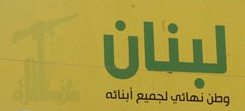
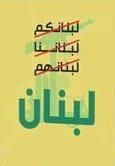 Everything suggests a shift of strategy by the Hizb towards emphasizing the themes of good governance, national unity, gradual reformism, and fighting corruption, while placing the military resistance on the back burner. In this context, one wonders whether the oft-asked question regarding the price for Hizbullah’s “integration” into Lebanese politics is a stale and irrelevant one, as it seems increasingly as though the Hizb is not waiting for anyone to make them an offer. Take a look at the campaign posters (above and left). The party’s famous Kalashnikov logo has been deliberately faded to contrast it with a bold-faced LEBANON, beneath three scratched-out titles: “your Lebanon,” “our Lebanon,” “their Lebanon.” It’s a strong message, and one which immediately brings to mind Saad al-Hariri’s promise to refuse joining a government of national unity after the elections.
Unlike the other big Lebanese parties, Hizbullah is the only one which seems to be taking the whole notion of an electoral program seriously. March 14th and the FPM have issued vague bullet points (which I suppose are better than PowerPoint presentations, but still…) while the Hizb published a nine-page document (see here for English) detailing all of the issues to which it is committed. What’s more, Nasrallah himself is planning to give a weekly address explaining different parts of the platform, which will be highly worth watching, given that Nasrallah (a.k.a. “the Bill Clinton of the Shiite Crescent“) is one of the most gifted orators of his generation. I can point to no hard numbers, but my sense is that a half hour-long speech by Nasrallah is worth several million dollars worth of silly billboard slogans, as far as winning over new adherents is concerned or at least changing people’s minds about the party.
Then again, maybe the Future Movement’s sectarian and just plain bizarro media counter-strategy (see especially “Christians Celebrate Holy Easter Within Uptight Hezbollah Speeches“) is working, but my sense is that they’re just embarrassing themselves.


 Qifa Nabki
Hi QN
Interesting post.
How do you settle that with the latest blunder in Egypt?.
“military resistance on the back burner”?
too soon to tell.
Posted by Idit | April 13, 2009, 12:30 pmThat’s very interesting that you mention the Hizb’s political programme – a manifesto. I’m sure you know I’ve been no fan of M14. But one of the things that irks me the most about them is their complete waste of their four years in power. They wanted self-control of the government, they got it, and they threw it away on a personal dispute.
Seriously, in M14’s defence, what exactly have they done??
So if the Hizb actually wants to do something for Lebanon, and has a dream, then good on them. Let’s see who “loves life” now!
Posted by Sasa | April 13, 2009, 1:25 pmHi Sasa
Just to play mu7aami al-shaytan, it’s not like M14’s four years in power were a walk in the park. Several of their people were assassinated, there was a war on Lebanon, there was the Nahr al-Bared debacle, and of course the eighteen-month long paralysis of the government.
Posted by Qifa Nabki | April 13, 2009, 1:32 pmInteresting article:
Bashar Assad the peacemaker? Think again.
In a recent interview with the Emirati newspaper Al-Khaleej, Assad made a remarkable – and indeed unprecedented – comment about what his concept of “peace” with Israel was. “A peace agreement,” he said, “is a piece of paper you sign. This does not mean trade and normal relations, or borders, or otherwise.”
Excuse-making will begin in 5 – 4 – 3 …
http://nowlebanon.com/NewsArticleDetails.aspx?ID=88159
Posted by Akbar Palace | April 13, 2009, 2:24 pmHezbollah in the Sinai just the “tip of the iceberg”?
Discuss amongst yourselves…
http://www.ynetnews.com/articles/0,7340,L-3700863,00.html
Posted by Akbar Palace | April 13, 2009, 2:37 pmAs always thanks for this QN. Quick question on the following platform statement:
“To combat deviation and harmful traits in our society, whether through the media or other means, to focus on educational and media guidance, to warn of the dangers of the spread of corruption and the decaying of values, and the strict control of scenes and images that impose on public decency and harm the humanistic image of women.”
The last part of this statement (starting from “strict control” worries me tremendously. I see this as the beginning of the end of enjoyable side of Beirut – the one which brings us the majority of our tourist revenues. I also see it as the first step in establishing a Ministry of Virtue and Combating Vice as you have in Iran, Saudi, Taliban, etc…
Your thoughts?
Posted by Johnny | April 13, 2009, 4:37 pmJohnny,
They are a conservative party; I’m sure they mean what they say. But I wouldn’t worry about a Ministry of Virtue. Lebanon’s is too debauched to reform!
Posted by Qifa Nabki | April 13, 2009, 9:07 pmakbar palace, please, i’d prefer you not to hijack each and every discussion on this blog by turning it into a debate about israel and the terrorists surrounding it, thanks.
qifa, very interesting, as usual. as for myself, i largely agree with your stance on the hizb and what it has achieved/will do so during the coming years. i also agree with your view on m14 and what they didn’t achieve. but every time i read your assessments, my discussions with m14/musta2bal people come to mind. for them, most importantly, what happened on may 7 does continue to pose a very personal threat. they live in raouche or generally ras beirut and had the hizb knocking at their doors, and in fact if they knocked, that was a good thing. this ‘fall of the hizb’, in their eyes, simply cannot be discussed away by a convincing electoral program.
furthermore, and this is a threat i as well see in the long run, there are those characteristics of the hizb that strongly remind me of the SED’s methods in the former german democratic republic. the stories i’ve heard evolve around bullying shi’a who do not support the hizb out of their homes in hizb-dominated neighborhoods in the dahieh, for example. or generally speaking, creating an atmosphere of surveillance where they can over there, with informants having both ears on the ground and their neighbor’s wall. or information-gathering a la hizb: a friend of mine used to work very closely with the electoral reform project. one day, people claiming to be journalists for some hizb bulletin/publication walk into her office and start asking questions about the project and people involved. it soon turns out they’re not journalists but simply party members who are asking around. this is exactly what people will tel you who lived under the GDR, about the ways the notorious Stasi functioned. of course, there are also stories about mass mut3a marriages/aka organized prostitution for ‘combatants’ who spend most of their time hiding in trenches, deprived from the pleasures a married life would provide them with, but let’s confine those to the realm of rumors, and anyway, it’s not what would mostly scare me in the hizb.
other than some of my musta2bal and christian friends i do not believe the hizb seriously wants to turn lebanon into any kind of islamic republic, ie i do not consider a ‘religious’ threat as the most imminent posed by the hizb. but i’m afraid the hizb may look a lot uglier on the ground than in its electoral programs, in nasrallah’s brilliant speeches, its tough organizational structures, or in its parliamentary face with MPs/cabinet members.
as for the dahie root, hhhhhmmm, it also gives you to appear, become visible (which is where dahieh is actually derived from i guess), so lots of room for interpretation of the hidden who appears, or something like that…
Posted by bint abeeha | April 14, 2009, 12:27 amIts interesting that the concrete and specific parts of the March 14 program (1 through 6) deal with external issues (except part 2, which is external/domestic), while the concrete and specific parts of the Hizb’s program dealt with purely internal issues (section A, political reform).
And I’m impressed they mentioned specific actions and policies: national council for abolishing sectarianism, proportional voting, ministry of planning, establishing an independent judicial authority.
I don’t know if they’ll win this election, and I’m not sure they’ll accomplish any of their promises if they do win. But if they do just one of the above four, the 2013 elections will be a cake walk.
Posted by RedLeb | April 14, 2009, 12:40 amWhy would they bother with a political programme when they can push their programmes by force? or by sabotaging parliament, or by marathon sit ins, or by blowing up cars of independant Shiaa voices, or by spying,kidnapping,threatening any dissident voices.
Its way too premature to even think that Hizb has an authentic programme that they will implement legally and democratically, but alot of us are so sick and tired of the status quo, were searching for hope in all the wrong places.
Posted by Maverick | April 14, 2009, 2:46 amQifaNabki,
Rest assured there are many, many Lebanese Christians in awe of the Lebanese islamic movement, and more precisely of Sayyed Nasrallah.
…And this is *not because of the Tayyar (Aoun’s) movement*, but strictly for the warmfelt actions and deeds of Hezbollah.
It is very hard for any reasonable intellectual not to feel respect for such a resistance.
Posted by theFool | April 14, 2009, 3:43 amYou always hear the all the kids talking about how Hezbollah has shifted from a terrorist group to a terrorist group with social programs etc. Right? So the conventional line goes…
But let me just say two things:
1. Qifa Nabki, your a great writer! Keep up the good work and don’t let those academic bastards grind you down.
2. We always talk about Hez like I just said right? Well, why this post is so good is that it starts to scratch the surface of “Hezbollah the cult of personality” That’s right. I’ve walked through both the Joe Stalin personality cult museum in Gori, Georgia and the Hezbollah museum in Beirut. Very similar.
People will ask about Nusrallah because he is is he. He is a man who has taken an organization and given it direction and leadership.
“Hezbollah the cult of personality” — Though it is still much more than that, many so-called experts overlook this striking fact.
Wpeaking of which, here is a good pic of me at the Stalin museum in Gori, Georgia:
http://bloggingthecasbah.blogspot.com/2008_08_10_archive.html
Posted by Abu Guerrilla | April 14, 2009, 4:20 amHow much emphasis is Hizb putting on foreign affairs in their pitch at the moment? Is “he of the portentous name” playing the current thing with Egypt up or down?
I’d like to know how this is all being read in Lebanon. How hot it is expected to get & how that works in to the current campaigning context.
Posted by netsp | April 14, 2009, 5:32 amQN,
Your material seems to get better and better as times goes by, with more provoking debate material. Hats off.
Now on the anniversary of the beginning of the civil war, I would like to extend my condolences for all the folks that have fallen in that conflict. Especially for the missings and their families, that to this day are still looking for closure.
That beautifull weather day, I remember very well. As a young man, I did hear the thuds and bombs from far away. Though I heard them and couldn’t make much of them and thought naively that it was a temporary event. Little did I know that it would change my life and my family’s life as well as the lifes of millions of people.
Once again, may the fallen (which most of them were civilians anyway rest in peace).
As to the election. First off, I think it’s a great thing the Lebanon is holding an election. As imperfect the established system is, it’s still an election that either coalition can win, and that’s a good thing. Not many arab countries have this opportunity, including beloved Syria. Let the chips fall where they may.
Now as far as HA. I think they are very shrewed, organized, and provide much needed services to their community and that to be applauded.
The biggest issue is their weapons. They consider them as a strong point. Others in the country fear them a la May 7.
In a logical way, these fears by the other communities are only natural both in an internal setting as well as external.
For example, lets say that HA and El Grande Generale Aoun win the election (which is fine, votes are votes), and HA makes an activity on the border, and Israel goes wild and bomb the hell out of Lebanon. What does that get us? all in the name of Moukawama. Other bigger players in the Moukawama camp aren’t putting their countries physically at risk like Syria.
My point is that Lebanon shouldn’t be the guinny pig in this whole affair. Let other bigger players shoulder the burden. Lebanon has paid more than its fair share in this whole Moukawama enterprise.
Best outcome in my view is to have the military branch of HA join the LAF and be under the Lebanese gov. direction. Thus when it comes to issues of war and peace, the civilian government in Beirut and Baabda will have the last word.
Just my 2 cents. Haapy Easter everybody.
Posted by Ras Beirut | April 14, 2009, 5:45 ambint abeeha,
Great comment. You raise all of the most important objections that have serious people worried, even if they are not spooked by Hizbullah’s religious overtones.
1. On May 7: Yes, it definitely still looms large in the minds of many, (and even larger in the rhetoric of several M14 politicians). What will be most telling is how much support Aoun loses as a result of May 7. His people say they haven’t lost anything… we’ll see.
2. On GDR/Stasi: Yes, this element is a bit unnerving. When we talk about how “organized” and “disciplined” the Hizb is, and how they are the only ones with a “strategy”, etc. we have to also wonder what the price for all of this “organization” is.
3. On HIZBallah vs. NASRallah: You’re right about not judging the party by its frontman. There are very few Hizb reps that put as good a face on the organization as Nasrallah. When I listen to Naim Qassem, I’m considerably less impressed. On the other hand Muhammad Raad is good.
Posted by Qifa Nabki | April 14, 2009, 8:15 amnetsp,
Nasrallah gave a speech two nights ago about the Egypt thing. You’ve probably read about it in the press. Other than that, there hasn’t been much hay made of it.
Posted by Qifa Nabki | April 14, 2009, 8:16 amRas Beirut,
“Best outcome in my view is to have the military branch of HA join the LAF and be under the Lebanese gov. direction.”
I have heard this thrown around several times & it does seem a natural alternative to disarming. But is it as doable as that?
They are far too substantial to be burried in the LAF As a prerequisite, Hizb cannot be (too) actively engaged in military conflicts. Otherwise they run the risk of bringing that conflict with them.
QN,
The reason I brought Egypt is that I (predictably, I guess) am interested in the Lebanese reaction to conducting a parallel foreign policy, & a troublesome one at that. I suppose that it’s related to my above comment. The more active processes conducted by Hizballah separately from the other Lebanon, the more difficult to integrate. Hizballah is insulated from many of the effects it’s actions would have were it the ruling party. If Egypt doesn’t pull its ambassador or threaten other sanctions in response.
Posted by netsp | April 14, 2009, 9:18 amnetsp,
Here are some pieces arguing that Nasrallah made a strategic error.
Daily Star editorial from today.
Interview with Walid Jumblatt from a couple days ago.
Abu Muqawama calls Nasrallah’s move a huge mistake.
Posted by Qifa Nabki | April 14, 2009, 10:06 amakbar palace, please, i’d prefer you not to hijack each and every discussion on this blog by turning it into a debate about israel and the terrorists surrounding it, thanks.
bint abeeha,
I thought we were discussing the Hezbos.
How shall I know what is acceptable to post and what isn’t?
i largely agree with your stance on the hizb and what it has achieved/will do so during the coming years.
bint abeeha,
The Hezbos will never abide by a government that makes peace with their Southern neighbor. You can take that to the (Syrian) bank.
http://www.stratfor.com/analysis/lebanon_violence_spreads_during_hezbollah_protests
Posted by Akbar Palace | April 14, 2009, 4:04 pmoh qifa, i was writing a long post on Hizbullah’s campaign! man when do you stop?
In my thesis I argue against the idea that Hizbullah has shifted from being revolutionary to emphasizing what you call ‘good governance’ and other such vague concepts. (as if the initial 1980s idea of an Islamic state does not preclude ‘good governance’).
Hizbullah has changed and not changed. Actually, it is not even an interesting question. Because this idea assumes that Hizbullah has a clear idea, at all times, of what ‘it is’. Hizbullah has no ideology.
More on this later.
Posted by Bech | April 14, 2009, 10:27 pmBech,
Looking forward to it.
Posted by Qifa Nabki | April 14, 2009, 10:32 pmI should preface this by admitting that I’m not Lebanese, do not have to live under whatever government you guys elect, and know much less about these matters than most people on this thread do. That said . . .
I just finished reading Vonnegut’s “Cat’s Cradle”, and recommend it to all. A minor character in the book is a former Nazi camp doctor who is doing his penance working in a third world hospital. Another character says of him something like “Oh yes, he’s doing wonders in the hospital, saving lives left and right. If he keeps going at his present rate, working night and day, the number of people he’s saved will equal the number of people he let die – in the year 3010.” Reading about Hizbullah’s social programs and whatnot remind me of that doctor. I’m not saying that Nasrallah is a Nazi, only that the damage he’s done is great enough that it trumps everything else in my judgment of him. The 2006 war was just so pointless and stupid for all parties concerned, as far as I can tell it was a pissing contest that got 1000+ people killed. Can anything else Hizb does really make up for that? Again, it’s not up to me to tell Lebanese people what matters to them, and I’m open to persuasion here.
Also, whatever Hizbullah accomplishes in domestic policy, it will be their foreign policy/weird statements that gets the most attention here. Ahmedinejad is far better known to Americans for the whole nukes/Holocaust denial/no gays exist in Iran claim than his (botched) efforts to champion the poor. In so far as it matters what Americans think of Lebanon, I don’t think Hizbullah can improve its image here without some dramatic changes.
Posted by Abraham Rotsapsky | April 15, 2009, 9:47 amI’m not saying that Nasrallah is a Nazi…
Abraham Rotsapsky,
C’mon, go out on a limb!;)
http://www.camera.org/index.asp?x_context=7&x_issue=11&x_article=1158
Posted by Akbar Palace | April 15, 2009, 2:44 pmAnyone has a bigger/better resolution file (jpg or any other format) of that لبنانكم لبناننا لبنانهم لبنان حزب الله poster? Appreciate your help.
Posted by pati | April 18, 2009, 12:19 amAny more specific links to the M14 media strategy or analysis of it? VERY interesting!
Posted by Amina | April 24, 2009, 10:36 pm