Anyone else feel that there’s a creepy symbiosis about Israel and Hizbullah’s messaging strategies these days? Take this little tidbit from al-Manar’s website, which cites an article in The Times (a Rupert Murdoch-owned newspaper) about Hizbullah’s growing arsenal.
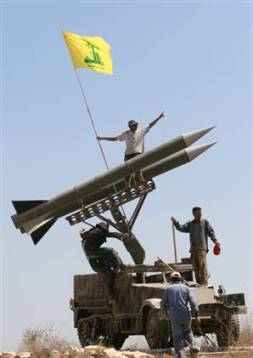 The original piece states:
According to Israeli, United Nations and Hezbollah officials, the Shia Muslim militia is stronger than it was in 2006 when it took on the Israeli army in a war that killed 1,191 Lebanese and 43 Israeli civilians.
Hezbollah has up to 40,000 rockets and is training its forces to use ground-to-ground missiles capable of hitting Tel Aviv, and anti-aircraft missiles that could challenge Israel’s dominance of the skies over Lebanon.
There are several theories about what purpose this new and improved arsenal serves. Some argue that it is part of an Iranian defensive strategy to prevent an Israeli attack on its nuclear sites. You hit us, and we’ll get Hizbullah to lob a couple hundred missiles at Tel Aviv, so the theory goes.
Others say that the missiles are meant to serve as a deterrent against an attack on Lebanon. Hizbullah is betting that Ehud Barak may think twice about authorizing another round of the so-called “boss-has-gone-mad” policy — which worked pretty well in Gaza last year (and, some argue, was successful in Lebanon in 2006) — if the rockets coming back aren’t Qassams but rather Iranian-built Fateh-110’s, which carry a 500kg payload. This is the mutually assured destruction theory.
I don’t buy the first explanation. Given that Hizbullah did not so much as fling a pebble over the border when the IDF flattened Gaza last year, who could imagine that they would launch a full-scale attack in the event of an Israeli strike against Iran? Such a move would be deeply unpopular in Lebanon (assuming there were any Lebanese left after Israel’s counter-attack). Coming to the aid of innocent Palestinians is one thing; keeping Khamenei’s nuclear hopes alive is a much harder cause to sell, particularly these days.
As for the second theory, it is certainly more plausible, but I’m still left wondering about the value of a deterrent that increases the chances of war. With so many missiles crowding the demilitarized zone and hundreds of fighters on a hair trigger, aren’t the chances of a confrontation much higher? Furthermore, the thought of mutually assured destruction only works as a deterrent if destruction is…well, mutually assured. That this would not be the case here hardly needs to be argued.
What makes more sense to me is that the actual strategy is the old, tried and true, let’s-keep-the-pot-boiling game plan that everyone benefits from (the Syrians, the Israelis, the Iranians) except the Lebanese, of course. The next Lebanon war won’t be ignited by an Israeli attack on Iran or an orchestrated repeat of the July War or Operation Cast Lead. It’ll be brought on by a felling of an Israeli aircraft or drone a couple of weeks after Obama’s peace process falls apart. And the cycle of destruction and recriminations will repeat itself.
PS: WordPress seems to have introduced a nifty new ratings system, so feel free to use it (see the little stars at the bottom of this post? those are for you.)
PPS: If you haven’t yet subscribed to the RSS feed, why not do so today? It makes keeping up with your blog reading much more efficient. (See here for an explanation of RSS if you’re unfamiliar with it.)


 Qifa Nabki
Wow, i’m surprised QN. I would have thought you of all people could manage a more nuanced reading of Hizballah and its weapons. Why is it either/or, balck or white?
Hizballah started out as a resistance movement, started by people who had had enough of the Israelis and their occupation. Their raison d’etre is fighting Israel in an intelligent and thoughtful manner (I know, as they are Arabs, its hard to believe). As such, its natural that they should try to find the best weaponry to do so.
still left wondering about the value of a deterrent that increases the chances of war?
As opposed to what? No deterrent at all for a nation whose leaders have time and again stated that they are not satisfied with Israels northern borders or have time and again attacked Lebanon on the most threadbare of pretexts?
What will start the next war? I don’t know but it wont be the felling of any Israeli craft over Lebanon. Hizballah dont play their cards that way and you really ought to know that. If they have AA weaponry, you can bet your bottom dollar that they wont show that hand until after war starts not before it (much like the missiles in 06).
And tbh, its a bit offensive to say that the many supremely brave and proud men who have given their lives (including Hadi Nasrallah) fighting Israel have done so just to keep the “pot boiling”. If Hizballah wanted to do so, their cross border activities would have been far more than the 5 recorded attacks on Israel between the 2000 Israeli retreat and the 2006 war.
Finally, if another war does happen, and inshallah it doesn’t, I think the mutual destruction will be more mutual than you think. And the battleground may just be further South than normal.
Posted by mo | August 5, 2009, 8:53 pmMo,
I was hoping this post would get you to stop by again. Where have you been hiding?
My response to your points:
“Their raison d’etre is fighting Israel in an intelligent and thoughtful manner…”
I thought the raison d’etre was to defend Lebanon.
“As opposed to what? No deterrent at all…”
Now you’re doing the black/white thing. Surely there’s a balance no deterrence and too much?
“What will start the next war? I don’t know but it wont be the felling of any Israeli craft over Lebanon.”
What else could possibly start the next war? The prisoner file has been closed. The land has been 99% liberated. Short of shooting down a plane or staging another kidnapping to liberate Shebaa, what else could they do that wouldn’t dramatically lower their support in Lebanon? I spent a lot of time talking to a lot of FPMers in Beirut over the past year, and nobody was interested in seeing a repeat of 2006.
“And tbh, its a bit offensive to say that the many supremely brave and proud men who have given their lives (including Hadi Nasrallah) fighting Israel have done so just to keep the “pot boiling”
I don’t buy this line of reasoning. It sounds like something that a Fox News anchor would say to someone who accused the U.S. of cynical designs in the Iraq war: “It is offensive to say that the many supremely brave and proud men who have given their lives…etc.”
Whatever the brave/proud men think they are fighting for, isn’t it possible to imagine that there are far more cynical designs at work among the higher-ups, even beyond Hizbullah?
Good to have you back.
Posted by Qifa Nabki | August 5, 2009, 9:13 pmin response to mo’s comments, you miss two points that Qifa pointed out in the article and which are more than apparent if we look on Hizballah as a political party, not just a quasi-PMC.
And the battleground may just be further South than normal.
I think Qifa rightly pointed out “assuming there were any Lebanese left after Israel’s counter-attack” – I just don’t believe that IDF would let the game be played in their own court (for security, economic and political reasons). Secondly, any kind of military action on Israeli soil would support hardliners within Israel and their support abroad and in the end would be damaging for Lebanon (and Palestinians too).
If Hizballah wanted to do so, their cross border activities would have been far more than the 5 recorded attacks on Israel between the 2000 Israeli retreat and the 2006 war.
Same thing, if Hizballah is to be seen as a political party, it needs to “sell” its activities to the public and, moreover, needs to make sure that nobody has a pretext to question Hizballah arms.
if Hizballah attacks Israel, there will be a plenty of pressure to actually effectively disarm Hizballah after the conflit (unless Hizballah is finished) – they must be aware of this…
Posted by michal | August 5, 2009, 10:05 pmI don’t live in the South, but I am sick and tired of Israeli military aircraft flying/hovering over any parcel of Lebanese territory. There must be an end to these violations. I hope the wise ones in our land make it clear to the Israelis & the Int’s community that we will shoot down any and all violating aircraft. Make it publicly known. Broadcast it all over the world and be ready to back it up. I’m not and I’m sure you won’t complain if every Israeli violation of Lebanese Airspace is replied by just measures from our side.
Posted by SL | August 6, 2009, 12:04 amQN,
Why do you think it is in Israel’s interest to “keep the pot boiling”? It is in our interest to have a quiet northern border, and the border has never been more quiet in the 60 years of Israel’s existence. Israel is quite happy with the current status quo, so why would we initiate a war? 2006 despite the many Israeli blunders was a net win for Israel because it changed the rules of the game, making any war too costly for Hizballah and Lebanon.
Also you forgot the golden rule: The man with the gold makes the rules. Iran will certainly ask Hizballah to attack Israel once it is attacked. What Hizballah will do is another matter. I think they will not attack for the reasons you mention. BUT, they may jeopardize their financial support from Iran if they don’t, so one can never be sure. It all depends in the end how crucial the Iranian economic and military backing is for the existence of Hizballah.
Posted by AIG | August 6, 2009, 12:14 amSL,
Talk is cheap. Shooting down Israeli airplanes is very difficult. Just ask the Syrians that could not even detect the planes that attacked their nuclear reactor.
I guarantee you that once 1701 is fully implemented Israel will not waste one liter of jet fuel flying over Lebanon. Until then, you will have to learn to live with Israel flying reconnaissance missions over Lebanon. These overflights may hurt your feelings but nothing else.
Posted by AIG | August 6, 2009, 12:20 amAIG,
Thanks for the lesson. Since, thus far, we are unable purchase and be trained in deploying Russian/European anti-aircraft missiles, I have no recourse by to talk, wish and hope we can put you in your place one day.
Posted by SL | August 6, 2009, 1:28 amSL,
Israel’s defense budget is roughly the same size as the TOTAL Lebanese budget. So it will take you a few generations to “put us in our place”, if at all. The Syrians bought Russian systems, did that help them in defending their nuclear facility? Israel is a technologically advanced country and is the only country to ever sell weapons to Russia since WWII.
http://en.rian.ru/russia/20090410/121045416.html
In short, spend your money first on making sure there is 24 hour electricity for everyone in Lebanon and learn to live with the Israeli overflights.
Posted by AIG | August 6, 2009, 1:42 amI envy Israeli technological prowess, and the lack of electricity in Lebanon is a real burden, and these are all our mistakes. We can wait you out few or 100 generations more if necessary, but I hope we never er in being as arrogant and obnoxious as you people have become.
Posted by SL | August 6, 2009, 2:37 amI really hope this comment can bring the conversation back to where it started.
The “lets keep the pot boiling” is an excellent way of thinking about what is happening but gives too much credit to the various powers. Just as the US funded Israel on mass after they achieved regional supremacy. Iran and Syria have funded Hezbollah more and more as they have proved that they are the most effective threat against Israel. This is why I think the deterrent argument is the most convincing. It may not be a matter of total destruction but Hezbollah have shown that they are capable of inflicting serious damage…is this the first group that may actually pose a threat to Israel in recent history? As for the Murdoch comment you are right but Blanford is a highly credible source he has very good contacts with both UNIFIL and Hezbollah (he is also writing a book on Hezbollah at the moment).
Posted by deensharp | August 6, 2009, 3:04 amQN,
Interesting post, particularly in its timing and the timing of the Times’s ‘news leak’.
I agree with you that the Iranian scenario is perhaps not the one that would alone be the decisive factor in any future flare-up on the southern border.
I also concur with the assumption that the Hizb has been boxing cleverly and would choose the timing of any battle with a view to the Lebanese domestic situation.
History also tells us that Israel has always been the first to embark on wide-scale belligerence, including, some might be surprised to learn, the 2006 war.
Yes, nearly 90% of Lebanon is now liberated; this leaves 10%. Are you suggesting that that 10% ought to be ignored within the publicly proclaimed aim of the Hizb of liberating all occupied land?
As to the issue of POWs in Israel, I would refer you to SHN’s latest speech in which he alluded to the case of Skaf.
That said, I believe that the phenomenon of the Hizb has surpassed its domestic political significance to occupy a regional strategic position that could change the regional status quo. Although it remains to be a force to be reckoned with in the ongoing endeavours of protecting Lebanese territory, integrity and independence (sounds like 14M!), it has become a major regional player with an eye on Israel. Anyone who doubts this reality ought to reconsider.
I understand that you feel that there is no real balance of power between the Hizb and Israel. Materially speaking no one can argue with you. Israel’s military budget far exceeds in GDP terms that of any other state in the area, and many a state in the world. However, it is the effect of the arsenal that counts in strategic terms. While Lebanese, especially in the south, have shown a willingness to take on board a great deal of harassment and outright bombardment of great proportions, one has to wonder how the Israeli society would react to a concerted war that would be fought on their own land reaching their own homes. It could be that the period of ‘learning from the last war with Lebanon’ that the Israeli leadership embarked on since 2006 has borne fruit. This however needs to be tested in action. On the other hand, the steadfastness of the Lebanese society, willing or otherwise, is proven.
A war between Lebanon and Israel is a live prospect. Indeed some say it is the only way to inject some urgency that would break the current state of impasse and uncertainty.
The Hizb know that, hence the waiting game.
Israel knows that, hence the tension.
The US knows that hence the efforts to defuse the situation or at least contain it in a way that it would not have negative repercussions on its regional and international interests.
Regards
Posted by QuestionMarks | August 6, 2009, 5:10 amBlog fatigue has happily kept me to simply reading rather than writing!
In response,
“I thought the raison d’etre was to defend Lebanon”
Semantics as it comes down to the same thing on the battlefield, since they wont be launching any kind of full scale invasion any time soon.
But off the battlefield, solidarity with the Palestinian cause is as important as defending Lebanon.
“Surely there’s a balance no deterrence and too much? ”
EH? How can one have too much detterence? And how does one judge when they have reached just enough detterence? Especially against an enemy who believes he is so superior to you?
“What else could possibly start the next war?”
Hold on a second. Am I reading this right? Are you actually assuming that its Hizballah that will want to start the next war? History will beg to differ.
And if you are not, oh how about a selection of pretexts for previous invasions, like a bus bombing in Tel Aviv or an attempted assasination of an Israeli ambassador, in London!
“It sounds like something that a Fox News anchor would say”
Yes, but I’m not ashamed of that. And the difference between me and a Fox news anchor is that Im saying it about men and women who died defending their land not invading others.
Yes its not too much of a stretch to believe that there are more cynical designs at work but as stated in many a previous post, Hizballahs core is the people of the South and these are smart people. If they felt they were being used and giving up their sons for the gain of “higher ups” those higher ups would know about it.
Posted by mo | August 6, 2009, 5:43 amMo I don’t quite understand what your rational is for Syria and Iran supporting Hezbollah? In your opinion if Israel attacked Iran would Hezbollah attack Israel on its behalf? Is this not why Iran is funding and giving it so many weapons? Or is it just pure benevolence to the resistance?
We get that Hezbollah have the highest of intentions and they have a good, in a region of very bad, track record. But do you think Iran, and even Syria, is supporting Hezbollah because they want to stop an Israeli invasion in Lebanon?
Surely it is clear that Syria/Iran support Hez becuase they offer a convincing geostrategic threat to Israel…? Not becuase of loyalty to the resistance, Palestinians, Lebanon, the people of the south. But that does make it wrong, it is what it is….
Posted by deensharp | August 6, 2009, 6:50 amAIG,
I thought the golden rule was: “Write a blog post about Hizbullah and Israel, and see your readership come out of the woodwork, all randy and opinionated.”
Will be back to moderate after I make my kid some french toast.
Posted by Qifa Nabki | August 6, 2009, 7:12 amI have no recourse by to talk, wish and hope we can put you in your place one day…but I hope we never er in being as arrogant and obnoxious as you people have become.
SL,
I hope you realize that your statements are silly. The border between Lebanon and Israel are pretty well defined. And Lebanon already “put Israel in her place” when she left Lebanon some 10 years ago. Are you really seeking to “liberate all of Palestine”?
IMHO, Israeli “arrogance” is simply proportional to the threat. Israelis have excellent relations around the world with peoples and nations who are NOT at war with her. Africa, Asia, and the West are all happy customers. The ME should learn to work WITH Israel, not against her.
It is time to rethink the equation.
Posted by Akbar Palace | August 6, 2009, 7:49 amAIG
“Why do you think it is in Israel’s interest to “keep the pot boiling”?
I think the right-wingers in Israel like things just as they are: a quiet northern front, but the persistence of a hidden threat. It gives them something to point to when Obama comes knocking and threatens to strip the poor settlers of their kindergartens.
That said, the arrangement benefits Syria more. Hizbullah is one of the only offensive cards Syria can play; Israel has many options.
Posted by Qifa Nabki | August 6, 2009, 7:58 amQuestion Marks
You make many good points. I’ll respond to each one.
1. “Yes, nearly 90% of Lebanon is now liberated; this leaves 10%. Are you suggesting that that 10% ought to be ignored within the publicly proclaimed aim of the Hizb of liberating all occupied land?”
I actually said “99% is now liberated”. The question is, how do you approach the remaining 1%? There are two options. We could wage a costly and destructive war to recapture it, or we could take a wait-and-see approach, like our neighbors to the east. The Syrians have managed to live without the Golan — a much larger and more significant piece of territory than Shebaa — for 42 years, and 31 of those years have been peaceful. If it’s good enough for them…
2. “[Hizbullah] has become a major regional player with an eye on Israel. Anyone who doubts this reality ought to reconsider.”
This is precisely my point. Given that Hizbullah has become — as one person once put it — a transnational organization stuck in a national context — why is it so hard to imagine that its calculations go beyond the impact of its actions on Lebanon’s territory, people, and infrastructure? They’re a regional player now, but like all regional players operating in Lebanon, they can’t ignore the domestic response.
3. While Lebanese, especially in the south, have shown a willingness to take on board a great deal of harassment and outright bombardment of great proportions, one has to wonder how the Israeli society would react to a concerted war that would be fought on their own land reaching their own homes.”
Question Marks, do you really think that most Lebanese are in favor of seeing their entire country destroyed (not just what was destroyed in 2006) for the sake of a tiny plot of territory and a prisoner kidnapped in 1978 who is probably dead?
Posted by Qifa Nabki | August 6, 2009, 8:20 amDear AIG
(assuredly ingrown gumstick?)
Thank you for your enlightning views on Lebanon’s social agendas to tend to. I am happy you have noticed summer is more pleasant with an up & going air conditioning system.
Pray tell if the hoards of kids and old people in jenin balata & the oether camps, gaza, the west bank might need food water or medicines as well? Or could these be dug from under the earth by those you left undead?
The boys at tsahal seem to be busy these days quicking balls through a “silenced fence…But the northern border team always suprised you with all what was left unsaid.
50 years build you that army but thousands seem needed indeed to learn the lesson of peace.
Al salam a3leykum is an Arabic expression, the culture of which you are years behind.
Posted by theolivetrees | August 6, 2009, 8:35 amdeen,
The triumverates relationship is not as simple as that. In fact the relationship between the three would require a rather long and complex paper. Syria supports Hizballah because it needs Iran and because the West thinks it has so kind of control over them so it likes to use the Hizballah card in its negotiations. But its ability to tell Hizballah what to do is zero. If you check the history books, up until 91 Syria saw Hizballah as its enemy.
The relationship with Iran is very different but still more complex than you think. For one thing, the support that comes directly from the Iranian govt. is highly over-estimated. And the personal relationships between the Iranian clergy and the Lebanses Shia community is also very deep and in many cases familial.
So to answer your questions:
No, I don;t believe Hizballah will attack Israel if Israel attackes Iran.
No, Iran does not see Hizballah in a purely geopolitcal view. It may not be interested in Lebanon or Palestine (but I believe it is) it virulently cares about fellow Shia.
Syria is just a red herring and is irrelevant.
Posted by mo | August 6, 2009, 8:55 amThey’re a regional player now, but like all regional players operating in Lebanon, they can’t ignore the domestic response.
QN –
What “domestic response” are you referring to? It seems to me, the Lebanese are quite incapable of confronting the brave Hezbo fighters, even in words.
PS – I’ll AIG respond to the “kindergarten” comment.;)
Posted by Akbar Palace | August 6, 2009, 9:00 amQN,
I still don’t get it. How is Hizballah connected to the settlements and how does this help right wingers in Israel with their argument??? The issues were never connected or presented as connected to the Americans or more importantly the Israeli public.
I think the interests of everybody are aligned in that no one wants another war. Let me repeat, in its 60 years history, Israel’s northern border has never been so quiet. The only risk of war is an Israeli attack on Iran. But even that is not a huge risk.
On another note, it is interesting how people can interpret the same facts so differently. That has been the main tragedy behind the Israeli Arab conflict and in my opinion the losing strategy adopted by the Arabs.
Posted by AIG | August 6, 2009, 9:14 amAIG
Are you really going to deny that there is a substantial segment of the Israeli political establishment (supported by a substantial segment of the Israeli electorate) that has no intention of giving up any territory to a future Palestinian state? Are you further going to deny that this wing of the establishment benefits from the persistence of a hidden threat on its borders, as far as its ability to court political and financial support is concerned?
Posted by Qifa Nabki | August 6, 2009, 9:42 amQN,
How does this “wing” benefit from the persistence of a hidden threat as regards to its agenda in the West Bank???
You are just assuming this but not providing an argument. I see no benefit for the West Bank cause from Hizballah. Let’s put it this way, if Lebanon agreed to peace with Israel for Sheba and Ghajar, would this “wing” say no? Of course not.
Posted by AIG | August 6, 2009, 10:34 amtheolivetrees,
If you prefer to buy weapons, then do so. It is always fortunate that Arabs do the opposite of what Israel suggests thus making their situation worse.
The culture of peace? There are almost no Jews left in Lebanon. You kicked them all out or made them so afraid, they left. There are 1.5 million Arabs living in Israel with more rights than anywhere in the Arab world, despite all your pontificating. There were 150,000 in 48. There number grew 10 times and they are 5 times richer on average than the average Lebanese. Wow, we must be treating them really bad. Have you no shame about ethnically cleansing the Jews from Lebanon Mr. “culture of peace”?
If you want peace, LEAD by example. Show you are tolerant and democratic and non-sectarian. Until then, your are arguing for an image of the Arab world that doesn’t exist. And if you care so much for your Palestinian brothers, stop treating them like dirt in Lebanon. In short, “the culture of peace” does not exist in the Arab world.
Posted by AIG | August 6, 2009, 10:55 amThe Lebanese do not understand that in 2006 the US saved your ass big time:
http://www.naharnet.com/domino/tn/NewsDesk.nsf/getstory?openform&0EA068B623D7FBCCC225760A0029C8C1
The important part:
“What happened in the second Lebanon war will not happen again … at the time a message from the United States indicated we must spare Lebanon’s infrastructure,” he added.
There are no more Hizballah-Israel wars. Only Lebanon-Israel wars. So the best solution for both sides is no war at all even when Israel attacks Iran.
Posted by AIG | August 6, 2009, 11:04 amthe olivetrees,
Where was the “culture of peace” before Israel’s evil occupation?
AIG –
Here’s the “culture of peace” Israel is more accustomed to:
http://littlegreenfootballs.com/weblog/pictures/PalestinianChildAbuse/
Posted by Akbar Palace | August 6, 2009, 11:46 amAIG
The hard right wing benefits by being able to say: “Look at all of these people who want to kill us. Don’t listen to the yafeh nefesh types. We know what’s best for Israel.”
Posted by Qifa Nabki | August 6, 2009, 1:15 pmQN,
The right wing has Hamas for that and their notorious charter. They do not need Hizballah for that. It is quite simple, the Israeli right wing would support peace between Lebanon and Israel while Hizballah won’t. 99% for the tension is Hizballah’s fault. There is no Israeli interest in a “boiling pot” with Lebanon.
Posted by AIG | August 6, 2009, 1:44 pmThe hard right wing benefits by being able to say…
QN –
Since when does an Israeli ever listen to another Israeli?
All the Israelis have done is to EXPERIENCE the violence that was felt after the famous Rabin-Arafat handshake. Or EXPERIENCE the violence after the Camp David 2000 breakdown. Or EXPERIENCE the 7 years of random Katyushas from from Gaza and Lebanon.
The “yafeh nefesh” have no alternative other than to ask Israelis to go further toward the edge of the cliff on a hope and a prayer.
The right wing benefits by default.
Posted by Akbar Palace | August 6, 2009, 1:48 pmQN #17,
Correct. You did say 99% and not 90%. It could be that we are both inaccurate in our assessment of how much of the 10,425 Sq. KM of Lebanon remains occupied by Israel, without taking on board certain ‘allegations’ about the 7 villages that the Lebanese government had to repatriate a few years ago, thus admitting that where they came from i.e. one of those villages were Lebanese before 1948, while not officially claiming the territory.
That said, I cannot help but wonder whether the percentage is a core issue here. When would it start to be worth it? 10%? 12.3456%? 30%? I always thought that the principle is that a state ought to endeavour, with all that it can muster, to be seen to defend its integrity, independence and liberty (sounds like M14 doesn’t it!). Unfortunately, the international community at large tend to pay more attention, indeed more respect to those who fight, successfully, for what they perceive is right. This is what the Hizb has done. What the Hizb has also achieved is a dramatic change in the age-old Lebanese political maxim of ‘our power lies in our weakness’, into something that any person with dignity would understand: do not mess with us for we will hit back. On a practical level, and with the some kind of ‘regional negotiations’ planned for, would it not serve Lebanon’s national interest to have bargaining chips on the table? The Hizb is such an ‘insurance’.
It is the first time I read you ‘praising’ the wisdom of our other ‘neighbour’. Be that as it may, but comparing both states is like trying to reconcile what is an apple with what is an orange.
In your second point we seem to agree on the central position of the Hizb, but disagree as to its priorities. You are well aware, I am sure, that the Hizb has changed dramatically over the years. It has become more ‘nationalistic’ than ‘international (in Islamic terms). What remains however is the central ideology that the major danger to the ‘Lebanese entity’ comes from Israel. As hard as Israel, some Arabs and the some in the West try, this premise remains central to the political Psyche of most Arabs, including Lebanese. A case in point for me would be a number of Lebanese Christians not members of the Communist party or one of the ‘left wing’ gatherings, but ordinary people becoming more conscious about the threats posed to the Lebanese identity. In essence, the Hizb constituency has expanded and started to supersede known sectarian boundaries. To imply that a side with regional reach would not try to appease its domestic constituency is a statement that perhaps needs more investigation in the case of the Hizb; after all it is a Lebanese party through and through. Just ask the hundreds of thousands of supporters in Lebanon and enquire about the nationality of the thousands of dead and injured in the struggle.
Your third point brings us back to the first. Nobody wants to see death and destruction in one’s own community. We have to remember that all wars in Lebanon by Israel (including 2006, I strongly maintain) is the direct result of a declared Israeli policy to run the region with an iron fist. This has not changed, and will not, unless there is a price to pay by the Israelis. This new status quo, balance of terror of arms in terms of its impact on either side rather than quantity –and perhaps quality- has been established. Hence the outcry against the Hizb.
My personal view for all that it is worth, the region has reached a state in history where things will have to change in a way that would be detrimental, to say the least, to Israel. They are locked between the proverbial rock and hard place: either they agree to live as an equal in this large community or face an ever-increasing prospect of a challenge to their existence. In my estimation, neither option is palatable.
Regards
Posted by QuestionMarks | August 6, 2009, 2:14 pmA belated “Flying Pig Watch” on LGF! Do a “print screen” on this, they don’t happen very often…
http://littlegreenfootballs.com/article/34381_Flying_Pig_Watch
Posted by Akbar Palace | August 6, 2009, 3:02 pm“learn to live with the Israeli overflights.”
Wow, what a mensch you are. How would Israel respond to Syrian or Iranian or Lebanese overflights? And why does Israel need these overflights when they receive American satellite reconnaissance info?
Posted by sean | August 6, 2009, 5:10 pm“And why does Israel need these overflights when they receive American satellite reconnaissance info?”
Wow, You seem to be in 2000, Israel has Day and Night Recod Sattelite for that, It was launched From India , January 2008 Report.
Now Israel might be peeping on you day and night!.
Lear to live with Israel, thats it for middle east coz , there can be Only one King in a Jungle of Middle East, and thats Israel.
Posted by Sandy | August 6, 2009, 8:30 pm“Lear to live with Israel, thats it for middle east coz , there can be Only one King in a Jungle of Middle East, and thats Israel.”
All that’s left in Israel is a bunch of rightwing lunatic nutjobs because all of the sane people have left. That’s why Labour is irrelevant. That’s why Netanyahu is in charge. That’s why you keep electing the same murderous dinosaurs into office.
Israel’s days are numbered. You don’t even have the US on your side anymore.
If Lebanon would just get its shit together, if Lebanese would exert some of that energy they use in spouting off conspiracy theories about the West or some of the energy they put into nightlife, if they would actually stand up and take charge of their country, they could easily compete with Israel. I’d love to see the Lebanese rise up again like they did on March 14, march into Martyrs Square, and demand the dinosaurs in their own government stop the BS, form a cabinet, and get to governing. But they’re too busy with their superficial nonsense to take charge of their destinies. They’d rather just blame the West for all of their problems.
-(not Israeli, not Lebanese, just a human.)
Posted by Human Being | August 6, 2009, 9:53 pmQuestion Marks
I’ll try to respond to your comment tmrw. Busy at the moment. Thanks.
Posted by Qifa Nabki | August 6, 2009, 10:33 pmSean,
Israel would shoot down any Syrian or Iranian overflight.
Where did I say that the Lebanese do not have the right to shoot down Israeli planes overflying their country? Give it your best shot.
What you really don’t understand is that the overflights are GOOD for Lebanon. They minimize the chance of Hizballah making a mistake and attacking Israel because they provide Israel with intelligence to hit Hizballah hard therfore deterring Hizballah and saving Lebanon.
Posted by AIG | August 6, 2009, 11:41 pmHey QN,
Nice post/discussion.
“(see the little stars at the bottom of this post? those are for you.)”
My FIVE STARS go to Question Marks and Mo.
Also, thanks Sean (#32). Wish more people see things in this light; peace may then have a chance.
Regards.
Posted by PN | August 6, 2009, 11:50 pmHuman Being,
Right, it was the Israelis that decided to fight among themselves and kill 200,000 of their own brothers because they are right wing genocidal lunatics. Oh wait, it was the Lebanese. If the Arabs are willing to kill their brothers so easily, do you not think it is reasonable for Israelis not to trust them very much? It wasn’t just any Arabs, it was the “enlightened” Lebanese that are apparently so much better than the violent and right wing Israelis who do not want peace enough. You guys always crack me up. Israel has not killed half the Palestinians the Lebanese (their “brothers”) have killed. You are delusionally pathetic.
Let me go make our army even stronger to ward off genocidal day dreamers like. I wish you luck getting your shit together, but whatever you do, make sure it doesn’t spill to our side because then you will be putting your country in danger.
Posted by AIG | August 7, 2009, 12:00 am“Coming to the aid of innocent Palestinians is one thing; keeping Khamenei’s nuclear hopes alive is a much harder cause to sell, particularly these days.”
Trust Said Nasrallah to sell it to the Lebanese – and from the hyperboles about Israel in your article and in the comments, he has his work cut out for him.
Posted by Yonatan Amir | August 7, 2009, 1:09 amBTW, this “symbiosis” is the language of realpolitik.
Posted by Yonatan Amir | August 7, 2009, 1:12 amAIG (#17) & #26,
Wahad (One). So you would prefer the Arabs to do just as the Israelis tell them to? What you mentioned is thus taken as a compliment, so shukran.
Tnen. Jewish Lebanese are inherent to the country’s confessional mosaic, part and parcel of its 18 officially recognized ethnic minorities by constitution. And that preceded the establishement of the state of Israel fyi. They consider themselves as Lebanese first and foremost.
A good read is always practical before a discussion: get acquainted with Jewish Lebanese history.
http://www.lebanonwire.com/0308/03082904DS.asp
Some even fought Israel during the 1948 war. The actual number of Arab Jews increased in Lebanon at the emergence of the conflict. Most of them elected to go to Europe, the States and Canada and not to Israel. For a state which defines itself first and foremost as a nation for Jews, a racial one, it will not be surprising then that after the intensification of the conflict, Jews were increasingly associated with the policies of Israel. You wanted them to leave their Arab lands and representatives were working hard aided by cash and promises to convince them to do so.
Tleteh. Are you really going to deny that Ashkenazi Jews, from europe, have been treated better than the Oriental Sephardi & Mizrahi jews? Are you really going to deny that Arab Israelis are given the status of second class citizens? By denition the Jewish state concept is based on ethnically preferential treatment towards Jews. Is boycotting elections not a sign of discontent? Is attempting to ban Arab political parties non discriminating? Arab citizens with Israeli passports are a demographic threat and will always be considered of doubtful loyalty. Your own high court justice has corroborated that in the Or commission investigations. Are you going to deny that half of your allies in the 22 year occupation of South Lebanon, South Liberation Army families, whom you have welcomed after you retrieved, have fled Israel because of ill treatment?
Arb3a. Internal affairs are issues to be dealt on a national level, issues should not be confused. The subject at hand here is Arab Israeli conflict, and the will to resolve it.
Khamsseh. I hope the foreign ministry are paying you well for your overtime internet warfare commentaries these days.
Now you know how to count to 5 in Arabic at least 🙂
Posted by theolivetrees | August 7, 2009, 3:23 amProbably the next war on the Lebanese by the Israeli military will come when the fragile Israeli coalition government needs a big diversion for the U.S. President – to divert the President’s attention away from his peace prosposals (i.e. the U.S.’ call for an end to ongoing Israeli land-stealing in the West Bank).
The Israeli government is looking for ways to blow up the U.S. government’s plans and an attack on the Lebanese could do the trick – ahead of an attack on the Iranians – which even the Israeli government seems to understand must wait until the U.S. has less troops sitting vulnerably in Iraq where they are so vulnerable to the Shiia backlash (the Shiia backlash won’t be against Israel, but against Western and U.S. interests in the Gulf one would imagine).
The Israeli government without a doubt will aim to destroy the U.S. President’s strategy to promote United States’ economic interests (i.e. America for economic and fiscal reasons needs to secure an end to the Israeli-Palestinian conflict and dislodge Syria off the Iranian axis).
It is totally against U.S. and Western interests for this Israeli-Palestinian fight to carry on much longer – sadly for poor Lebanese civilians, the United States is just not in a strong enough position at the moment to do much about what the Israeli government has planned to ambush Western interests and Lebanese lives.
Posted by Sofia | August 7, 2009, 7:43 amthe olivetrees said:
They consider themselves as Lebanese first and foremost.
Wow! You mean 100 elderly Lebanese Jews consider themselves “Lebanese first”? This is certainly a great accomplishment.
Where can I send a letter of congratulations?
http://en.wikipedia.org/wiki/Jewish_exodus_from_Arab_lands
The actual number of Arab Jews increased in Lebanon at the emergence of the conflict.
Do you think this was because Jews were fleeing Syria to live in Lebanon and the border between Lebanon and Israel was closed shut?
http://books.google.com/books?id=wfLnqyxeE78C&pg=PA77&lpg=PA77&dq=lebanese+immigration+%22to+Israel%22&source=bl&ots=DCcm2aGlP2&sig=Vt5sSiVnJyoAz_7r_NFJrno82fE&hl=en&ei=PBd8SsGgNsfBtwe62-T1AQ&sa=X&oi=book_result&ct=result&resnum=1#v=onepage&q=lebanese%20immigration%20%22to%20Israel%22&f=false
Posted by Akbar Palace | August 7, 2009, 8:07 amtheolivetrees,
I am more than happy to discuss the benefits of a secure peace and how to get there, but when you start talking about a “culture of peace” that you represent and we don’t, all we can do is laugh. Israel is far from perfect. We are an average democracy with average people bumbling along as best we can in a very complex situation. BUT, we are committed to playing by democratic rules and unlike the representatives of “culture of peace” like you, we do not kill 200,000 of our fellow citizens because we disagree with them. That was 5% of the population! Like 15 million Americans being killed in a civil war.
Until proven otherwise by 2 generations of quiet, civility, democracy, rule of law and non-violence between Lebanese, it is the opinion of most Israelis that the Lebanese are genocidal killers under a very thin veneer of “culture”. And you are the “nice” Arabs. Unlike others, we know the history of the middle east. After the Hebron Massacre of 1929 en.wikipedia.org/wiki/Hebron_massacres it is clear that Jews cannot live under Arab rule or be safe as an unarmed minority in the midst of Arabs. If the Jews of Hebron that lived for centuries with their Arab neighbors were massacred, then what about the rest of us?
So let’s stop this stupid discussion about “culture of peace”, “being a mensch” and all the other high faluting BS. We live in the mid-east not the mid-west. The Arabs decided that the gun will decide this conflict, and so it shall be until the Arabs change their minds and adopt non-violence among themselves and towards others.
Posted by AIG | August 7, 2009, 10:37 amAIG #44
No, let us not stop discussing the culture of peace. In fact, let us put that oft-lauded but frequently abused concept in its historical Middle Eastern context.
This “…average democracy with average people bumbling along as best we can…” was created at the expense of displacing millions of people who became destitute and stateless, quite humane and peaceful.
Terrorist Gangs –historian’s assertion not mine although I tend to strongly agree- such as Stern whose Menahim Begin reached the highest echelons of power in the state of Israel, and who once was (not sure remains to be) on the UK’s most wanted persons for clandestine criminal activities in Palestine (not even Yasser Arafat enjoyed such an accolade); those gangs brought in non-Palestinians (yes, it was Palestine) and caches of armaments for the sake of peace driven by peaceful intentions, I am sure. They also committed atrocity after atrocity against unarmed Palestinian citizens with the aim that news about such atrocities would travel before them and instil the fear of God into them, guided by the light of the culture of peace.
Israel begged, borrowed and robbed in its successful efforts to build and maintain a nuclear arsenal for peaceful reasons. In fact, their endeavour to introduce the nuclear element into the equation helped to establish peace in the region, and not force other regional powers into starting their own such destructive weapon programme, some failed as in the case of Iraq, while other are nearing fruition as is the case with Iran. Peaceful culture indeed!
Of all the wars in the ME between the Arab states and Israel was instigated by the latter’s culture of peace. 1948 and the invasion of mainly heavily European Jews to claim a land that is already inhabited by a peaceful a true peaceful society. In 1956 Israel cajoled Great Britain and France into invading Egypt, for all the peaceful reasons in the world. In 1967 Israel, driven by its blind love of peace launched a three pronged attack against Egypt, Syria and Jordan, occupying n the process vast lands that by far exceeded its initial mandated terretory. It was a peaceful pre-emptive strike.
Now to Lebanon. After the Palestinians themselves, the Lebanese had to suffer most Israel’s culture of peace. It started way before Hizbullah came to be. If we were to forgo the late forties and early fifties of the last century and jump to the late sixties we start seeing Israel’s peaceful benevolence when it comes to Lebanon and the Lebanese. 1969 witnessed the first major instalment when the Israeli air force laden with messages of peace attacked the civil (non-peaceful) airport and destroyed some 13 civil aircrafts while aggressively docking on the tarmac with the engines off. 1973 witnessed yet another measure of peaceful intentions towards Lebanon when a group of Special Forces came from the sea bearing peaceful designs and killed 3 men.
With 1978 came the peaceful invasion of south Lebanon only for Israel to assert its peaceful culture by invading the whole of Lebanon in 1982. Alas, peace abandoned Lebanon when the Israeli occupation forces had to grudgingly and hurriedly leave taking their peace with them.
Yes, let us discuss the culture of peace, really let us.
In my opinion, Israel cannot survive in a peaceful environment. It is anathema to its existence; the core of the ideology of the founding fathers. Israel is an army that has a state, not the other way –normal way.
The elusive peace would dictate the Israel abandon its phobia of being a minority and thus requiring it to flex its muscles in terrorising and intimidating its neighbours. In short, it will dictate that the state live in the area as an equal amongst equals, to forget about certain core elements of its existence such as the “Jewsishness” of the land, of Jerusalem, of settlements etc. Peace would put economic pressures on the state, as sponsors would be less likely to economically and financially support the burgeoning military budget.
A peace in the area would set the scene for a civil war in Israel pitting ‘moderate’ Jew against ‘orthodox’ Jew, the latter, represented by illegal settlers, fed for generations on a diet of sole ownership of the land, and beyond for some, hate for anyone who is not a Jew as well as other such peaceful sentiments.
A peace in the area would be a prelude for the end of the state of Israel as we know it. Objective students of natural human history can easily ascertain that the element of demography is essential to the sustainability of any group of humans. The same applies to states.
Peace would impose some form of stability in the region that would, in time, make obsolete the need to maintain an army that is constantly on alert. People would rather turn towards economic development and social climbing. The rules of nature indicate that a small minority would in time be swallowed by the majority.
On second thoughts, let us not discuss the culture of peace; it could be uncomfortable thinking for some.
Regards
Posted by QuestionMarks | August 7, 2009, 11:47 amQuestionMarks,
Boy are you off the mark in all aspects. The whole gist of what I wrote is that there is no “culture of peace” in the middle-east. On that we certainly agree.
Thankfully, your view of history is so blinded, you cannot reach the right decision about how to move forward and how to improve. Do you have any excuses for the Hebron Massacre of 1929? That is the crux of the matter and the beginning of the militarization of the conflict.
Your assertions are trivially wrong. Let’s say that what you say is true that peace will bring civil war to Israel. If you really believe that, then why haven’t the Arabs accepted the Israeli deals such as Barack offerred in 2000? Why do they have so many conditions on a peace deal instead of accepting what is on the table and watch Israel go up in smoke?
You know why? Because most Arabs understand that the biggest benefactor of the peace would be Israel because of its democratic, globalized high tech society and its ultra-entrepreneurial nature. What would the Arabs gain? Nothing, they would still be run by the dictators with their sorry excuses for lack of development.
Posted by AIG | August 7, 2009, 12:03 pmAIG #46
No, we do not agree. What I am asserting is that Israel, for all its shady attempts at claiming otherwise, has no culture of peace; quite the contrary. I supported this statement by citing historical facts that all you could do to counter is allege that my view of history is blind. Quite convincing, I say.
The massacre of 1929? Is that what you have to counter with? Oh I see your point. The decision to displace millions of people and deny them all human rights, confiscate their land and chase them with killing and destruction wherever they are; a decision about all this was made only post-1929. My understanding of history indicates that the region at the beginning of the last century was rife with sectarian strife as a result of the ever-weakening of the central power of the Ottoman Empire. I do not think that a clash between a group of Palestinian Jews and their fellow Palestinian Moslems or even Palestinian Christians would entail the robbing of land and the displacement of its inhabitants on the part of one group. Furthermore, lest we forget, the gangs who invaded Palestine and uprooted its people were not, by and large, indigenous inhabitants of the land of Palestine, rather a collection of military minded people who arrived mainly from Europe and who, most probably haven’t seen, let alone lived in Palestine.
I wonder whether you are really privy to the details of the so-called Barak’s offering of peace to the Arabs. I certainly know about an Arab (initially Saudi) peace proposal that dictates the adherence to international i.e. UN resolutions pertaining to the conflict foremost among which are the ending the occupation of land by Israel (who else occupies other’s land in the region!), the freezing and then dismantling of the illegal, by international resolutions including USA, of settlements, and the repatriation and/or the compensation of displaced Palestinians. This would bring real peace a step closer, and will herald the beginning of the end of the state of Israel as we know it. I am not saying the destruction of the state, rather a dramatic shift in its existence away from the narrow minded phobia of racism defined in part by a supremacist attitude towards others, as is clear from your tonality.
Arabs, at least Hizbullah and the subscribers to the concept of resisting occupation, aggression and intimidation by building on one’s own strengths, want peace, but an honourable one. They are prepared to wait for the inevitable to happen, while sustaining and building on the new strategic balance that has been asserted since 2000; the year of the forced withdrawal of occupation forces from Lebanon.
At the risk of repeating myself, let me say that the main problems in the region are directly related to the occupation, inhuman treatment of the occupied and expansionism. The Arab’s way of political life is an issue for the Arabs to deal with, and they will; in fact have been doing.
Let us not attempt to shift the goal posts every time one feels that one doesn’t enjoy a recourse to a valid argument.
Regards
Posted by QuestionMarks | August 7, 2009, 12:43 pmQM,
You call dirt poor Jews like my grandparents that came from Europe “militarized gangs”? Don’t make a fool of yourself. The people who came to Israel were mostly poor refugees who did not have much choices.
Before 1929 there was a chance of a bi-national state. After the Hebron Massacre of 1929 there was only one possible solution, partition. By showing how intolerant they were of Jews the Arabs killed the bi-national option. The UN came up with a partition plan on Nov 29 of 1947. The Arabs REJECTED the plan (culture of peace?) and decided to solve the problem using war. They lost and now you complain. That is plain funny.
Repatriation of Palestinians means the destruction of the state of Israel so you are saying a contradiction.
The main problem in the middle east as every knowledgeable person knows is the lack of democracy in the Arab world. It is what keeping the Arabs down and is robbing their future. Israel and “occupation” are just excuses. The proof is the pre-1967 situation. There was not “occupation” but there was no peace and the Arab world was not in better shape.
I was for leaving Lebanon in 2000 but after I see your interpretation of the events I know I was wrong. Israel should have stayed there even though the cost was the lives of about 10 soldiers a year.
The Arabs have been waiting 60 years for the “inevitable” to happen. In all the period they have grown weaker relative to Israel and are as far away from democracy as they were 60 years ago. Keep up the good work and let’s talk in another 60 years.
Posted by AIG | August 7, 2009, 1:13 pmThe “Main Problems” Revisited
The decision to displace millions of people…
QuestionMarks,
Where did you get this figure?
At the risk of repeating myself, let me say that the main problems in the region are directly related to the occupation, inhuman treatment of the occupied and expansionism. The Arab’s way of political life is an issue for the Arabs to deal with, and they will; in fact have been doing.
Speaking of excuses, the occupation excuse crumbles as Israel was at war and without peace many years before there ever was an occupation.
Good luck with the political life “issue”. I have turtle that makes faster progress.
Posted by Akbar Palace | August 7, 2009, 1:22 pmFor you QM:
http://www.ynetnews.com/articles/0,7340,L-3758123,00.html
And if you don’t believe it, just come visit.
PS Don’t mention you are Hizballah at the passport control
Posted by AIG | August 7, 2009, 1:28 pmI’m not sure why but something about this discussion feels familiar to me.
Could it be because we’ve had it ONE HUNDRED AND THIRTY ONE MILLION TIMES?
AIG, tell me what your birthday is. I want to assemble a set of links to all the times that you’ve made the exact same arguments over the past two years (since I’ve known you) and give it to you as a gift, for easy reference.
😉
That way, whenever we start moving in the direction of one of these discussions, you can just link to the boiler plate responses (which are pretty good, I’ll give you that) and then we can just call it a day.
PS: Please don’t call Question Marks “QM”… it’s too confusing.
Posted by Qifa Nabki | August 7, 2009, 1:40 pmQN,
I was conceived November 29, 1947 and was born on the 15th of May 1948…:)
Thanks for the present, but the arguments are so ingrained, I know them by heart.
You are right about the arguments being basically the same but occasionally I even surprise myself and am surprised by the Arab response. For example QuestionMark’s view that it was organized military gangs that came from Europe was new to me.
And you know I am always at your service to get some action on you blog…:)
Posted by AIG | August 7, 2009, 2:09 pmAkbar #49
Typical uneducated sarcasm we have seen from you before. I will humour you though and downsize the number to hundreds of thousands displaced. Now this sounds better dosn’t it. A crime against 100,000 people is not as big a crime committed a million or millions.
Yeh.
AIG #48 & #50
What I am saying is that armed gangs who came mainly from Europe and had nothing to do with Palestine took it upon themselves to effect a political and demographic change in the land. Granted, some came driven by the need to find pastures greener and to escape persecution; your grandparents could come under this category. Historical references, including Israeli I might add, are awash with detailed descriptions of the military natured activities of these gangs. I suggest you revisit, or start reading whatever the case may be, some independent, objective historical titles.
So, one alleged massacre in a turbulent region used to violence has lead to making million (for the sake of your colleague Akbar I will say hundreds of thousands) destitute away from their lands and bereft of the most basic of human rights! Oh, I see.
Many Palestinians whose parents and grandparents have been displaced consider the pre-1976 Palestine as their stolen land. You would feel the same if you were kicked out of whatever European state you originally came from, and you were left on the borders dreaming of your house, room, garden, field and all the other human feelings that are supposed to be shared by us all.
No peace between Arab states and Israel even before 1967, you rightly say. How could there be peace when Israel continues to refuse to recognise the suffering of Palestinians, let alone their existence.
Before the (alleged) 1929 massacre there was a chance for a one state, you claim. Yes, one state of Israel where the indigenous inhabitants become subservient to the new political supremacist attitude of the gangs that arrived mainly from Europe with the sole purpose of establishing a state on the ruins of existing people.
By the way, I do not belong to Hizbullah; it is an honour I cannot claim for myself unduly. But I certainly can relate to their thinking and can see why they are doing what they are doing, and indeed can appreciate where they are going.
That said, yes, perhaps we will meet in Palestine sometime in the not-too-distant future.
Regards
Posted by QuestionMarks | August 7, 2009, 2:10 pmTypical uneducated sarcasm we have seen from you before. I will humour you though and downsize the number to hundreds of thousands displaced. Now this sounds better dosn’t it. A crime against 100,000 people is not as big a crime committed a million or millions.
QuestionMarks,
“Educated” people like you usually don’t make errors that are off by an order of magnitude. Also, educated people also usually know what a crime is and what it isn’t.
Now, as far as I know, it is not a crime to defend oneself from 5 invading arab armies. I doubt those 5 invading armies were going to see to it that Jews remained safely in the partitioned part of Palestine that the Partition Plan called for. Afterall, the Arabs rejected that.
Nor is it a crime to allow Arabs to flee in the hope that the 5 invading armies “resettle” the Jews safely in their “space” (the Med), wait it out, and then return to a partitioned Palestine (1 part Arab, the second part arab).
The next time you want war, think about the consequences.
Posted by Akbar Palace | August 7, 2009, 2:34 pmQuestionMarks,
What are you smoking? The Jews came from Europe unarmed. As an answer to Arab hostility they formed armed organizations in Israel. The largest by orders of magnitude and the most important was the Haganah. Read all about it and how it changed dramatically following 1929:
http://en.wikipedia.org/wiki/Haganah
The “alleged” massacre in Hebron? Have you no shame? It was well documented by the British, Arabs and Jews. Violence begets a violent reaction. 1929 was the turning point. The Jews in Hebron lived there for at least 400 years. Yet, that didn’t stop the Arabs from massacring them and evicting the rest. They did this, just because of a rumor about some people in Jerusalem doing something anti-muslim. They turned on their 400 years neighbors and killed them. I guess that is the culture of peace.
So at last the cat is out of the bag. It is not the occupation that is the problem, as you have a problem with the Jewish state pre-67. It is the idea of a Jewish state. So why do you lie about the occupation being the problem instead of being honest?
And no, I do not understand how the Palestinians feel. Most of my family was murdered by the Nazis. I do not feel like killing or hating Germans. There were 3-4 million Jews in Poland. They had plenty of homes and land as well as money. There were certain large Polish cities that were more than half Jewish. My family came from one of these cities. The Poles never returned any of the homes or lands or assets owned by the Jews. Yet I do not wish ill will on the current Poles because of what their grandfather’s did. I do not want to blow up Polish buses. My grandparents did not whine about being refugees. They worked their asses off to stand on their feet again. That is what the Palestinians should have done, and I have 0 compassion for those that chose to live as idle refugees in camps. I also have 0 respect for them and for their Arab hosts who did not help them. Your excuses for them are pathetic.
Posted by AIG | August 7, 2009, 3:09 pmWhen the Israeli army attacks, the main thing for Lebanon is to never cease being what it is: a nation of diversity, where 18 communities have official recognition and official Right of Return.
Lebanon must continue to be a refuge for the weak – the 400,000 Palestinians, the 150,000 Armenians, the 20,000 Jews that arrived and settled between 1900 and the 1960s – the last community leaving after only after the 1967 war when the the ethnic-cleansing state invaded Old Jersualem, WestBank, Egypt and Syria and claimed to speak and act on an entire ethnic community’s behalf so confusing everyone – these 3 communities’ history, though recent, is not so different from the history of the Druze, Maronite, Shiia migrations and settlement in Lebanon.
What Lebanon must always guard against is to become a state built on organised, industrial-precision ethnic cleansing – like that state to the immediate south – every hour of its existence an exercise in industrial-precision racial-based clearing (in 2009 its in Tiberia/Nazareth, Arab East Jerusalem, Acre, WestBank, the corrosive rust of that child of late 19th century European ideology, long dead and buried in central and western Europe, still lives in Palestine and in eastern Europe).
Lebanon’s challenge is not to get so brutalised and damaged by Israeli military onslaughts as to become no better than the adversary that has caused so much strife – from the dumping of the Palestinians on our soil in 1947-48, the endless tit for tat terrorism with the PLO from 1960s to 1980s, the occupation of 1978-2000 to the endless threats and periodic bombardments ever since…
That’s the challenge, the real challenge, for Lebanese!
Posted by Jean 'CZ' Estiphan | August 7, 2009, 3:13 pmFor crying out loud, can we do away with the Whos better then who,you started it, no you started it, playground antics BS thats given me a brainf**k.Theres enough negative aspects of both cultures/countries/people to write an encyclopedia.
Now can you deflate your semetic freeken egos for one blog and enjoy the homous thats on offer.
Posted by maverick | August 7, 2009, 4:50 pmJean, the Palestinians were never settled in Lebanon – they have no right of return. As a matter of fact, the Lebanese constitution forbids granting them citizenship. They weren’t “dumped” on Lebanese soil in 1947-8, most of them fled to Lebanon after Black September.
As Maverick wrote, we can do away with the “who started it” routine. The topic of this post is the NEXT Lebanon war, and there’s plenty to argue about there.
Posted by Yonatan Amir | August 7, 2009, 5:04 pmIt’s disappointing to see how predictably advocates/apologists for Israel can derail a blog from setting off down some unmarked trails and pressure people to spin their wheels in familiar ruts–answering to unself-critical, apologist perceptions.
Posted by j anthony | August 8, 2009, 9:07 amAIG said:
“I was conceived November 29, 1947 and was born on the 15th of May 1948…:)”
Well if this just isn’t the worst case of l’état c’est moi…
Posted by Qifa Nabki | August 8, 2009, 9:14 amIt’s disappointing to see how predictably Israel opponents, including the blogger himself, stick to the same lies and hyperboles, even though these have been refuted over and over again.
Actually, it’s tiring more than it is disappointing.
Posted by Yonatan Amir | August 8, 2009, 9:59 amQN,
That is one way to read it. I do not expect even the most moderate of Arabs to use charity when interpreting what Israelis say. The right way to read it is that I am but a very-small part of a much larger project. What project are you part off? The one that involves sitting on the fence and criticizing the actions of the people on the field? That project will not get you to the future you want.
Posted by AIG | August 8, 2009, 11:58 amRe: “What project are you part off? The one that involves sitting on the fence and criticizing the actions of the people on the field?”
Yes, I know. What matters not is what the Arabs say, but what the Jews do. I’ve heard that one before I think.
Are you suggesting that writing a blog is a pointless activity? You’re probably right. As a wise man once said:
“Those who can’t do, teach. And those who can’t teach, blog. And those who can’t blog, write comments on other people’s blogs.”
(Except those who are “a very small part of a much larger project,” of course.)
😉
Posted by Qifa Nabki | August 8, 2009, 1:54 pmYonatan,
I’ve just noticed that you’re accusing me of lies and hyperboles. Would you care to elaborate?
Posted by Qifa Nabki | August 8, 2009, 2:10 pmWe’ll start with the “IDF flattened Gaza”, move on to “if there are any Lebanese left”, and finish with the Israelis’ “benefit” from what you call the “let’s-keep-the-pot-boiling game plan”.
Now it is time for you to elaborate – what do you mean by “the Israelis”? Every Israeli? Jewish Israelis? The Israeli government? None of these really benefits from this “game plan”, or at least at any lesser sense than “the Lebanese”, i.e. Hizbullah and other groups that gain more credibility to the joke that is “the muqawama”.
Posted by Yonatan Amir | August 8, 2009, 2:30 pmQuestion Marks #30
Why don’t you state what you think Hizbullah’s goals are and we’ll take it from there?
I hear what you are saying vis-a-vis Hizbullah’s nationalist identity and the fact of its having changed the whole “our strength is in our weakness” mentality, but to my mind these developments are ancillary.
What’s the purpose of the resistance? Liberation of lost territories? Which ones? Or is it a national defense? What kind of defense? Against what? Invasion? Settlement of the Palestinians?
Posted by Qifa Nabki | August 8, 2009, 2:48 pmI believe Hizbullah’s goals are to benefit the Lebanese Shia, and as with all political parties, they tend to mix the means (gaining political power) up with the ends.
The “resistance” has nothing to do with the Palestinians. If Hizbullah cared so much for the Palestinians they would begin by caring for the welfare of the Palestinian refugees in Lebanon.
It has very little to do with liberation, for there is very little for Hizbullah to liberate since Israel’s withdrawal to the UN-demarcated border, and the best way to “liberate” the bits that are left is to minimize aggression, as their occupation is based on security needs alone.
The “resistance” does have some defensive purpose, but one that is strictly NOT national (unless you consider the Lebanese Shia a distinct nation). As a matter of fact, this “defense” has already to proved to be quite a liability to Lebanon’s security.
Posted by Yonatan Amir | August 8, 2009, 2:59 pmYonatan
Did the IDF not flatten Gaza? What verb would you use to describe the operation? I’ll be happy to use your word next time.
As for “if there are any Lebanese left”, I was merely extrapolating from what various Israelis — ranging from Ehud Barak to our very own AIG — have said about the likely consequences of the next Israel-Lebanon war. They assure us that it’s going to be big, bloody, and absolutely merciless. I guess you’re right though about the hyperbole. It would be pretty hard to kill all of us! Maybe just a lot of us. A whole lot.
and finish with the Israelis’ “benefit” from what you call the “let’s-keep-the-pot-boiling game plan”.
See my exchange with AIG.
Posted by Qifa Nabki | August 8, 2009, 2:59 pmThe IDF certainly did not flatten Gaza. For one, Gaza is under a siege that severely limits the supply of construction material. If it were flattened, there would be no buildings left. Look up some recent photos of Gaza and you’ll see that though the destruction is widespread, it cannot be described as “flat”.
I’d use “invaded”, but I wouldn’t object to “attacked”, “bombarded” etc. Keep in mind this was not some carpet-bombing campaign, rather many ground forces were sent with full appreciation of what awaited them.
As someone who participated in the latest Lebanon conflict, I assure you we tried very hard to kill AS FEW Lebanese as possible.
Posted by Yonatan Amir | August 8, 2009, 3:09 pmYour exchange with AIG is very personal, the arguments are hard to separate from the insults.
Posted by Yonatan Amir | August 8, 2009, 3:12 pmNext time, then, I’ll say Israel waged a campaign of widespread destruction upon Gaza. Does that work?
As someone who participated in the latest Lebanon conflict, I assure you we tried very hard to kill AS FEW Lebanese as possible.
Yes, but the next war is going to be different, didn’t you hear? It’s going to make the last war seem like a round of patty-cake.
Posted by Qifa Nabki | August 8, 2009, 3:14 pm“A campaign of widespread destruction” works for me. I hope you agree it carries a much different meaning from “flattened”. Do you know the story about the boy who cried “wolf”?
Every war is different, but we can already analyze some of the differences with the next war. For one, there is the UN force in SL, which is tasked with keeping Hizbullah weapons out – we should hope they give it an honest try, but I doubt they’ll be able to do much – see the latest “accident” in Hizbullah’s weapons cache. One thing that will be made apparent, though, is the extent of Hizbullah’s use of civilian clothes, vehicles, infrastructure and lives. Not that it matters much to you or anyone else outside Israel.
The Lebanese military is also deployed there, which also means the Lebanese establishment will have a harder time separating itself from the actions of Hizbullah. I believe the Israeli leadership will use this to try to extract a greater toll from them, hopefully they’ll be able to gain enough leverage to end the war promptly and without much blood. The beaches of Beirut may actually see more people in the next round, because there won’t be any electricity to run the AC in their homes.
Another difference will be Hizbullah’s tactical deployment, but I’ll leave you to speculate on that.
Posted by Yonatan Amir | August 8, 2009, 3:30 pmAIG,
After the Hebron Massacre of 1929 en.wikipedia.org/wiki/Hebron_massacres it is clear that Jews cannot live under Arab rule or be safe as an unarmed minority in the midst of Arabs
In no way am I condoning the horror of the Hebron massacre, but do you really think it would have happened in the absence of the Zionist colonization of Palestine? How many Jews were killed by Palestinians before the Balfour Declaration?
And no, I do not understand how the Palestinians feel. Most of my family was murdered by the Nazis. I do not feel like killing or hating Germans. There were 3-4 million Jews in Poland. They had plenty of homes and land as well as money. There were certain large Polish cities that were more than half Jewish. My family came from one of these cities. The Poles never returned any of the homes or lands or assets owned by the Jews. Yet I do not wish ill will on the current Poles because of what their grandfather’s did. I do not want to blow up Polish buses.
This is really a silly comparison. Poles may have done horrible things to Jews, but Poles haven’t been engaged in an inter-communal struggle with Jews over the same piece of land for 90+ years. The proper comparison would be to places like Bosnia, Kenya, Northern Ireland, Cyprus, etc.
My grandparents did not whine about being refugees. They worked their asses off to stand on their feet again. That is what the Palestinians should have done, and I have 0 compassion for those that chose to live as idle refugees in camps. I also have 0 respect for them and for their Arab hosts who did not help them. Your excuses for them are pathetic.
I don’t understand how it’s “whining” for Palestinians to insist on their right to return to their homes they were dispossessed out of 60 years ago, when Jews have their own right of return to Israel based on the existence of a Jewish kingdom from 2000 years ago.
BTW, when allowed to hold jobs & run businesses, Palestinian refugees have been one of the most productive groups in the Middle East.
Posted by Peter H | August 8, 2009, 3:31 pmQuestion Marks,
One more thing, regarding deterrence and the need to fight for independence, integrity, etc.
Given what we know today, namely that Israel would launch a massive and disproportional attack upon Lebanon in retaliation for any offensive action by Hizbullah, would you be in favor of another operation along the lines of the one conducted in 2006?
If not, then is it fair to say that you regard the resistance primarily as a form of deterrence against Israeli attacks? If you could maximize this deterrence by negotiating with Israel (as Syria is doing now) in addition to building up a missile stock, etc. would you be in favor of this?
Posted by Qifa Nabki | August 8, 2009, 3:33 pmOh sorry, looks like I answered the question meant for Question Marks.
That’s what you get for choosing that nickname!
Posted by Yonatan Amir | August 8, 2009, 3:36 pmMa`lesh, anyone can respond.
Posted by Qifa Nabki | August 8, 2009, 3:39 pmPeter H said:
In no way am I condoning the horror of the Hebron massacre, but do you really think it would have happened in the absence of the Zionist colonization of Palestine?
I’m glad you are not “condoning the horror of the Hebron Massacre. However, your question pretty much erases your disclaimer.
Of course, if no Jews were in Israel, there would have been no violence.
And if there were no blacks in Detroit in 1968, there would have been no riots.
So what are you saying? Are you saying Jews had no right to live in Palestine in 1929? Like AIG said, the Jewish community of Hebron was hundreds of years old.
People have to learn to live with different people. As we see in Lebanon and across the Middle East, there’s a huge amount of violence just WITHIN the different sects of Islam.
Jewish immigration to Palestine or Hispanic immigration to the US, or Iraqi immigration to Syria should NEVER be an excuse for murder.
Posted by Akbar Palace | August 8, 2009, 4:36 pmPeter H,
“In no way am I condoning the horror of the Hebron massacre, but do you really think it would have happened in the absence of the Zionist colonization of Palestine? How many Jews were killed by Palestinians before the Balfour Declaration?”
Let’s say 0 (there were a few). What has that got to do with anything? The Jews did not “colonize” Palestine. The Ottomans and the Brits did. The Jews bought EVERY SINGLE piece of land before the war of 1948 and you know that very well. What the Hebron massacre proved is that co-existence in a bi-national state was impossible and that the only solution is partition.
“This is really a silly comparison. Poles may have done horrible things to Jews, but Poles haven’t been engaged in an inter-communal struggle with Jews over the same piece of land for 90+ years. The proper comparison would be to places like Bosnia, Kenya, Northern Ireland, Cyprus, etc.”
The comparison is not silly at all. The Poles confiscated the land and property of 3 million Jews without ever giving the Jews one shekel of compensation. There is no inter-communal struggle because the Jews decided not to fight one. They let bygones be bygones, unlike the Palestinians that carry a multi generational grudge.
“I don’t understand how it’s “whining” for Palestinians to insist on their right to return to their homes they were dispossessed out of 60 years ago, when Jews have their own right of return to Israel based on the existence of a Jewish kingdom from 2000 years ago. BTW, when allowed to hold jobs & run businesses, Palestinian refugees have been one of the most productive groups in the Middle East.”
Who has stopped the Palestinians from being productive? It is the Arabs, their so called brothers, that insisted on leaving them in refugee camps. The Palestinians are “whining” because they put their life on hold and adopted the status of perpetual refugees. Did you see any of the Jews kicked out of Poland or the Arab countries do that? I have no problem with the Palestinians yearning to return. But to make that your whole being? To perpetuate 3 generations of refugees because of that? That is pathetic.
Posted by AIG | August 8, 2009, 4:41 pmQN #74
I was promised a response quite some time ago; we all still have a life to live I suspect.
In response to your question, I would not second guess the resistance in Lebanon. I have a feeling that they have the inside rail more than anyone else. I further believe that they know what they are doing more than anyone else. Military history taught us that at certain junctures attack could be the best strategy for defense. Ask the Israelis, especially in 1967.
Contemporary history also taught us that the State of Israel has no qualms about using its massive firepower whenever it feels its appropriate or, and here is the core point, whenever it finds itself unable to subdue its adversaries by psychological operations before actual field battles commence. We have seen this happen over and over again, especially since the early eighties.
What I am trying to say is that Israel will launch an attack on Lebanon, simply because the resistance represents a regional, and not only domestic i.e. between Lebanon and Israel, obstacle to Israel’s broader strategy. In essence, the resistance brings the Israeli military out of its comfort zone, and that is no fun, and consequently represents perhaps the only real threat since the days of Nasser’s Egypt.
Yes, the Israelis have ample firepower; so does Hizbullah. Let us not kid ourselves with the notion that Israel held back in 2006; far from it, they tried to subdue their adversary and failed. They managed to influence the Hizb’s natural constituency in the south by effecting mass transfer of people to no avail. They attacked the country’s infrastructure with all their might, again with no real ‘result’. They had major elements within the Lebanese establishment that was prepared to pave the way for a Hizb surrender. This did not bear the hoped for fruits.
Yes, the next war will bring death and destruction; nothing new to Lebanon when faced down by Israel. However, this time round, the ability to inflict pain and horror is almost equal; remember SHN’s assertion that this time round Tel Aviv for Dahieh and not Beirut, as the case was in 2006.
Perhaps I have to rationalise my going on and on in answering your question. However, Yes, the Hizb represents a deterrence, and an effective one at that. Whether its a deterrence with a view to holding negotiations from a position of strength, this a different scenario that depends really on Israeli designs and peace strategy if it has one. Alas, I do not believe that the majority of Israel’s society, let alone its current leadership, believes in the merits of peace built on compromise, especially Jerusalem, the illegal settlements and the right of return to the Palestinians, issues that are enshrined in international law and the relevant UN resolutions,
Regards
Posted by QuestionMarks | August 8, 2009, 6:27 pmThe Land of Israel is a binational state, just one with very clearly defined unequal rights based on racial/ethnic background.
The greatest rights are for (1) Israeli citizens that reside in Judea and Samaria – they can carry guns and can shoot, steal and cause mayhem as the mood takes them and normally expect, as citizens, to be protected by the Israeli state; then there are (2) Israelis with full citizenship rights who live within the ’67 borders;(3) then there are Israeli and Golani Druze – they have almost the same rights as the second group; (4) then there are Israeli Muslims and Christians – the Palestinians that often got internally displaced in 1947-48 fighting but found themselves within the ‘Green Line’ at armistic ’49 – sure the Israeli state in a majority of cases denied them the right to live on their own land in their own villages, but they do enjoy Israeli citizenship; Then there are (5) Israeli ID holding Arab Jerusalem residents; (6) then there is the Gaza residents – they experience food and medicines and aviation and ports embargo, which is not so good, but they don’t have to contend with the risk of armed Israeli settlers round their villages and camps; and finally there are Class Category 7 Persons – the Muslim and Christians in the West Bank – subjects of the binational state, their daily lives under the authority of the sovereign Israeli government, but having no citizenship rights and subject to the armed attacks not only of the State but also of the Israeli citizen-settlers that are underfunded by the State that cause planned and random mayhem for them.
All of this is lawful in the sense that that is what the constitutional working arrangements are within the binational state.
Of course a state like that finds a place like Lebanon an existential threat – if Lebanon, with Right of Return to 18 confessional/ethnic groups and is based on a compact of compromise – rather than a mixture of ethnic expulsions, land-stealing and Berlin Walls – if Lebanon succeeds and makes a go of a multiethnic society, then of course that undermines the moral and political basis of the project south of the border.
So of course every now and again Lebanon is going to be bombed and smashed up because it represents resistance and a more federalist alternative.
And so yes there will be another war on the Lebanese – and yes there will be more settlements and violence in the WestBank too – the challenge for Lebanon and the Lebanese is not to get so brutalized and bitter that Lebanon becomes like the adversary.
Posted by 'CZ' | August 8, 2009, 7:28 pmYonatan (post #69),
“As someone who participated in the latest Lebanon conflict, I assure you we tried very hard to kill AS FEW Lebanese as possible.”
YA,
I did not want to dignify such a comment with a reply, but since QN was soft on you with his reply, I could not help it; just in case some uninformed reader of this blog takes your comment at heart.
So, by showering us with FOUR MILLION bomblets in 34 days, you REALLY expect us to believe that “you tried to kill as few Lebanese as possible”?
Much of these cluster bombs, famous for the “Drop Today and Kill Tomorrow” strategy, were dropped in the last few days of the war; i.e. after UN resolution 1701 was drafted and was on its way to implementation by the powers at be in our civilized world, AND right before the estimated 800,000 Southern Lebanese were getting ready to go back to camp in their backyards while their flattened homes get rebuilt.
Should you have no remorse on participating in such a conflict and possibly having our kids blood on your hands, then PLEASE spare us your fake attempt to come across as if you care about our lives.
WE REALLY DO NOT CARE.
Posted by PN | August 8, 2009, 7:53 pmYonatan #69
Quite typical. A propaganda that flimsy is a reflection of desparate attemp at denial.
PN expressed a universal sentiment very eloquently.
I will add for the record: over 1000 Lebanese civilians murdered, tens of thousands of civilian homes flattened, nearly 30 bridges connecting the country destroyed, 3 plants for generating electrical power disabled, UN facilities, especially those hosting children, women and old folk targeted, 1000lb bombs used to shell inhabited areas …!
How many Israeli civilians died in comparison with the number of Israeli soldiers? How many home completely destroyed?
No, the Israeli army embraces the concept of ‘honour in arms’. In fact, this is the concept that was used to ‘great’ effect in Gaza.
Regards
Posted by QuestionMarks | August 8, 2009, 8:14 pmQN,
Yes, writing blogs and comments on them is no more than frivolous entertainment, at least for me. Do you really think you are helping Lebanon with your blog or that I am in any way trying to help Israel? I just enjoy exchanging views with people that disagree with me.
Seriously, what is your view of how you want Lebanon to look and what are you doing to further it?
Posted by AIG | August 8, 2009, 11:05 pmQuestionMarks, PN and QN,
There is only one party responsible for the death of any civilian in Lebanon and that is Hizballah. You attack our country and then whine about your country getting bombed and your people dying? Take care of Hizballah or don’t complain. You can’t have it both ways.
You guys are just lucky that Israel does try to minimize civilian deaths unlike the Lebanese who proved their ruthlessness in the civil war. The cluster bombs were an unsuccessful attempt to stop the short range rockets. With hindsight they were ineffective and shouldn’t have been used because of their persistence after the war. But let me be very clear, IF the cluster bombs were effective it would have been wise to use them. Since the outcome was not known, the usage was justified.
I care about human lives, but naturally I care about Israeli lives more than I care about Lebanese lives. The first responsibility of the state is for the security of its own people.
And for those that don’t understand that Israel held back in 2006, I guess they will learn only after the next war. But don’t blame Israel, we told you exactly what would happen. If you want to take your chances, tfadal. And we know about the Hizballah rockets and what they can do. That is why every house in Israel has a shelter or safe room. A war will cause damage in Israel, but it will be the end of Lebanon as a modern country. On the other hand, Israel will quickly rebuild and be as strong as ever.
Alas, this is the essence of the Arab-Israeli conflict. Our expectations of the future are so different. The Arabs constantly underestimate Israel’s strengths and durability and so they test it and then pay the consequences. Oh, well. Some people only learn the hard way.
Posted by AIG | August 8, 2009, 11:30 pmYonatan,
Let me explain to you how Lebanese think. If a Lebanese fires a rocket at Israel, then Israel has to figure out who exactly fired that rocket and then file a complaint with the UN. After all, Israel deserves the rockets because they are a colonizing usurper or something along those lines. No action against Lebanon is ever justified.
Don’t expect any Lebanese to say: Wait a moment, perhaps we are responsible for rockets fired from our territory and the Israelis have a right to defend themselves? This natural reaction for you or me seems to be alien to the majority of Lebanese.
You see, the only way for the Lebanese not to have another civil war is to be irrational. Because if they were rational, they would have had to forcefully confront Hizballah and that would have been catastrophic for Lebanon. Therefore, they need to rationalize the irrational.
Posted by AIG | August 8, 2009, 11:43 pmPN & QM,
If you wish to have a real discussion, please cease the venomous personal attacks. I’d be happy to elaborate as I did with QN’s questions.
If you’re residents of SL and would rather receive standard HE artillery rounds instead of bomblets, kindly identify yourself by your real names and I’ll see what I can do.
Posted by Yonatan Amir | August 9, 2009, 5:14 amAIG,
I doubt any of these commentators are Lebanese.
Posted by Yonatan Amir | August 9, 2009, 5:18 amAIG #84
Thanks for the free lesson in psychology. It is a profound statement about lack of a coherent argument and continued state of denial.
Yonatan Amir #85 & #86
I do not believe that describing a situation amounts to personal attacks, venomous or otherwise. It would be useful to all if you were to identify such ‘personal attacks’.
As to the not-so-subtle threats, it is yet another reflection of one detached from reality, and resorting to intimidation.
Does it really matter if we were Lebanese or not? We could very well be disenchanted Israelis. After all, it is the ideas that count.
Regards
Posted by QuestionMarks | August 9, 2009, 6:41 amGuys
My internet access has somehow gone out at home so I can’t moderate what is turning into an angry exchange (as all of these discussions do, alas).
I owe responses to Question Marks and AIG which I’ll provide tomorrow. In the meantime, everyone take a break, or go comment on the other post. This one is shut down for now. Thanks.
Posted by Qifa Nabki | August 9, 2009, 7:14 am