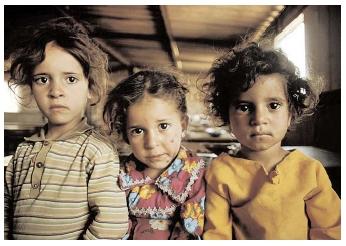
 There are few issues that provoke such a strong response among the Lebanese as the question of the Palestinian refugees’ future in Lebanon. Interestingly enough, unlike most other controversial issues, there is a remarkable degree of consensus about this one. I have met very few Lebanese who do not strongly believe that the Palestinians must never, under any circumstances, be settled permanently in Lebanon as citizens.
The reasons advanced for this view are many, and I will consider the most prominent of them below, in the hopes of generating a good discussion. But first, a few background remarks.
There are over 400,000 registered Palestinian refugees in Lebanon. The actual number is unknown, and estimates vary between 250,000 to upwards of half a million. The living conditions of these refugees — most of whom were born in Lebanon — is dismal. They have few civil rights; they are banned from working in over seventy trades; they are dependent almost entirely on the welfare of UNRWA for basic social services like education, water, food, etc. Of all the Palestinian communities in the diaspora, the Lebanese one is surely the worst off.
It seems to me that while most Lebanese are solidly against the naturalization of the Palestinians, most also believe that their conditions should be improved. The question is: how can this be achieved without risking the integration of the communities into Lebanese society, which — as people will tell you — is the thin end of the wedge.
Now, I’ve had the so-called “tawteen” (naturalization) conversation so many times that I can practically rehearse in my sleep the arguments that are commonly advanced. They break down into the following four genres:
I. The Sectarian Argument
“Lebanon’s political system, which is based upon a delicate sectarian balance, cannot handle the influx of several hundred thousand new citizens, the majority of whom are Sunni Muslims.”
I can’t tell you how many times I’ve heard this argument. It’s usually the opening gambit, particularly when listening to either a Shiite or Christian politician, whose communities will (allegedly) be politically disenfranchised by the swelling of Sunni ranks.
There are several problems with this argument, as I see it.
- First of all, it implies that the current system of political confessionalism is actually functional and worth preserving.
- Second of all, it assumes that the current system is an accurate and just reflection of demographic realities, when it is not. Given the fact that the quotas accorded to each sect in Parliament are already out of sync with the actual sectarian balance in the country (and yet, nobody is making a big deal out of this), and given the fact that (for example) there are nine thousand voters per MP in Bsharre and twenty thousand voters per MP in Sur, isn’t it intellectually dishonest to pretend that the sectarian system mirrors the sectarian reality?
- Thirdly, if Lebanon moves to abolish its system of political confessionalism, as called for in the Ta’if Accord, then why is the influx of additional Sunnis an insurmountable problem? Often enough, even the most fervent Lebanese proponents of secularism will continue to argue against naturalization on sectarian grounds. “Yes, of course I am for abolishing sectarianism. But this will take generations, and this is why we cannot naturalize the Palestinians,” is a common refrain. I find this deeply unconvincing.
II. The Socio-Economic Argument
“Lebanon is barely big enough for its own people. We don’t have room for anyone else. “
The Maronite Patriarch made a comment along these lines last week. I find this to be a very strange objection. Don’t these politicians realize that the refugees are already in Lebanon? They’re not arriving by the shipful, Moldovan-bouncer-style. They already live here. Obviously, they’re disconnected from the services of the state (such as they are), but is integration really going to cause mass shortages of kibbe nayyeh for everyone else?
This argument sounds especially disingenuous when it is advanced by people who simultaneously argue that the Palestinians’ conditions must be improved. Where do they think the improvements are going to come from? UNRWA? Obviously, they want the Lebanese state to step in and play a stronger role, but when it comes to integrating the Palestinians into that state as full legal citizens, the charity ends.
III. The Moral Argument
“We did not create the refugee problem — Israel did. Therefore, Israel should be responsible for solving it either through the right of return, or through compensation. Naturalizing the Palestinians deprives them of their right to restitution.”
This is usually the argument that people whip out to browbeat you when the previous two run aground on the shoals of common sense. In its basic outline — the idea of a right of return or compensation — it is not that problematic. But let’s say we accept its premise. What happens then?
In other words, what if we imagine a hypothetical scenario where Israel signs a peace deal with Lebanon and Syria, accepting a certain number of returning refugees and compensating the rest? Should those compensated refugees be entitled to naturalization in Lebanon?
“No!” insist the anti-tawteen crusaders, reverting back to either the sectarian or socio-economic argument. “We can’t accept them! Lebanon is too fragile! Lebanon is too small! Why can’t another Arab country take them?!”
Which brings us to the final argument, one of my favorites…
IV. The “Why-Can’t-Someone-Else-Take-Them?” Argument
“Why can’t they go to Saudi Arabia or Jordan? In a larger country, four hundred thousand new citizens would be nothing. It’s the size of a small city in Syria!”
So let me get this straight. When politicians in a certain country to the south start advocating the mass transfer of Palestinians to other Middle Eastern nations, we refer to this with terms like “the destruction of a nation,” “the persecution of a people,” etc.
But it’s ok for us to insist that these same people be uprooted again and transplanted in a foreign country, despite the fact that they’ve been living in Lebanon for three generations? Why is it acceptable for us to deport a few hundred thousand Palestinians to a specially-constructed Refugeeville, built for them in the middle of the Saudi desert, but it’s not ok for Israel to do it? (Note that I’m NOT arguing that Israel should be able to do it either.)
**
This post might anger and frustrate some readers. Please be assured that my objective is not to diminish or make light of the bitter experiences of the Lebanese Civil War; I understand where the distrust between many Lebanese and Palestinians comes from. However, I also feel that there is a poverty of rational thinking around this issue, and I’d like to see that change.
Finally, please note that this entire discussion is predicated on the idea that a peace deal is reached which provides a solution to the refugee crisis that does not involve a massive return of Palestinians to their homeland. If Israel agrees to take them back, then this discussion is moot. Furthermore, I am not advocating that the refugees be naturalized prior to a peace deal, only that their living conditions be dramatically improved.
The floor is yours…


 Qifa Nabki
The living conditions of the Palestinians in Lebanon MUST be improved, there’s no two ways about it.
However, I’m against granting them full citizenship. Whilst you’ve dismissed the sectarian angle, it does little to change the fact that Lebanon is an incredibly fragile country. As the Angry Arab put it, a country always on the brink of civil war.
I long for the day when sectarianism is thrown out the window, but it won’t be anytime soon. I oppose any move that will inflame tensions in Lebanon.
I also support, by principle, the Palestinian right to return. It’s inscribed in UN Resolutions, they have this right under international law, and it is something worth pursuing.
I’m unfamiliar with the resident status’ applicable in Lebanon, but is it possible to have a specific category that enables Palestinians to work, have access to education, health care and other Lebanese institutions without granting them citizenship?
The sticking point to all of this would be, of course, property rights. But if the Saudis can buy half of Lebanon, why can’t the Palestinians?
Posted by Antoun Issa | November 19, 2009, 5:04 pmFrom the Israeli perspective, the more the Lebanese insist they cannot live with the Palestinians, the more they are supporting the Israeli point of view.
If the Lebanese cannot live with their fellow Arab brothers in peace, it beggars belief that the Jews will be able to do so. If the Palestinians were the cause of civil strife in Lebanon, an Arab country, why wouldn’t they cause even more problems in a Jewish country, among people they really hate?
In short, Lebanon and how it treats its Palestinians is the ultimate proof that a one state solution will not work. It is the ultimate proof why Israel should never grant the Palestinians the right of return. Thank you Lebanon.
I have in the past suggested this solution. From some date, for example 1/1/2010, every Palestinian born in Lebanon will have the option to choose when he becomes 18, whether he wants to become a Lebanese citizen. This means that the Palestinians, only if they want, can become Lebanese citizens. It will take about 50 years for all Palestinians to become citizens, thus making their integration into Lebanese society quite doable as it will be done very gradually. It will also give the Palestinians hope that their children can have a better life.
Posted by AIG | November 19, 2009, 5:07 pmIf a country as well off as the US, or any country for that matter, refuses to be burdened with a massive immigration and selects qualified immigrants on an individual basis… why is Lebanon expected to be a push over country, especially given that it is under -resourced and over-populated as it is? Currently the Lebanese are being ethnically cleansed due to economic pressure, it’s their return that Lebanon needs to work towards, not passing on Lebanese resources to Palestinians. Incidentally, I support the Palestine cause, provided it doesn’t turn into an abuse of Lebanon.
Posted by halayc | November 19, 2009, 5:12 pm“Moldovan Bouncer style”. Points for slipping that one in there.
Posted by Colin | November 19, 2009, 5:12 pmThis issue is particularly important to me, since it affects my future family.
That said, I understand (without supporting) the fear of not wanting to grant citizenship to Palestinians. What I do not understand and cannot stomach is the lack of rights for Palestinians in Lebanon. Palestinians should have the rights of full residents, including the right to do whatever profession they please and own land anywhere they want. The Lebanese act like Palestinians are some kind of welfare case, when the truth is that the refugees of 1948 built much of Lebanon, including the banking sector and the media. So much like Iraqis in Jordan, the Palestinians were squeezed dry and left to rot, except the Christians who were promptly given citizenship to juke the sectarian stats.
Lebanon is definitely the worst place for Palestinian refugees, and some of the camps even rival Gaza in their misery. It is a shame and ought to be a scandal, but unfortunately, it’s about the only thing most Lebanese seem to agree on.
What angers me even more, though, is the disingenuous act from Israelis like AIG. If the Palestinians aren’t integrated and naturalized, then he gives a spiel like the one above. But if they were to be naturalized, he’d be the first to say, “look, they’re Lebanese now, not Palestinians, and as such have forfeited any claim to their former homes!” It’s very convenient how no matter what happens, it’s an argument to deny Palestinians the right of return.
Posted by sean | November 19, 2009, 5:36 pmSean,
My position is not disingenuous. Let me make myself clear. The Palestinians in Lebanon, whether naturalized or not, have forfeited any claim to their former homes. Furthermore, the only way they will return to their “homes” is literally over my dead body. Zionism is about building a Jewish state and it is a cause I am willing to sacrifice much for including giving my life. There has to be one place on earth where a Jew does not need a visa to come. I am not playing any games or trying to play tricks.
And why are you more angry at me than at your fellow Lebanese? That is a strange attitude. Israel has treated the Jewish refugees from Arab countries 100 times better than the Arabs have treated Arab refugees from Israel. You should give Israel as a shining example of what should have been done with the refugees.
Posted by AIG | November 19, 2009, 5:53 pmWhat you forgot is the important issue of “do the palestinans want to get a lebanese citizenship?”
Of course tha palestinians want to have bether living conditions and civil rights. But the palestinians in Lebanon in large (what I understood) do not want a Lebanese citizenship since that would danger the possibility for their “right to return” to their villages in what is today Israel.
Since it is not likely that Israel would allow the palestinians to return, a BIG problem would accour if a peace deal is reached wich excludes the majority of the palestinians in Lebanon the possibility to return. Is such a peace deal even possibile?
And how would the palestinians react to that? I mean there are a couple of hundred thousand refugees in Syria, how still dont hold citizenship for the (officialy) same reason. That they will return to Palestine sometime in the future.
I know there are suggestions from different sides that in a peace agreement between PA and Israel it would be included that the palestinians in Lebanon (in particular) would be allowed to settle in the EU and the US or some other rich countries. But is that likely to happen?
Posted by viktor | November 19, 2009, 6:08 pmThank you for this article.
@AIG: I don’t think the premise of your argument is accurate: “If the Lebanese cannot live with their fellow Arab brothers in peace, it beggars belief that the Jews will be able to do so. If the Palestinians were the cause of civil strife in Lebanon, an Arab country, why wouldn’t they cause even more problems in a Jewish country” — Israel exists only because Palestine has been under attack for years now! For Palestinians and Jewish people to live in peace (or not) in one country (as your argument proposes); both parties must create a just nation that welcomes both peoples equally. Right now, this is far from being a reality. We’re not telling Israel to integrate Palestinians within Israel or nationalize them, we’re telling Israel to GIVE BACK Palestine to Palestinians (at least I am; not that it would mean anything, but still). Oh and by the way, people who were forcefully pushed away from their land, their homes and their country did not forfeit any right to anything! They had to run to stay alive because of military power they could not possibly resist. That doesn’t mean they don’t deserve to be Palestinians. That doesn’t mean they don’t deserve to get their land and homes back. And that doesn’t mean what Israel did and is still doing is legitimate or even legal in any way! Ethic cleansing is something you should know about and it should disgust you. Actually it disgusts anyone with a little bit of humanity. If the Nazis in EUROPE harassed you, that doesn’t give you the right to harass Palestinians. And if the EUROPEANS THOUGHT THEY OWNED OUR COUNTRIES at the times of the colonies and THOUGHT THEY COULD JUST GIVE IT AWAY AS A GIFT TO ANYONE, needless to say they thought wrong. And finally Israel treated Jewish refugees from ANY country properly because Israel is BASED on these refugees. Without them, there would be no jews in Palestine. Or not enough at least to make a country of its own. Of course it’s going to welcome refugees. They need people to inhabit all that stolen land! Incidentally, they did not welcome any other RELIGION. Jews welcoming Jews is not a sign of kindness. Jews welcoming non-Jews is what would be outstanding.
—
That being said; we cannot possibly stay blind/quiet to the humanitarian disaster that is the Palestinian situation in Lebanon.
These are human beings.
People in other countries go through great lengths to provide help and support to people living seas away from them in times of struggle, war, natural disasters, etc. And somehow, the people of Lebanon cannot bring themselves to feel the least concerned with tragedies happening in their own nation! The Palestinians are not seas away! They’re here. Next to you. And ignoring them will not result in their disappearing.
Posted by R.A. | November 19, 2009, 6:09 pmI’m more upset at Israel than Lebanon, because Israel is guilty of the original sin. So while Lebanon has behaved shamefully, it would have never been in that position had it not been for Israel.
Also, it’s impossible to equate the treatment of the Palestinian and Jewish populations forced to leave their homes because of 1948. For one thing, Israel wanted Jews from Arab lands to come to populate areas cleansed of Palestinians, whereas neighboring states did not want to take in hundreds of thousands of Palestinian refugees. In many cases, and especially in Iraq, the Israeli government actually colluded with Arab governments in order to facilitate Jews being expelled from Arab lands and brought to Israel:
The Jewish population grew more receptive to the overtures of Mossad, which had become increasingly active in Iraq since the Golden Square took power, some agents entering the country as volunteers with the British army during the 1941 invasion. Mossad’s objective was not to improve the position of the Jews in Iraq, but to hasten their departure. Pamphlets appeared discouraging Jews from mixing with Arabs, and arguing that any attempt to do so ‘leads to butchery’.
The Israeli government circulated stories about Iraqi ‘pogroms’ and ‘concentration camps’ and denounced the hanging of seven Jews charged with Zionist activism in March 1949 – executions that Mossad’s own agents in Baghdad insisted had never occurred. Unless Iraqi Jews were allowed to emigrate, Israel warned, it would back armed resistance to al-Said’s government, or find itself unable to prevent Iraqi Jews already in Israel from killing Palestinians in revenge. The Israelis also began to promote the idea of a ‘sorting out’ of populations, involving a swap of Iraqi Jews for an equal number of Palestinian refugees, an idea quietly encouraged by the Foreign Office: ‘National exuberance is a phenomenon which is going to last a long time in the Middle East. On the whole, elimination of awkward minorities is likely to cool rather than fan the flames.’ If Israel was a sanctuary for Iraq’s Jews, it was also among the reasons they were in such desperate need of one.
Posted by sean | November 19, 2009, 6:17 pmI really do not understand. Israel wanted to absorb the Jewish refugees. Correct. Because that is the right thing to do. You help your fellow nationals. The Arabs did not want to help the Arab refugees. Shame on them.
As for Israeli collusion in Iraq, as usual it is greatly exaggerated. No one force the Iraqis to fire all Jewish government employees and make constant threats against the Jews.
The Jews are a small minority and without a state were mostly powerless. They were given one option by the powers of the era. If you don’t like that, go complain to the powers, not to the Jews. The right of the Jews to have ONE place in the world where they do not need a visa to go, over rides any Arab rights to Palestine. The Arabs should have accepted the partition plan. They chose war and have to pay the price.
Posted by AIG | November 19, 2009, 6:30 pmAh, Lebanon – the Switzerland of the Middle East, home of 18 different religions, so tolerant – except when it comes to Palestinians, Jews, Saudis, Syrians, Gulfies, Maghrebis, Ethiopians, Phillipinos, Madagascarians, Indians, Americans, Somalis, etc.
Always the victim, never the bride…
Reminds me of what happened at Nahr el Bared, when sad living conditions allowed Fatah al-Islam to flourish. Remember that? That’s what’s going to keep happening if Lebanese continue to keep Palestinians in concentration camps.
The funny thing is that over the course of pretty much the existence of humanity, the races have become so mixed – especially in Levant/Tranjordan area – that the fact Lebanese think they are that much different than Palestinians is laughable.
The other funny thing is that Lebanese and Israelis are on the same side.
Posted by Vic Tim | November 19, 2009, 6:41 pm@AIG; First of all the Arab world is made of various INDEPENDENT countries, two of them being Lebanon & Palestine. So Palestinians are not “fellow nationals” to Lebanese. Otherwise the whole “nationalization” issue would not even be in question!! So get your facts straight, then propose an argument.
Secondly, in your last comment there are so many atrocities and justifications of despicable behavior on the part of all the nations that thought because they were military powerful they had the right to play God, I don’t even know if it’s worth replying! Your attitude and spirits most certainly show why we are still where we are in the region. Defend occupation just because well, the “powers” did it. Who cares? They had NO RIGHT. And that is why Israel is also paying the price of what these powerful nations did.
They forced a country on an already existing nation.
They caused humanitarian tragedies and the biggest exodus in history (not to mention the ongoing genocide).
Only one reaction is expected: resistance.
Which means that as long as this tragic mistake is not repaired; as long as the people have not returned to their homes; as long as justice is not in place there will be resistance: i.e. Israel will continue to pay the price of this decision made by the “powers” you so proudly talk of.
Being powerful does not justify being a criminal.
No forced, illegal, illegitimate and murderous occupation lasts forever. Even the biggest empires have fallen in the face of smaller resistance.
One day, the Palestinians will get their land back. Not because they are “powers” but because they are honest, honorable and most importantly, they are right.
Sometimes history takes its time. No big deal. We can be patient and in the meantime, Israel can keep on paying the price of their gift (and thank the “powers”).
Posted by R.A. | November 19, 2009, 6:52 pmGranting the Palestinian refugees in Lebanon their inherent rights is arguably the single most pressing issue that the country faces next to eliminating political sectarianism.
Like many others I have spoken, written and participated in many a panel discussion regarding this seminal issue. My latest post on this subject was on July 3 , 2009
http://rationalrepublic.blogspot.com/2009/07/fate-of-palestinian-refugees-in-lebanon.html
Although I was tempted to reproduce my post I decided not to abuse either the hospitality or make excessive use of the “real estate”. Those who are interested may log on to the above URL.
Posted by Ghassan Karam | November 19, 2009, 6:58 pmR.A,
In 1948 the Arabs living in Palestine viewed themselves first and foremost as Arabs and belonging to Greater Syria. Their Palestinian identity was established much later. For example, between 48 and 67 not one so called Palestinian demanded a state in Gaza or the West Bank even though these were controlled by Egypt and Jordan respectively.
My parents were born in Israel and so was I. I have more right to Israel than a Palestinian born in Lebanon. In fact, he has no rights. You want to turn back history. Good luck with that. Long before the Palestinians in Lebanon have ant chance to return to Israel they will cause civil war in Lebanon. So if you want to play a waiting game, that is fine with us. Let’s wait until Israel crumbles. And by the way, being weak does not mean you are right. The Arabs thought they were strong in 48 and that is why they chose war. They lost, and in my book it is quite fair when you suffer because of a war you started. If you start a war, make sure you can win it.
Posted by AIG | November 19, 2009, 7:08 pmQN,
Great invoking article, as always. A few questions if I may:
1) Over all these years, how DID the Lebanese see the likely resolution to the growing refugee problem in Lebanon? Did anyone really think Israel would one day take back 400,000-500,000 Palestinians (from Lebanon alone)?
2) How do the Sunnis in Lebanon view the Palestinian refugees? If I understand correctly, the refugees represent approximately 10-12% of the population of Lebanon. Could such a huge number really not “be counted”? You mentioned the typical arguments by Christians and Shia. What about the Sunnis?
3) We’ve often heard the argument that “If Israel only withdraws from Lebanese land, Hezbollah will have to disarm…” But what is the organization’s view on the refugees’ role in Lebanon? Does it also not “count them”? Is it going to fight for their liberation only out of Lebanon, not inside it? Has anyone brought up this issue inside Lebanon?
Posted by Shai | November 19, 2009, 7:11 pmFate of Palestinian Refugees in Lebanon: Revisited
by Ghassan Karam
Whenever parties that represent opposing points of view , concerning practically all matters, agree on an issue by taking even a united stand then it should be obvious that something is amiss. The Lebanese political scene is represented by all sorts of ideologies, homegrown, imported, extreme right and extreme left but yet time and again all of these discordant voices sing in harmony the tune that the over 400,000 Palestinian refugees living in Lebanon should not be given the chance to become Lebanese citizens but must be kept as aliens that eek an existence in camps that lack access to modern school, job opportunities, social safety network, decent infrastructure or even recourse to law enforcement. The residents of these camps are discriminated against in practically every single sphere only because they are Palestinians.
So why do the Lebanese politicians of all stripes insist on the continued dehumanization of these unlucky Palestinian refugees? It cannot be the fear of a cultural clash since the Palestinians and the Lebanese are practically indistinguishable and it cannot be the concern of the fiscal burden associated with assimilation since most studies conducted in various countries all over the world have demonstrated that new immigrants usually more than pay for their share of the fiscal cost because of the additional jobs and economic growth that they create. So if there is no basis for an economic argument neither is there a rationale for a cultural argument why do the Lebanese parties act united in their opposition to absorbing the Palestinian refugees? The common response by all sides is that these bigoted policies are adopted because they are good for the Palestinians. Yes you heard it right. Depriving people of their rights and forcing them to live in sub human conditions is good for them, it builds character and keeps them yearning for their fatherland. This is as good as arguing that slavery was good for the slaves since they did not have to worry about their next meal. What a crock.
How come no one used this argument when the Armenians came to Lebanon and why is it that most of the Christian Palestinians have been absorbed into the Lebanese society not only without creating a meaningful fiscal burden but by playing an essential role in the economic growth and prosperity of Lebanon in all fields? The answer is clear. The only reason for insisting on the continuation of policies that deprive the Palestinians of their inherent rights is political. The real reason that the Phalange in addition to the Lebanese Forces and the Aounists oppose the integration of the Palestinian refugees is sectarian. They are very concerned that the demographic position of the Lebanese Christian who barley account for 40% of the population but are granted 50% of the parliamentary seats would become untenable. As soon as the youthful Palestinian refugees are given Lebanese citizenship then the Christians would become 35% of the population which will then highlight the absurdity of their insisting on 50% of the parliamentary seats. This absurdity should remind us of the Orwellian dictum that “we are all equal but some are more equal than others”. The Lebanese progressive parties on the other hand, led by Hezbollah, cannot bear to loose the only cause that justifies their presence. Take away from these parties the need to “resist” on behalf of the disinherited and you would have taken away their whole reason to exist. The progressives would not look favourably on any attempt to take away their power to use the Palestinian refugees as pawns in justifying their “resistance”.
What makes both of these selfish positions powerful is that each of them is based on half truths. A sectarian society would not welcome policies that will throw its sectarian balance out of whack and the “Pan Arab resistance” parties cannot surrender an issue that is essential for their existence.
Fortunately there is a solution that will benefit all sides. (1)The adoption of a secular electoral system will dispense of this divisive sectarian tribal system once and for all. This can actually be a boon to all by enabling true citizenship to emerge. (2) The act of transforming the deplorable conditions in the camps will rob the “resistance” parties of their military option which has been ineffective anyway but should help them move into the potentially more productive realm of promoting civil disobedience policies. And obviously every single Palestinian will gain more self respect and a greater opportunity to fulfill their human potential.
Posted by Qifa Nabki | November 19, 2009, 7:25 pmI’m willing to quit my job and make sure that Palestinians will never be naturalized in Lebanon. For the sake of Lebanse and the Palestinians.
Posted by Joe | November 19, 2009, 7:51 pmHow about if we concentrate on the real problem and not turn it into a tit for tat with close minded so-called Israelis or Zionists who for one reason or another tend to blame everyone except themselves for their alienation from the rest of mankind and always seek to offload their ills on other societies? Besides, unfortunately, it has been proven time and again that Zionists are the most argumentative among the human species and often with no real substance behind their arguments. Most often the aim would be to distract from the real issue.
This is obviously a Lebanese problem concerning Lebanon and its future and the Lebanese must provide a Lebanese solution. It is obvious from the above that you cannot expect a viable solution from an Israeli or a Zionist. He simply cannot be objective either due to innate undeclared guilt, lack of human understanding, intoxication with power or all of the above. In fact a Lebanese should not expect such a solution should emanate from such quarters – at least according to the contributions provided from them already.
I can see some proposed solutions already, mostly revolving around so-called resistance and right of return. In other words the Lebanese are opposed to integrating the Palestinians. So, the obvious answer here would be to allow these ‘sub-human’ Palestinians to be active in the resistance project. From what I understand resistance has become the sole monopoly of Hezb. Would Hezb be interested in relinquishing this monopoly and allow the Palestinians to form their own resistance in order to reclaim their rights with their own hands provided guarantees are given that the Palestinians will not engage in petty Lebanese conflicts? As QN and many have remarked, the Palestinians are already IN Lebanon and already armed and trained. In my opinion providing them with human rights only is not sufficient because they would still be looked at as second class while contributing to Lebanon in a manner that someone remarked outpaced the contribution of the Lebanese themselves since 1948. Besides, giving them all the rights without citizenship would only mean their gradual and eventual integration undermining the sacred right of return.
So either integrate them fully or give them the right to go and fight for their land. If there is going to be in Lebanon a legitimate Lebanese Resistance (i.e. Hezb), let there be a Palestinian Resistance in Lebanon as well. The best human right these ‘sub-humans’ would get would be the ability to feel they are on their way to reclaiming their former homes.
Posted by mike | November 19, 2009, 7:52 pmAIG. I am glad that you pointed out that Israel has been so gracious to Jewish refugees from Arab Lands. Could the only democracy in the middle east work on giving 20% of its population (arab israeli’s) those same rights it afforded to those refugees.
Vic Tim… perhaps we should should take a drive in the southern suburbs, south lebanon, akaar, or the bekaa and see how some Lebanese citizens are doing. Sure they don’t have lebanese army checkpoints surrounding their towns. Poor is poor, poverty is poverty, it does not discriminate between Lebanese or Palestinians as far as I am concerned.
Sure let’s give Palestinians rights in Lebanon, but what are rights without justice?
Tawteen? Come on… Lebanon is a crack whore mother with 18 babies from 18 different daddy’s, and its only aim is feeding that crack addiction (interest payments on its debt and corruption). Luckily we have the Saudi’s who just might be willing to add our crack mommy to their harem and and pay off mommy’s drug debts!
I have heard about the Palestinians going to Israel, EU, USA… Here is a thought how about they become automatic citizens of the future state of Palestine.
It is clear Israel does not want peace nor do I believe that there will be peace in my lifetime because Israel needs to change the facts on the ground, and it will wait another 60 years to do so.
Please Arab Israeli’s make a lot of babies and change the realities of Israel from within!
sorry for my rant and any vulgar terms that may have offended anyone
Posted by Tamer K. | November 19, 2009, 7:58 pmAn excellent, thoughtful blog post (and, for that matter, most of the comments too). Then again, it’s an issue that’s especially close to my heart.
Leaving aside the issue of the right of return and the contours of any future deal (and, in all seriousness, none of the permanent status negotiations have really assumed the return of refugees en masse to Israel), I would love to see some of the discussion turned to what can be done to significantly improve the situation of Palestinians in Lebanon now (short of naturalization). There was significant improvement in Lebanese policy under the Siniora government–can that (often glacially slow) reform be continued? If so, how? What ought to be the priorities?
Posted by Rex Brynen | November 19, 2009, 8:02 pmMike,
If I was a Hizb I wouldn’t want to give the Palestinian’s the right to resist from my land. Last time I checked it was 1 of the many reasons Israel decided to occupy the Hezb homeland of the south for 22 years. Its not easy for me to give the Hizb credit, but comparitively speaking I think they did a better job with the resistance thing, and other things for that matter.
Posted by Tamer K. | November 19, 2009, 8:08 pmTsk tsk tsk … the democratic but small countries by the Mediterranean that used to be part of Greater Syria (Thanks AIG for reminding us) are not very hospitable it seems.
Let me start with my usual Syrian propaganda intro.
It was probably because Syria used to be “Greater Syria” that we were fortunate enough to count on the almost automatic acceptance by the Syrian people and successive leaderships of:
-over 100,000 Armenian refugees in 1915
– over a million Turkish Kurdish refugees from 1960 until 2000
– hundreds of thousands of Lebanese refugees during the civil war, and then again during the recent Israeli invasion in 2006
– 400,000 (est) Palestinian refugees from 1948 and 1967
– Up to 2,000,000 (now 1.2 mil) Iraqi refugees.
Compare that to Israel (we are not taking back the Palestinians …”over my dead body”) .. Lebanon (Our economy/system can not handle the Palestinians), Jordanians (Palestinians who used to live in the West Bank are ok because they were Jordanian citizens up to 1967, but the 1948 ones live in refugee camps) … Saudi Arabia (We USED TO need them in the 60’s and 70’s, now we don’t … they are not welcome anymore), Kuwait (you supported Saddam? … we will never forgive you) …
Syria took 48 and 67 Palestinian refugees, gave them almost full rights (except citizenship), there are even some Palestinian generals in the Syrian army. Syria took Christian and Muslim refugees (not only Muslims) .. Syria took Arabs, Armenians and Kurds … not only Arabs
And not only Syrians …
And not only when it could handle it … summer of 2007 Syria had an unusually hot weather which, in additin to the 2 million (at the time) Iraqi refugees, forced all Syrians to spend few hours each hot summer day without airconditioning … electricity supply was not enough to handle the heat and the overnight 10% increase in Syria’s population.
Syria has, by far, the world’s largest per capita number of refugees.
Elias, this was yet another excellent post. And I agree with Rex, most comments were quite interesting to read too, including AIG’s.
The obvious conclusion to me out of this discussion so far is that .. there is no easy way to justify the continuation of the way the Middle East is split today. You can not fight for “your people” against your cousins without steering far from common sense.
Our biggest problems in the region are the two fortresses .. Israel (Jewish fortress) and Saudi Arabia (Sunni fortress).
Salvation will come at the hands of Turkey/Syria/Qatar type of leaderships
Posted by Alex | November 19, 2009, 8:57 pm** NOTE TO ALL COMMENTERS **
Thanks for the great conversation so far. I’ll try to chime in at some point.
In the meantime, if you are a first-time commenter, your comments will go to moderation and will not appear immediately. I will keep releasing new comments as quickly as I can, but I’m trying not to stay glued to the computer, so there may be occasional delays.
Cheers,
Elias/QN
Posted by Qifa Nabki | November 19, 2009, 9:12 pmThere is a simple solution. Let them have a Palestinian Citizenship (after all the PA does issue passports) and they will become like all the foreigners legally established in Lebanon, with legal rights and duties i.e paying taxes and able to work.
Posted by Battal Agha | November 19, 2009, 9:32 pm“If I was a Hizb I wouldn’t want to give the Palestinian’s the right to resist from my land.”
Thanks for the response Tamer. If you’ve been following this blog for quite sometime, you would understand right away that what I’m really saying there should be NO resistance from Lebanon whatsoever, neither by Hezb and nor any other paramilitary groups. I am actually for full Lebanese control by the army over all of Lebanon. I was just using the argument against Hezb which claims more than it can deliver in relation to so-called sacred causes of right of return, Palestine, etc…
But thanks for allowing me to add this clarification.
Posted by mike | November 19, 2009, 9:53 pmThe biggest problems in the middle east are lack of liberal democracy and lack of economic growth. If the Palestinians in Lebanon were living like their kin in America they would not be a problem to anybody. And in spite of all your bitching about them, the Israeli Arabs are the least militant and “angry” of all Palestinians because they have been able to reap huge benefits from Israel’s economic miracle and they have more political rights than all their Arab brethren anywhere.
Let us not forget that it was not Syria that agreed to accept refugees. It was Asad. The Syrians were told they had to make sacrifices. No one asked them if they wanted to.
The problem in the middle east is not how the nations are split, it is how the nations are governed. The problem in the middle east is that people are concerned about how to share a diminishing pie instead of how to make it bigger.
In a well governed country, immigration is a huge help to the country. Israel is a great example of that. The Palestinians can be a huge help for Lebanon if you guys start to think constructively instead of viewing everything as a zero sum game. A Palestinian getting a job is not taking a job from a Lebanese, he is creating jobs for 3 other Lebanese because now he can consume and spend. This is the frame of mind that will bring real change to the middle east. It is the frame of mind that has made Israel successful.
By the way, I highly recommend the new book Startup Nation.
http://www.amazon.com/Start-up-Nation-Israels-Economic-Miracle/dp/044654146X/ref=sr_1_1?ie=UTF8&s=books&qid=1258683394&sr=8-1
It will help you understand Israel.
Posted by AIG | November 19, 2009, 10:19 pmAIG and other imported jews (in Palestine) on this forum. You are bunch of imported Russian/European Jews residing on stolen, ethnically cleansed lands. Although I consider myself a none violent person, a pacifist for all intents and purposes, I tell you other imported Jews: “Hello. My name is Inigo Montoya. You killed my father. Prepare to die.”
Posted by sl | November 19, 2009, 10:34 pmI think we Lebanese should thank you AIG for giving us the potential to create 1.2 million jobs in Lebanon while depriving Israel of this benefit!!!
How thoughtful…?
And generous?
Posted by mike | November 19, 2009, 10:41 pmsl said:
You are bunch of imported Russian/European Jews residing on stolen, ethnically cleansed lands.
That may have been the case when Israel was first established. But because Israel is now over 60 years old, about 70% of Israeli Jews are Sabras (born in Israel).
http://en.wikipedia.org/wiki/Demographics_of_Israel
Posted by Akbar Palace | November 19, 2009, 10:52 pmAlex , well said ,
Elias ,
That is interesting , i agree with many of you , most people do not care about voting or getting elected , only politicians do , people care about having good jobs , schools for their children an ability to have a house , owned or rented and a future for their children , all this can happen without giving the Palestinians the right to vote , as Alex said above and from my experience , it looks like we import people from the philippine , Indonesia , and other places but complain about unemployment and lack of opportunity for our people , employing foreigners is a drain to our resources as these people send their money back to their countries instead of spending in our states , it is time to employ our people Palestinians , Syrians and others .
I have a cynical question for all of you ,
Is it possible that putting Lebanon in debt for up to 40 billion dollars was a plan to enslave Lebanon and push it into participating in solving the Palestinian refugee problem ,
I mean the West will forgive the debt and give more for the giving the Palestinians Lebanese citizenship.
Would Lebanon accept , I know WD will not .
Posted by norman | November 19, 2009, 10:56 pmAlex states:
Elias, this was yet another excellent post. And I agree with Rex, most comments were quite interesting to read too, including AIG’s.
Alex,
Having a good opposing point-of-view increases “customer readership”, or haven’t you noticed?:)
Posted by Akbar Palace | November 19, 2009, 10:58 pmMike 28 Aid 26
Mike, I have been doing some rather serious research on immigration for over a year and the gist of the statement by AIG is accurate. Most studies have shown rather conclusively that immigration on balance is beneficial to the redepient country. I must admit that the benefits are not huge but then it is not a burden to society at large. The segment of society that benefits the most are the owners of the means of production while the ones who pay the price for immigration are the poor, since they are the ones that are most in competition with the low skilled immigrants. My point is that on purely economic grounds Lebanon will not be burdened if the Palestinians are “liberated”. On the contrary besides the expected benefit from the additional demand for goods and services Lebanon can initially expect some windfall from wealthy Arab countries that would help fund this effort. Economics is not a valid excuse in this case.
Posted by ghassan karam | November 19, 2009, 11:03 pmQN,
My last two “private” e mails to you have bounced back. I just wanted to say tnx for posting my comments . You did not have to do that.
Posted by ghassan karam | November 19, 2009, 11:07 pmThanks QN for the thread. Somehow I had the feeling that it would evoke lots of charged emotions from all sides. But that is ok and healthy as long as all the posters make an effort to keep it civil.
Now to your questions. My recommendations would be as follows:
1. Give the Palestinian refugees all the rights except the right to vote as not to rock the sectarians’ boat. This can only enhance the GDP of Lebanon and its security. Plus it is the right and humane thing to do. All will be better off with it including the rejectionists.
2. Lebanon should continue to pursue its current policy of not recognizing Israel unless in the course of negotiations (if any materialize that is) Israel steps up to its obligations on this issue in ways that Lebanon and the Palestinians would be satisfied with. Basically, no recognition unless they make amend to their past wrongs.
Posted by Ras Beirut | November 19, 2009, 11:08 pmMike,
Since we benefited so much for the Jewish Arabs that immigrated to Israel, it is only fair that we let Lebanon benefit from the Palestinians.
SL,
I have been preparing to die since I was born. As for stopping premature death, that is what the IDF is for and why I served there many years. In which army did you serve or are you talking trash? And thanks for demonstrating what it means to be a pacifist Arab. Apparently it means you can kill only Jews. Why am I not surprised? It kind of reminds me of the cannibal tribe that converted and became Christians. Now on Friday they only eat fishermen.
Posted by AIG | November 19, 2009, 11:13 pmNorman,
I have just noticed your filast comment and feel compelled to correct what appears a misconception. Most of the Lebanese debt is domestically owned and that is why Lebanon does not rank high on the list of countries that have a high proportion of external national debt.
Before you jump to conclusions let me immediately say that I am not condoning the debt but I am simply making an objective certifiable statement that most of the $40 billion that you refer to is NOT owned by foreign institutions.
Posted by ghassan karam | November 19, 2009, 11:14 pmBasically, no recognition unless they make amend to their past wrongs.
Ras Beirut,
What past wrongs does Israel have to amend until you would recognize Israel?
Posted by Akbar Palace | November 19, 2009, 11:17 pmAP,
1.Agreeing to the Balfour declaration
2.Being forced to leave Europe and the Arab countries.
3.Setting up a viable and democratic Jewish majority state
4.Defending ourselves against the Arabs
5.Not knowing our place
6.Winning wars the Arabs started
7.In short we need to amend for all the Arab’s failures which are of course our fault.
It will take a long time to amend all items on the list above. Shall we start?
Posted by AIG | November 19, 2009, 11:25 pmAIG,
Yes, a long time. But we’ve only scratched the surface.
I believe the prudent thing for us to do is contact Shai on the other peace site, Syria Comment, and get his unabridged list. We don’t want to miss anything.;)
Posted by Akbar Palace | November 20, 2009, 12:03 amAIG said
“Let us not forget that it was not Syria that agreed to accept refugees. It was Asad. The Syrians were told they had to make sacrifices. No one asked them if they wanted to.”
hmm … that’s why I said “people and leaderships” …. Assad did not accept the 100,000 Armenians running away from the 1915 genocide to the north or Syria for example. Assad did not accept the 1948 Palestinian refugees.
And in 2006 when Israelis were enjoying watching TV reports showing their marvelous F16s destroying Lebanese apartment buildings, many of my Syrian friends in Montreal were making calls to their relatives in Damascus asking them to open the apartments they own there (only used by them for a 3-week ammual vacation in Syria usually) to the Lebanese refugees that flooded Damascus. Assad did not tell those very rich Canadians from Syrian origin to open their luxury homes in Damascus to the random Lebanese who would be the occupant .. for an unknown period of time.
While most Syrians supported their leadership’s decision to host the Iraqis, some Syrians complain that the 10% overnight boost in population was too much to handle. Ghassan Karam’s point about immigration helping boost the economy of the host country is a bit different from this extreme case … imagine if the US accepted 30 million Iraqi refugees (instead of the 5000 it accepted) … gave them all medical insurance, and free education … and job permits …
Posted by Alex | November 20, 2009, 12:42 amAlex,
When there is freedom of speech in Syria, maybe in 30 years or so, we will know what Syrians think. Anecdotal evidence of a few rich ex-Syrians living in Canada does not cut it.
Syria cannot cope with internal refugees due to the drought. The government is not taking care of them and cannot provide them neither housing nor jobs. It is asking the UN and international community for help. How irresponsible is it of the government to accept so many Iraqi refugees in this situation? It only makes things worse. If there were democracy in Syria, the government would have lost by a landslide for this irresponsible behavior.
Posted by AIG | November 20, 2009, 12:57 amGhassan,
Before we get swamped by Jewish rants let’s get back to the main topic, and hopefully QN will find a way to limit their distractions from a topic which is of great importance to Lebanese in particular.
Wallahi ya Istez Ghassan, I fully understand the benefits of immigration. As you may have learnt from my comment 18, I’m actually for the full integration of the Palestinians into Lebanon not just giving them so-called human rights which by the mere granting of such rights a second class status is implied. When a person contributes to a country, it is only fair that he/she should become full participant in all rights and duties including voting and running for office.
The case of the Palestinian refugees is not a simple case of immigration. The refugees are a case of forced mass exodus. To pretend that we need to learn the benefit of immigration from a person like AIG is a big insult to human intelligence as well as a huge disgrace to its dignity.
Countries choose their immigrants. Immigrants don’t get forced on countries. A country which normally receives immigrants such as US, Canada and others has the right to deport any immigrant back to the country of origin. Based on this universal practice, Lebanon has the same right to deport the Palestinians that were forced upon it by the invading Zionists. Yet, Lebanon has not yet exercised such right on the huge mass of refugees that were forced upon it. If Lebanon were to exercise such right and has the means to enforce it, then these refugees should go back to their original homes in Palestine.
Notice that I haven’t even touched yet on the so-called right of return and injustices inflicted on these people by the likes of AIG. This is purely based on Lebanese jurisdictions and international practices and legalities.
Thanks for pointing out to Norman the issue about the national debt. It looks like they have been eavesdropping on our discussions of last week and rehashing it over in another forum. But I would have preferred if you had taken the time to point out to him his false conceptions about elections and democratic governance. We certainly are not interested in Lebanon in such rule as the despotic, authoritarian and police regime as they have in Syria. Despite the many ills of our zuama, we still like them because they are elected by us and we feel that we have a say in who should be ruling us unlike them in Syria who can be ruled like sheep by a dictator son of a dictator who represents less than 5% of the population. I think we can handle our debt without any advice from despotically infected opinions. Don’t you think?
Posted by mike | November 20, 2009, 1:09 amAkbar, you want a reminder why AIG is not on SC anymore? … he starts with a reasonable argument, then when challenged he comes back with things like this one:
Alex,
When there is freedom of speech in Syria, maybe in 30 years or so, we will know what Syrians think. Anecdotal evidence of a few rich ex-Syrians living in Canada does not cut it.
Won’t cut it? .. who asked you to authenticate anything?
Let me help you though: 225,000 Lebanese refugees of one of your latest attacks on civilian population in the neighborhood (Lebanon 2006) did find place in Syria to sleep for weeks. If the population of Damascus did not open its homes, Syria’s hotels (already full for the July tourists) would not have been able to host a tiny fraction.
Posted by Alex | November 20, 2009, 1:38 amAnd “How irresponsible is it of the government to accept so many Iraqi refugees in this situation? It only makes things worse.”
Hmm .. maybe Syria should learn from Israel how to start frequent and unnecessary wars that generate hundreds of thousands of refugees instead of saving their lives.
1.2 million Iraqis remain is Syria few years after they entered the country … their children are going to Syrian schools and speak Damascene accent by now.
While your ex ally Turkey dropped you, Syria is Turkey’s closest new friend … we don’t need lessons from you on how to deal with our neighbors .. we are doing fine. Your fortress/country is not.
Posted by Alex | November 20, 2009, 3:05 amExactly. And let’s be honest – the Palestinian leadership has basically made the wrong choices at the wrong times. Had they been half as smart as Ben-Gurion in ’48, they would have realized that even in the execrable Partition, they would have dominated one state, and made up a near-majority in the other. One generation later, and they’d have a majority in both – and could have pushed for re-unification.
But no, they under-estimated the Zionists, as they have pretty much throughout the past 60 years.
As for the “we will eventually win” argument,why don’t you ask the native Americans of the United States in particular and Latin America in general? They’re a tiny minority with a handful of reservations in the former, and the bottom of a social hierarchy throughout most of the latter – well over a century after the fact.
Posted by Brett | November 20, 2009, 4:05 amWhy don’t you ask the crusaders who also built the most impressive fortresses in the same region you are in now, but few decades later they lost.
Why don’t you realize from the Lebanon 2006 and Gaza 2008 wars that Israel started that even with the Bush Cheney administration which was Israel’s closest ally ever, your enemies were not defeated … they are still the main players today after being subjected to Israeli war crimes.
Israel can agree to the Arab peace pan and live happily next to the Arabs… why don`t you stop being greedy and give the Arabs back 20% of Palestine that you took so that they can have a proper state and leave you to enjoy the other 80%
Posted by Alex | November 20, 2009, 4:30 amGreat article! We have had this issue in Northern Ireland for hundreds of years. We have always taken the view, and will continue to take the view, that you should be afforded the rights of citizenship of the country in which you are born, regardless of the circumstances of why you were born there. If you are born and live your whole life in Lebanon, then you are Lebanese, even if others call you Palestinian, or even if you yourself call yourself Palestinian. If you are born and live your whole life in Ireland then you are Irish, even if you think yourself (as many do in Northern Ireland) to be British, and if you are born and live your whole life in Bosnia, then you are Bosnian, even if you think yourself to be Serb or Croat. This should be such a fundamental cornerstone of international human rights and citizenship law and it beggars belief that people, in the 21st century, argue against it. Curiously enough, this is the position of many Lebanese in Liberia, who are denied citizenship of the country of their birth due to Liberia’s racist citizenship law. “We are born here, that should entitle us to Liberian citizenship.” Shouldnt the same principle apply to the “Palestinians” born in Lebanon? And why should affording citizenship to all people born on the territory of Lebanon affect any eventual return to homes taken from people ethnically cleansed in 1948? There is a concept called “dual citizenship,” the Israelis know all about it. Forcing Israel to eventually accept the rightful return of those it expelled in 1948 should not in any way be linked to the argument “but they have somewhere else to live now!” Jews have lots of countries to live in, completely without persecution. But Israel recognises dual citizenship for Jews, and should do the same for its citizens (and eventual citizens) that maintain dual citizenship with other countries.
Posted by Joseph McGann | November 20, 2009, 4:40 amQN, nice post & an interesting discussion; very much worth the wait. I particularly enjoyed the comments made by RA (8, 12), Tamer (21), & Ras Beirut (34).
Alex, thanks for the insights; did not know that the number of incoming Iraqis to Syria has approached that range; i.e. ~10% of the resident population!
Ghassan (32):
“The segment of society that benefits the most are the owners of the means of production while the ones who pay the price for immigration are the poor, since they are the ones that are most in competition with the low skilled immigrants. My point is that on purely economic grounds Lebanon will not be burdened if the Palestinians are “liberated”.”
According to your assessment, the “poor” among the people base in Lebanon are the ones that get affected, so “on economic grounds Lebanon won’t be burdened”.
My understanding is that the poverty rate in Lebanon is quite high and that in some areas it exceeds 55-60% (maybe you have more accurate estimates). What about them? Aren’t these people usually factored into the economic burden scale or aren’t they factored in Lebanon? Please, elaborate more since I may have misundestood your statements.
As many of the commentators mentioned above, the socio-economic status of the Palestinians residing in the 12 refugee camps in Lebanon is by no means acceptable. Likewise, the sad socio-economic state of a significant chunk of the Lebanese population should not be acceptable. For any skeptical, I’d like to invite you to take a quick tour in Akkar for instance which is the Caza am originally from. It won’t take you much time before you find many villages and towns that are not much better off than the camps.
Hopefully, steps will be taken in the not-so-far future to improve the “economic” situation for all residents in Lebanon (citizens and otherwise).
Inshallah, not only the Palestinians get “liberated” from the “prison-like camps” Ghassan, but that the land of Palestine gets “liberated” as well. As RA (12) said, “Sometimes history takes its time.”
Best.
Posted by PN | November 20, 2009, 4:52 amMik2 #42,
You said:
“Countries choose their immigrants. Immigrants don’t get forced on countries. A country which normally receives immigrants such as US, Canada and others has the right to deport any immigrant back to the country of origin. Based on this universal practice, Lebanon has the same right to deport the Palestinians that were forced upon it by the invading Zionists.”
I never considered the Palestinian refugees in Lebanon as only a case of immigration. I was only responding to a statement made by AIG and your response to it. But it is not true that countries choose their immigrants. Well as you already know both North America and the EU have a major problem with undocumented/illegal immigration. Estimates vary since no good count of the number of undocumented exists but many believe that the US has upward of 12 million such immigrants.
Back to the Palestinian refugees in Lebanon. Yes it would be helpful to understand the historical factor that has forced people to seek refuge but we should never use the historical reason as a pretext for inaction. The world has over 12 million stateless person and many countries , some poorer and as densely populated as Lebanon, have taken measures to protect the rights of these stateless people. The only prism through which the Palestinian refugees in Lebanon should be viewed is that of human rights. Deportation , and in particular after 60 years, would be criminal. Even if the right of return is to eventually be recognized in some form the potential outcome will probably not change the “facts on the ground” that much.
It is highly unlikely that Israel will take back the Palestinian refugeesfrom the camps. I can see a possibility of monetary compensation, offer of resettlement for some in the West Bank or even a token gesture of allowing a few of the surviving 1948 refugees to go back into Israel. But to bet on all or some of the above as taking place in the near future in order to resolve the current Palestinian refugee problem in Lebanon is foolhardy. Even if all the above options are offered then the current refugees might choose not to depart from a place that they have grown to call home.
Let me mention the way that we have dealt with the Armenian refugees and some of the Palestinian one more time. By naturalizing the Armenians and many of the Christian Palestinian refugees Lebanon has done the right thing. That hugely successful model of integration should be followed inthe current case. The refugee camps are a blight that has to be eradicated totally and the Palestinians themselves should have a great say in determining their final status. They might wish to be considered as Palestinians living in Lebanon, they might choose to integrate or they might choose to leave the country. What they choose to do is their individual rights, Lebanon has no choice but to do the right thing by at least easing the transition into naturalization over a period of time, say ten-15 years whereby annual eligibility is chosen randomly.
And finally let me suggest that it would be especially helpful to view this issue and its potential remedy as similar to Pascals wager: Which is better (1) Integrate and then find out that there is a solution to the Palestinian Israeli problem or (2) Keep the camps as is and learn that there is no solution to the Palestinian Israeli problem. As we all well know this is a no brainer.
Posted by ghassan karam | November 20, 2009, 8:06 amTo pretend that we need to learn the benefit of immigration from a person like AIG is a big insult to human intelligence as well as a huge disgrace to its dignity.
Mike,
If you took the time to drop the bravado and the anti-Jewish comments, you would see that AIG is spot on. He doesn’t have to render an opinion on Lebanese naturalization. It isn’t his nation’s problem. The Zionist Entity has done a fairly good job of integrating Jewish cultures from across the globe, including a million Russians.
Why don’t you ask the crusaders who also built the most impressive fortresses in the same region you are in now, but few decades later they lost.
Alex,
I would have expected a better response than that from you. Resurrecting Arab victories from 500 years ago is a bit of a stretch at this point. More importantly, the crusaders had their faimlies and motherlands to return to. Israelis have no other option.
Brett,
Honesty is something we rarely get here, and especially on the Syria Comrade. Most participants are too busy beating their chests. Thanks!
Akbar, you want a reminder why AIG is not on SC anymore? … he starts with a reasonable argument, then when challenged he comes back with things like this one
Alex,
It is human nature to shun things we don’t like to hear. So either we participate on websites where everyone is in agreement, or we can learn from each other. I prefer the latter. Who knows, by listening to opposing points-of-view, perhaps it will strengthen your convictions.
In any case, AIG makes extremely good points, he cuts right into the issue, and, worst of all, he offers no apologies.
Personally, I think Syria has sacrificed a lot for the Palestinian cause, and I know how important that is. But, more recently, however, now it’s beginning to look like the “Assad Cause”. Israel is ready to give up the Golan for real peace, isn’t that in Syria’s interest? What about the reform that Syrians NEED? Doesn’t JAD’s words reflect that? How does Iran’s influence benefit Syria more than the EU and the West, especially when Syria needs help?
Anyway, I think it’s time to walk away from this bullshit and modernize.
Posted by Akbar Palace | November 20, 2009, 8:17 amInteresting post no doubt, and some viable solutions…on paper.
Placing the human misery of Palestinians -as atrocious and hideous as it is, and it is- at Lebanon’s doorstep ignores fundamentally legitimate humane and political rights denied the Palestinian mass at large by virtue of their displacement from their homelands. It further accepts a de facto situation, and provides legitimacy to forceful occupation and displacement of indigenous populations.
Someone shamefully alluded to the Red Indians of North America and Latin America’s Indians, which leaves one lacking in words to reply except express utter condemnation for such lack of humanity. The issue of Indians in the American continent ought not be a source of pride to the perpetrators of that historical genocide, unless the idea is to legitimise the contemporary genocide perpetrated against the Palestinians.
The fact remains that Palestinians are only part, a significant one surely, of the bigger issue of the Palestinians in the diaspora. This issue can only be approached by adhering to long-standing internationally recognised values, treaties, conventions and resolutions that forbid, indeed outlaw illegal occupation, mass displacement of indigenous peoples and the change of character of occupied areas, among other things. In essence everything that Israel has been doing for the past 60 years or so (and not only in Palestine, I might add), and Zionists since well before that.
The problems in the region are borne out of occupation that perpetuates misery, inhumanity and aggression; not to mention regional and perhaps international insecurity.
I also read with interest the debate about the ‘resistance’ and its real or perceived role in elevating the misery of Palestinians in Lebanon.
Whether one is political and/or ideologically for or against the resistance, one cannot ignore the fact that it has posed a real challenge to Israel and its regional policies and strategies; more so than any traditional army ever.
If there is a near consensus that the Palestinians are hard done by, and they certainly are; and if all other endeavours (Peace Process, Road Map etc.) have failed to make a dent in the miserable situation of Palestinians (…and most observers doubt that it will any time soon), then it is only logical to accept the arguments for the resistance. I go further as to assert the requirement (not need) to embrace it and support it.
The ever-present diversionary efforts of referring to democracy as the central problem of the ME is yet another over-used and abused argumentative tactic.
It seems to me that an issue such as the occupation of Palestine, the displacement of Palestinians and the denying of their human, political and nationalistic rights embody the core element of democracy in the Arab world, as it is a reflection of the will of the people with an acknowledged near-consensus in support of these issues amongst the people of the Arab states.
I hasten to add that no two objective and rational observers disagree over the need for more democratic practices and transparency in Arab states that reflect popular will, but when it comes to issues pertaining to Palestine and the Palestinians, I believe the wish of the Arab people is well respected.
I will not enter a debate about the level of democracy in Israel. Plenty an observer and philosopher deem it, in certain aspects, especially when it comes to the non-Jews in general and the Palestinians in particular, as bordering on the racism and apartheid.
End expansionist policies and occupation, accept the legitimate rights of others, that includes the right of return and self determination, and the thorny issue of the Palestinian presence in Lebanon becomes obsolete.
Regards
Posted by Question Marks | November 20, 2009, 8:52 amI will not enter a debate about the level of democracy in Israel.
Question Marks,
Wise choice.
Posted by Akbar Palace | November 20, 2009, 9:02 amA year or two ago, I coined a term on Syria Comment (that probably isn’t mine), which I believe is the long-term solution for the Palestinian problem in Lebanon, in Israel, and anywhere else around the world. It is the “UME” – United Middle East – something between a United States and the EU. Some form of independence for each member nation, but an overseeing Parliament with federal powers governing the entire structure.
In this futuristic UME, there is no significance to a majority in a particular member state. The total figures are known in advance – X million Sunnis, X million Christians, X million Shia, X million Jews, etc. There is no preference given to any sect or religion. It is all a free and democratic structure. A Jew and a Palestinian are as equal in the UME as they are in the US or EU.
And in this UME, everyone has a right not only to travel, but also live and work anywhere. A de facto Right-of-Return is then possible at any time. Just as a Jew can move back to his former fatherland, or live and work in Riyadh, Damascus, or Kuwait City.
To many in Israel, perhaps most, such a UME is the end of Israel as a “Jewish State”. To me, it is the beginning and most promising solution.
It is a natural thing to want to exist in a majority. But it isn’t a condition to peaceful coexistence. There are some 6 million Jews living in the U.S., out of over 300 million non-Jews, and they are living quite safely and peacefully. If they weren’t they would have all left by now for Israel. Some do, but the overwhelming majority do not. There is no reason why 7 million Jews cannot live the same way amongst 300 or 400 million non-Jews in our region. If the Arab world accepts us in this region (and we’ve been offered this, in 3 separate Arab summits since 2002), there is no reason we must continue to fear either the Arab nations, or the Palestinians.
The best solution for Jews and Palestinians, is the UME.
Posted by Shai | November 20, 2009, 9:04 amNothing new; the usual objective practice of reading line one and skipping line two for propaganda expediencies.
A case of reading exclusively within one’s comfort zone and being blind to the bigger picture, or is it that facts are a bitter pill to steer away from! I wonder.
Regards
Posted by Question Marks | November 20, 2009, 9:11 amMy comments in #53 refer to contribution #51, in case there is any confusion!
On second thoughts, it may apply to other like-minded contributions I have been reading.
Regards
Posted by Question Marks | November 20, 2009, 9:15 amDear all,
Thanks for a highly stimulating discussion.
I’d like to respond to just one comment for now, because I promised Shai that he’d get an answer and I don’t think he has yet:
1) Over all these years, how DID the Lebanese see the likely resolution to the growing refugee problem in Lebanon? Did anyone really think Israel would one day take back 400,000-500,000 Palestinians (from Lebanon alone)?
Depends on whom you ask. Many believe that Israel will take them back. Many believe that they will go back to the West Bank or Gaza. Very few realize that neither of these eventualities is very likely.
2) How do the Sunnis in Lebanon view the Palestinian refugees? If I understand correctly, the refugees represent approximately 10-12% of the population of Lebanon. Could such a huge number really not “be counted”? You mentioned the typical arguments by Christians and Shia. What about the Sunnis?
The Sunnis stay quiet about them, precisely because they know how politically charged an issue it is. When you can turn on the television and see Hassan Nasrallah, Naim Qassem, Amin Gemayel, and Michel Aoun all railing against tawteen within the same half hour, then you know it’s not worth making an issue out of it.
3) We’ve often heard the argument that “If Israel only withdraws from Lebanese land, Hezbollah will have to disarm…” But what is the organization’s view on the refugees’ role in Lebanon? Does it also not “count them”? Is it going to fight for their liberation only out of Lebanon, not inside it? Has anyone brought up this issue inside Lebanon?
Hezbollah will never recognize Israel, at least according to Hassan Nasrallah. So they don’t talk in terms of quid pro quos (i.e. “if Israel gives up Shebaa AND takes back the refugees, then we’ll disarm, etc.”)
What they DO talk about is how the Palestinians will never never never be naturalized, and how Israel will soon cease to exist, at which point the Palestinians will return to their land.
Posted by Qifa Nabki | November 20, 2009, 10:25 amBy the way, I’ve just updated the previous post (Nick Noe’s article on Hizbullah) with Joshua Landis’s response. You’ll find it at the bottom of the post.
It’s worth reading.
Posted by Qifa Nabki | November 20, 2009, 10:34 amI have tried to read through most of the comments but sorry if I missed some and what I say is a repeat.
1) Let me debunk a myth: The Jewish immigrants from Arab countries were treated like cow-dung – put in camps in 1948 for example. AIG, go check your history. On the whole, they were not treated much better than Palestinians who fled to the different Arab countries and succeeded, built companies, got rich, educated and prospered. The only difference is that the Jewish immigrants were given citizenship because, surprise surprise, Israel would not exist without such citizenship.
2) Palestinians should be given resident rights and treated in the same way as Gulfies who can buy land. This way they could work and Lebanon could rely on Palestinians instead of other foreign labor. This would help the Palestinian community and the country. Along with this, a Ministry of Affairs for the Right of Return should be set up to ensure rights for Palestinians in Lebanon. The ministry would also work on strengthening society in Lebanon (Lebanese and Palestinians) to demand and struggle for the right of return. This way you have rights along with an instituted strategy for Right of return – this strategy should not be passive or reactive.
QN, thanks for this post. Your 4 main arguments were good. I think your own opinions were also great. But I do think that, unfortunately, it isn’t black or white so that some of the arguments also are somewhat legit. I think the real issue is not the argument but the intention. The moral argument you had, for example, is no longer a moral argument when it is a mask for other more sinister arguments. If I say that Palestinians should not get citizenship it is not coming from the same place as a right wing phalange. The key is that our position should be in solidarity with the Palestinian refugee calling on the right of return while also calling to be treated as equals in Lebanon. The key is to work together to make that happen.
Posted by Sam | November 20, 2009, 11:33 amSam,
Let me ask you: what is your argument for why they should not be given citizenship?
Posted by Qifa Nabki | November 20, 2009, 11:37 amSam,
All refugees were initially put in tents, as there were no houses. That includes for example my wife’s grandparents that were refugees from Poland. They first lived in tents in Germany for a couple of years and then they lived in tents in Israel before moving to a house.
Israel was in dire economic straits in the fifties and most people felt like cow dung. There was in fact food rationing for several years also during that period.
As for the cause of things, it is the other way around. Israel exists to grant Jews citizenship. It is the only place a Jew can come without a visa and I am thankful every day that such a place exists.
Posted by AIG | November 20, 2009, 12:03 pmqu’en pense les palestiniens eux-même?
Posted by mc | November 20, 2009, 12:04 pmIt is the only place a Jew can come without a visa and I am thankful every day that such a place exists.
Huh? 🙂
Do Jews, per se, need a visa to go to other countries? Should other religions establish nation states in order to avoid visa problems? 🙂
This strikes me as a strange argument, AIG.
Posted by Qifa Nabki | November 20, 2009, 12:05 pmQM,
The simple question you have to answer is whether it is ok to treat Palestinians like shit until eventually Israel allows them to return. You cannot influence Israel. You can only control your own actions.
Pointing at what you think Israel is doing wrong won’t help you. Blaming Israel for how YOU treat Palestinians is a travesty. Lead by example and show us Israelis how you treat Palestinians much better.
Posted by AIG | November 20, 2009, 12:24 pmAIG,
How are Arab Jews and Ethiopian Jews treated these days as opposed to European Jews? Not a whole lot better than Syrians or Jordanians treat Palestinians (Lebanon being the exception which I am not going to defend).
QN,
There are several issues why citizenship is a problem. For one, giving 250 or 400 thousand people citizenship in a country of 4 million is a logistical nightmare and does indeed transfer the moral and legal responsibility from Israel to Lebanon. That is something we would have to contend with. More importantly, I think the question of citizenship creates a bunch of noise.
What is the point of granting citizenship if those citizens will be second class, hated and marginalized – think Palestinian Israelis? On the other hand, if we shift the debate away from citizenship and talk about equal rights, work, and healthy, humane living, then it seems we’ll get farther. The question of citizenship seems like a purely political issue and has to do with the fear that this would be equivalent to negating the right of return. Who talks about Palestinians in Jordan within the framework of a peace settlement and return anymore?
So my issue is not about granting them citizenship or not. If Lebanese, Palestinians, and the world, can guarantee to struggle for the right of return after granting citizenship, and if the Palestinians want full citizenship, then in principle that is not a problem for me. Of course, those are way too big IFs. So I prefer we not engage people on their silly terms of tawteen and talk about equal and human rights. I prefer we talk about how to strengthen joint Palestinian-Lebanese solidarity so we can face Israel and our internal social issues together – not as us and them.
Bring it back to rights, refuse tawteen, and do this in solidarity, in parallel, with work with palestinians. Not like the FPM, who act like they care but are doing it for the sake of Lebanese first. it must be for the sake of the Palestinians (for the sake of the other if you will) – they are the ones living with little hope. My point is: don’t use these causes, believe in them. The causes are legitimate and moral, they have just been stripped of these qualities but it doesn’t mean we should give up because others have turned the causes into self-interested politics.
Posted by Sam | November 20, 2009, 12:28 pmQN,
I just saw AIG’s last post. My last few sentences are meant to address that. By turning our causes into self-interested politics we have turned on each other. In the meantime, many have become disillusioned, and instead of fighting harder they have decided the Palestinian cause is worthless and hopeless – “transfer them because we don’t want them” they now say; Right-wing Christians in Lebanon reached this conclusion in the 60s but many of them started as leftists. By working with palestinians on equal terms we would be far better equipped to counter the Israeli position. Israelis will try their hardest to ensure that this does not happen.
Posted by Sam | November 20, 2009, 12:34 pmQN,
The Jews are a nation as well as a religion.
Please read about the Evian Conference and let me know if you understand me better and if our concept of “visa problems” is the same:
http://en.wikipedia.org/wiki/%C3%89vian_Conference
http://www.ushmm.org/outreach/en/article.php?ModuleId=10007698
As Weizmann said after Evian:
“The world seemed to be divided into two parts – those places where the Jews could not live and those where they could not enter.”
Because of Israel, there will always be a place where the Jews can enter.
Posted by AIG | November 20, 2009, 12:35 pmSam,
You raise a good point with the Ethiopian Jews.
http://www.google.com/hostednews/afp/article/ALeqM5j3q1TQ4mdCGD6JxErd5mbwUCytrQ
But there is an important distinction to be made. While certain elements in Israeli society have been shown to be racist against Ethiopian Jews and while prejudices remain in a wider swath of the population, the Israeli Government went out of its way to help the Ethiopian Jews. It actively brought them to Israel, it gave them citizenship immediately, it supported them for years while they learned Hebrew and got acclimated. There is absolutely no institutional or governmental discrimination against them. In fact there is a lot of affirmative actions working in their favor.
In addition the Israeli press is unified in condemning any show of discrimination against the Ethiopian Jews. And this is what makes me optimistic that in a decade or two, the Ethiopians will feel much better.
Posted by AIG | November 20, 2009, 1:17 pmElias,
I apologize for steering the discussion away from the main topic of this post, but at the end of this comment I will explain why.
Akbar,
I do believe the crusaders’ example is at least partially valid even though it is hundreds of years old. If the current Israel (the Zionist one) is “defeated” 20 years from now, Jews would remain full citizens with equal rights in whatever state will exist in that area … They won’t have to go anywhere. No one can “defeat” Israel by pure force .. Israel has hundreds of nuclear weapons. The 2020 or 2030 version of “defeat” is simply a defeat to the current fortress Zionist model that Israel continues to adopt. What I am suggesting is that it is much easier for Israel and everyone else to go for comprehensive peace in the Middle East based on UN resolutions 242, 338 and 497 which ask Israel to go back to its pre 1967 borders (keeping 80% of historic Palestine) … start to live in peace with all the people in the area. THEN, at some point in the future (10,20 or 30 years from now?) Israeli Jews will feel totally confident to open up even more to a very secular and civilized Middle East when they assess that the majority Muslim population is really ready to treat them just like Syria treats its Christians, just like Lebanon treats its Druze, and that the majority Arab population is ready to treat them just like Syria and Lebanon treat their non Arab Armenian citizens today.
Before we get there there are prerequisites … Saudi Arabia is due for many serious reforms, Iran will need to become Israel’s friend (after Israel proves its peaceful intentions) …
Shai’s UME, or my open borders middle east makes states almost irrelevant. We are not ready for it yet obviously, but it is the only long term viable solution to this area’s many problems.
Take for example the Kurds … they will not get their Kurdistan because Turkey, Iran, Syria and even Iraq won’t allow it. But look at the Turkish Syrian border which is now open … no visa is required to travel both ways. Kurds in southern Turkey can now drive 30 minutes south to see their relatives who escaped Turkey to live in Syria few decades ago. They can do business together more easily too after the many trade agreements between Syria and Turkey … in few years, Kurds living in what they hoped to call a united Kurdistan, will start realizing that they are living in a “united” area (across Syria and Turkey) minus the name Kurdistan.
Going back to the question of Lebanon’s Palestinian refugees … Israel will not take them. AIG will not take them (over his dead body, as he said above), peace-loving Shai will not take them either. Israel will not take back a million Palestinians from Syria and Lebanon any time soon. Israel needs to remain a Jewish state for another decade or two until Arabs genuinely accept the Jews as a legitimate part of the region and until Israelis stop needing to be treated as the special (superior) entity in the region.
Syria will have to take most of Lebanon’s Palestinian refugees in addition to the 400,000 + Palestnian refugees in Syria already.
Syrian minorities, the Christians (10%) and Alawites (12%) will not complain that 800,000 Sunni Palestinians joined the rest of Syria’s Sunnis just like Syria’s Sunnis are not complaining today about the large number of Iraqi Christians who seem to be staying in Syria for good even if Iraq is safe to live in again.
But that can only happen as part of an overall settlement in the region. The rich Arab states will help Syria economically, the United States and Israel will also have to do all they can to help Syria absorb all those people with the least pain.
Israel will have to take a symbolic number of Palestinians back … maybe 50,000 or a 100,000 out of the possible millions of Palestinians out there, just so that hardliners in Hamas and Iran will be able to claim that they were successful in pushing for the respect of right of return.
Elias and Shai … What Nasrallah meant was that as long as Hezbollah is there, there will be no recognition of Israel.
But after a comprehensive settlement is reached, Hezbollah will disappear (gradually perhaps) … in its place there will be a larger Amal or a new Shia political party.
Until that happens, we will have to wait for the Israeli people to accept to do the right thing so that we can all deal with the thousand related problems we have, like Lebanon’s treatment of its Palestinian refugees.
I’m afraid I believe that before that happens, there will probably be another war. 94% of Israelis supported the Gaza operation, and 94% of Israelis dislike (or hate) President Obama… I don’t think Bashar Assad or Khaled Meshal will be able to succeed in communicating with them and convincing them to give back all the occupied territories in exchange for peace where Obama failed to convince them to FREEZE FOR A YEAR settlements.
Posted by Alex | November 20, 2009, 2:16 pmAIG,
You touch on the second myth I did not debunk previously. Israelis (and others) seem to believe that an Arab is an Arab. Thus, why shouldn’t a Palestinian just live in Lebanon since they are Arabs. The Palestinians don’t need a land because they are Arab and can just be incorporated elsewhere, the saying goes. While many of us might consider that we are all Arab we also consider that each has the right to live in the land of their origin, and that Arab should not trump any right for self-determination (national or otherwise) on ones native land.
On the other hand, Israel proves the point that it is the most openly anti-Semitic place today because it essentializes the category of being Jewish. A Jew from Ethiopia is a Jew from Austria is a Jew from Morocco. Isn’t that similar to the German laws of the 30s? Thus, this allows Israel to think of all Jews as subscribing to the same national ideology – that of zionism – and then trying to incorporate them all as part of its national plan. If Israel did not take these Ethiopians and reeducate and relocate them, then it would be equivalent to Israel admitting it is not the Jewish national home. Providing citizenship to Jews is the primary task of the Israeli state. The Arab states are not constructed in this way, although they could work on giving citizenships to human beings in need. Israel also does not acknowledge the category of human beings as non-jews are cast out of the state’s myopic vision.
Posted by Sam | November 20, 2009, 2:20 pmOn the issue of Palestinians in Lebanon…
School dropout high among Palestinian refugees: UN
(AFP) – 20 November 2009
BEIRUT — The school dropout rate among Palestinian refugees in Lebanon is alarmingly high with 50 percent of 17-year-olds and 40 percent of 16-year-olds receiving no education, UN officials warned on Friday.
“We are sounding the alarm that the dropout rate is too high among school-aged children from the intermediary to the high school level,” said Ray Virgilio Torres, head of the UN Children’s Fund (UNICEF) in Beirut, as he issued a report on the subject.
The report was released to coincide with the 20th anniversary of the international convention on the rights of the child.
Torres said that overall, nearly 15 percent of children between the ages of seven and 17 living in Lebanon’s 12 Palestinian refugee camps and in Palestinian gatherings throughout the country drop out of school.
One third of those children are illiterate, according to the UNICEF report.
“The figure is really worrisome when you consider that half of 17-year-old children are school dropouts as opposed to 40 percent when it comes to 16-year-olds,” Torres said.
“This is a sensitive age and if you add that to other risks they are exposed to in the camps, there is reason for alarm.”
He said most of the kids drop out because of poverty, the lack of appropriate educational programs and a lack of perspective for the future.
“The youngsters say ‘why study when I can’t work afterwards’,” Torres said.
Lebanese law prevents Palestinian refugees from practising most professions or owning property.
Torres said another alarming factor is child labour among Palestinian refugee children which stands at 6.1 percent, most of them boys
“This is too high when you compare it to figures in developed countries where child labour has practically disappeared,” Torres said.
There are an estimated 250,000 to 270,000 Palestinian refugees living in Lebanon. The majority are from families which arrived in 1948 following the creation of the state of Israel.
Posted by Rex Brynen | November 20, 2009, 2:30 pmIt seems that the consensus is emerging against naturalizing the Palestinians in Lebanon. No matter what the pretext, that means that the 60 years saga of this unfortunate people will continue perhaps for the next century or so. Along with this saga the torments of the poor country of Lebanon will just endure.
The Lebanese are a hard-headed bunch of disparate collection of tribes and have proven over and over again that their allegiance to tribe is paramount. The economic benefits of integrating the Palestinians (with all due ‘thanks’ rendered to AIG (AKA UIG), sorry Ghassan, I did not include you in this ‘thank you’ on purpose) is either lost on the Lebanese or is treated with cynicism in a manner that will either ensure the gain of these benefits indirectly by extending token human rights treatment, while denying these ‘sub-humans’ the return on their ‘investment’ by having been forced to contribute to a country in return for receiving only daily bread (wages) without claiming the pride of having contributed in the building of a home that a certain landlord can enjoy and claim to have expended meaningful effort in its creation on his own. I believe that this is what Ghassan meant by warning QN few posts back on this forum that what he is about to embark upon (the main article) could be too costly morally in terms of the connotations that it carries with the well known historical practices of slavery in building empires (economies).
I appreciate that QN has shown courage and took up the challenge. In fact he even offered himself, in his own words, as a sacrificial lamb for this purpose. It is time to chase the lamb and make the sacrifice. QN, you have to prove to us that your motives are not what Ghassan has alluded to, and that you’re not seeking to create a class of slaves in Lebanon by just ‘treating’ these ‘sub-humans’ humanely and depriving them of their current ‘home’ as well as their former lost ‘homes’.
Having said all that, Lebanese hard-headedness and tribal allegiances are not all negative. There is some silver lining. This ‘slavery’ enterprise may eventually result in AIG having to pack up and leave just like his crusader predecessors who did not belong to a region in which they created havoc that they became so much of a burden that they will eventually be cast away by the very earth upon which they tread. I feel grudgingly that I have to agree with a certain supporter of a despot who alluded to this same outcome in this thread in comment 46. It looks like history is repeating itself. And sorry AIG (A.K.A. UIG) you may have to pack up and leave despite the fact that you are a third generation Israeli-born immigrant from Poland. As I mentioned to you in a previous thread, there were sixth generation crusaders and they had to pack up and leave for the same reason: they just didn’t belong. You did try your best to prove your case in this thread. You just have to count how many comments you’ve ‘contributed’ already. But sorry, you fail again. You are unconvincing. You’ll probably get your 50 years lease you asked for, but my guess is it is more like 30 years. And again what is 50 years in our long stretch of existence in history?
You could still leave swimming if that is your preferred method of departure. For as I told you previously, even though the Arabs do not practice democracy by in large, they do believe in human freedom of choice.
Posted by mike | November 20, 2009, 2:58 pmSam,
I always enjoy reading your posts. I have a few comments though regarding #64.
– “Bring it back to rights, refuse tawteen, and do this in solidarity, in parallel, with work with palestinians.”
I could not agree more with you on this point. However, you followed your statement with these words:
– “Not like the FPM, who act like they care but are doing it for the sake of Lebanese first.”
As an FPMer, I will never apologize for placing the interest of Lebanon/the Lebanese first. That does not make me care less about the Palestinian cause and neither should it be used as a premise that we “act like we care”.
To help you better understand our POV, I suggest you check the comments made by the Palestinian officials themselves post their frequent visits and meetings with the FPM leadership.
Posted by PN | November 20, 2009, 3:02 pmIt is becoming clearer to me that some of us contributing to this post are quite eager to propagate any argument for the Palestinians to to do anything an everything that would, superficially at least, appear to be renouncing their legitimate rights under international law as dispersed and oppressed bereft of their ‘right of return’ enshrined in all relevant UN resolutions.
While others depart from the sorry state of the Palestinians in Lebanon; I admire the sentiment and and respect initiatives to make it better.
I appreciate that the post is originally about Lebanon; but this is a systematic simplification of an otherwise quite complex situation with which one cannot Lebanon and find a solution in isolation of the wider Palestinian issue regionally and globally. I say this while reiterating my appreciation of those with good intent.
Simplifying the big issue as such provides the occupiers and aggressors with psychological (internal) and propaganda internal and external) ammunition to defend their transgression and perpetual occupation of others’ land. and continued crimes against humanity.
Regards
Posted by Question Marks | November 20, 2009, 3:15 pmWith all the talk of solidarity and championing the Palestinian cause, I think it’s informative that almost no one here seems to have mentioned asking Palestinians if they’d like citizenship or not.
I’d be really, really curious to see a poll done on the question. Or hell, even a focus group.
Posted by sean | November 20, 2009, 3:25 pmAnd as usual some Arabs would happily cut off their hand to see Israeli hurt its finger. They choose to live in the false hope that in the future Israel will disappear and all their problems will be miraculously solved rather than solving their problems know.
50% of Palestinian kids in Lebanon do not finish high school and have no jobs? No big deal, Israel will disappear soon and they will return to their homes. Compare this to the understanding that these kids are going to be prime recruits for Al-Qaida and ilk and before they begin to hurt Israel, they will hurt Lebanon 100 times more.
Have you once stopped to think who the PLO has hurt more, Israel or Lebanon??? I hope your brains do not overheat, but the truth and the conclusions from it are awful for many of you to face.
Posted by AIG | November 20, 2009, 3:37 pmAlex,
As usual you misunderstand me. First, you have to understand that if someone does not agree with you it does not mean he is insulting you (that is only true in Baathist countries :).
Second, most of Syria’s people live on less than $2 per day. What your wealthy friends in Canada say is anecdotal evidence. It does not tell us anything about what most Syrians think or believe. There is no freedom of speech in Syria, so we do not know what people really believe and if the majority is happy about the refugees.
Third, you failed to address the elephant in the room. If Syria cannot handle its internal refugees, how can it handle additional refugees??? Many Syrians believe, including you by the way, that without the dictatorship, there will be sectarian strife in Syria. How do you know there will not be a huge movement to send the immigrants out, like in Lebanon? In fact, while we cannot be sure, it is quite likely to happen when the Syrians find freedom finally.
Posted by AIG | November 20, 2009, 3:48 pmArent some of the Lebanese and Syrian Christians and even Muslims the Descendants of the Crusaders?
if that is the case you too Mike need to get ready to swim unless you prefer to get KICKED which is also your “humane freedom of choice”
Posted by V | November 20, 2009, 3:48 pmSam,
You misunderstand the situation. Israel is the Jewish homeland, just as Japan is the Japanese homeland and Hungary is the Hungarian homeland. Each country has its own immigration policies. In Japan, you need BOTH parents to be Japanese to get a citizenship. A third generation Japanese in the US cannot get a Japanese citizenship if his parents do not have one!
In Israel, the immigration rules are much more lenient. Yet, you fault Israel for laws that every nation country has. For what purpose? To prove that the Arabs can treat the Palestinians like excrement. The Palestinians view themselves first and foremost as Arabs and then as Palestinians. You cannot wash your hands from your responsibility for them just as I feel responsible for the safety of every Jew in the world and am willing to fight to help him whether he likes Israel or not.
Posted by AIG | November 20, 2009, 3:57 pm# 78 ranter,
Thanks for bringing that up. Actually you could be right for a change. I am a descendant of crusaders. But my ancestors told me that we were left alone by the Arabs when they reclaimed the land because the Arabs figured out that we DO BELONG.
What about you? Where do you live now? Have been KICKED already?
Posted by mike | November 20, 2009, 4:11 pm# 78 ranter,
Thanks for bringing that up. Actually you could be right for a change. I am a descendant of crusaders. But my ancestors told me that we were left alone by the Arabs when they reclaimed the land because the Arabs figured out that we DO BELONG.
What about you? Where do you live now? Have been KICKED already?
Posted by mike | November 20, 2009, 4:12 pmAlex states:
Akbar,
If the current Israel (the Zionist one) is “defeated” 20 years from now, Jews would remain full citizens with equal rights…
The 2020 or 2030 version of “defeat” is simply a defeat to the current fortress Zionist model that Israel continues to adopt.
THEN, at some point in the future (10,20 or 30 years from now?) Israeli Jews will feel totally confident to open up even more…
Alex,
Without sounding too surprised, I’m glad you have it all figured out. I’m sorry to say your post doesn’t sound much different from a poster we used to entertain named Majed. Remember him? He swore to us the Mahdi was coming this Fall and the Zionists would finally disappear.
Meanwhile Israel is still around and growing. And jewish immigration to Israel is growing. Wake up Alex and smell the kawa.
http://www.nbn.org.il/index.php
Posted by Akbar Palace | November 20, 2009, 4:14 pmThis conversation is a perfect example of why there is rarely progress on issues like Palestinian rights:
We start with some intelligent acknowledgment of a problem, and instead of using the opportunity to think of legitimate solutions, it quickly digresses into a blame game.
So, I’ll say the same thing I tell my kindergarten students – you are responsible for your choices and only your choices.
When Leb is confronted with this issue, the retort is often similar to “but he made me!” in its blame to Israel. Israel points to Leb, saying, “Well, he’s not taking them, so why should I?”
Anyway, my point is that this kind of blaming distracts from finding a fair and more ethical solution for Palestinian’s in Lebanon, which was the original idea. We are only responsible for our own actions. Perhaps Lebanese who are truly concerned about the Palestinians in the country should be focusing on what they can do to help, rather than what Israel can do to help.
To AIG: I have to say that I was unaware that my Jewish friends growing up in the States needed special visas. I’m sure I saw a passport once, and it was just like mine. Perhaps someone made a mistake?
Posted by laurenmeyer | November 20, 2009, 4:20 pmAIG: We’ve had this discussion before, and the delusion that you have that the Jewish “nation” is the same kind of category as the Hungarian or French or Icelandic nations is patently absurd. The proof is that I can convert to Judaism and make aliyah tomorrow, replete with subsidized housing in Gilo or elsewhere in the West Bank.
On the other hand, I can’t go to a temple and convert to Hungarian or French. The distinction for most nationalities is a political or ethnic one, whereas Judaism is a strange mixture of Nuremberg ethnic criteria that’s still based on religion and then straight forward religious criteria.
It’s ironic that the Jewish nationalism you espouse is based on remarkably similar assumptions about Jews and nationality as those that were espoused by Stalin and anti-Semitic Germany.
Furthermore, who are you to say that Palestinians consider themselves Arab first? That’s so far off the mark it’s not even funny. Almost every Palestinian I know is first and foremost a Palestinian nationalist.
Posted by sean | November 20, 2009, 4:26 pmPN,
I would not take the Palestinian leadership as a “marja3”. They hardly represent the Palestinian people anymore. I would admit that not all FPMers are the same and there are different strands. But a very strong strand is one that comes from the Ahrar and is quite right-wing on this issue.
Sometimes the issue of the Palestinians can be easily used to advance personal Lebanese interests and so it looks like a group actually cares about the Palestinian situation when really they would be just as happy if the Palestinians drowned in the sea. I think this is a strand in the FPM that is not a weak one and I know from personal experience. (Let me add that I have respect for many of the other FPM positions over the years)
I am a bit cautious of any discourse that claims anyone “first.” And so I am an advocate of not doing that, as hard as it is. Just like we think Lebanese Muslims and Christians should come together equally, I see no distinction between Lebanese and Palestinians in Lebanon. This SHOULD NOT be taken as returning us back to tawteen. Tawteen is used to scare us so that I cannot talk like this. And I urge us to separate the two.
Sean,
there was a Poll taken a few years back with many saying that in a full and just solution they might elect to stay in Lebanon. In absence of that, I think they were not so willing to give up their right of return. Again, what does citizenship mean? What difference would it make if you got it but were not accepted by the Lebanese and thus faced worse than second-class citizenship status?
Posted by Sam | November 20, 2009, 4:40 pmSean,
many non-Palestinian Arabs are first and foremost Palestinian nationalists before being Arab 🙂
Posted by Sam | November 20, 2009, 4:42 pmSean,
If I am having delusion then so are millions of Jews in Israel and all over the world. In fact, the Jews are all “crazy” for viewing themselves as a nation. It really does not matter what you think. What is important is how we Jews think and we have self determined ourselves as a nation. I am an atheist. According to you, I cannot therefore be a Jew. But in fact I am a Jew. This is conclusive proof that you are wrong.
Now to your “proof”. Yes, if you convert into Judaism you can make aliyah and become Israeli. The problem is that you misunderstand what Jews mean by conversion. It means joining the tribes of Israel as well as accepting the religious practices of the tribes that are one and the same with their customs. Conversion in Judaism is like the process you undergo to join some African tribes. You have to commit to tie your destiny to that of the Jewish people not just follow the same customs (which you call religion). Most Rabbis will not convert you unless they see you are sincere in tying your fate to that of the Jews. Read the book of Ruth in the bible if you want to understand.
If conversion was so easy and fun, many more people would do it. But given the history of the Jews, who in his straight mind would want to become one? That is why the Jews are very wary of converts.
The truth about Palestinians coming from the mouth of Azmi Bishara:
Believe me that the translation is 100% accurate. I do not deny there are Palestinians. There are, because that is how they self-determined themselves. But to say they are not first and foremost Arabs is ridiculous.
Posted by AIG | November 20, 2009, 4:56 pmAIG,
I don’t know what the context is in which Azmi Bishara spoke. But from my knowledge of his views, he is saying that there is no Palestinian nation just as there is no Israeli nation. So if you want to negate then you have to go the distance and negate it all. There is a peoples connection to a land, whether they are Arab or Palestinian, they belong to this land. Nationalism in the Middle East is a colonial construction, but it does not deligitmize the Palestinian struggle or the injustice of the Zionist settler-colonial project.
Posted by Sam | November 20, 2009, 5:17 pmI’m not saying that Jews can’t or don’t self identify as a “nation,” but I am saying that you are using the term as a fundamentally different category than it is used when talking about the French nation.
Also, hahahaah, I’m glad to see that you understand Palestinian nationalism to such a point that your evidence to support the contention that Palestinians consider themselves Arabs before Palestinian nationalists is an old clip (in Hebrew!) of a Christian Nasserite member of the Knesset with Israeli citizenship! Bishara may still be somewhat popular (despite his recent work on Jazeera) with some people, but he certainly doesn’t speak for all Palestinians.
Posted by sean | November 20, 2009, 5:21 pmI’m not Israeli.
As for the crusaders, they largely ruled over a majority-muslim populace. That’s not like Israel, where most of the population in Israel proper is Israeli Jewish (and will probably stay that way, since the Israeli Arab population is predicted to top off at around 25% of the population when you look at the demographic trends).
It’s merely a point against those who argue that “history is on their side”, that Israel will inevitably fall, and so forth. History generally isn’t friendly to the displaced and defeated, and getting land back is rare (ask the Germans after World War 2 about their chances of getting Silesia and Kaliningrad/Konigsburg back).
Time isn’t on their side, either – while the Gazan population is exploding in size, population growth among the Israeli Arabs and West Bank Palestinians has been dropping steadily (and in the latter case, supplemented by annual departures). Moreover, in the next few decades, there won’t be a single Palestinian refugee from pre-1948 Mandatory Palestine alive – they’ll all be descendants living out of the area in question.
Surviving total annihilation in an area you’ve lived in for decades and are the most familiar with, even while the country burns around you and you take greater casualties, is not particularly impressive.
That’s what they and other “rejectionists” like them have been saying for 60 years. Somehow, I’m not convinced.
Conveniently enough, 50,000-100,000 is close to the estimates of the numbers of actual refugees (meaning people who fled in 1948-49, not their descendants) still alive. Israel could agree to let them and maybe their spouses to return.
Ah yes, the beauty of inter-generational land claims. You realize the Zionists used the exact same thing (the idea that they had a long-standing claim to the land in question that superceded the rights of the people who had actually been born and living there) to justify the creation of Israel?
As for the “crusaders”, they were driven out. Do you see that happening to Israel, which could potentially turn the rest of the Middle East into a glowing parking lot if they were ever seriously in danger of collapse?
In 50 years, all surviving refugees – the actual ones, not their descendants who somehow have a right to “return” to land they’ve never lived in*- will be dead, and we’ll be dealing solely with their descendants, none of whom will have lived in Israel. Seeing as how Squatters’ Rights tends to apply, my guess is that their claim will be pretty tattered by then.
*I find the claim that someone has a “right” to live in an area they’ve never lived in and were never born in just because their grandparents lived there rather amusing. One of my parents had German parents – do I have some fundamental “right” to live in Germany proper?
Who gives a shit about what your “ancestors” think? They’re dead in the ground. My ancestors thought that it was their duty and destiny to bring Pax Britannia to the world, and my American predecessors thought that North America was God’s gift to them. Do they belong more than the native Americans?
History is full of backstabbings, land invasions, cruelty, and death. At some point, people need to actually accept the facts on the ground (that includes Israel, by the way, with its ridiculous hopes of Greater Israel), and stop trying to turn the clock back to an era that is dead and won’t come back.
Posted by Brett | November 20, 2009, 5:22 pmThere is a somewhat weird parallel conversation about the crusades developing that I think is, well, weird!! I read a few of the comments and some people seem to think that if your name is “Mike” then you are a descendant of the crusaders. How is that? There have always been Christians in the Middle East. Non-Eastern Christians could be converts as much as they could be kids of crusaders. Just like many Muslims I know can themselves trace their roots to Crusader families. These racial-historic claims are baseless and silly in the context of conversions and inter-marriages.
Posted by Sam | November 20, 2009, 5:41 pmSean,
There is very little difference between the French nation and the Jewish nation. They each have a common language specific to them, they each have a history unique to them and they each have customs and peculiarities specific to them. You can become a French citizen if you seek for example political asylum there but it may take your family a generation or two to integrate into the French nation. You are mixing the legal status of citizenship with the sense of belonging to a nation which is not a legal state but a psychological state.
By converting to Judaism, a process that can take many months, the convert attains the initial psychological state of belonging to the Jewish people. This sense will grow and mature with time. The state of Israel is lenient and provides a legal status to such people. What the hell is wrong with that??? In my opinion if someone shows a love of France, its history, its language and shows a commitment to the French people, he should be granted an opportunity to become French. Alas, the French are not so open minded as the Israelis.
Posted by AIG | November 20, 2009, 5:46 pmAkbar,
If you do not understand the huge difference between what I am saying and between what Majed was saying then it is not my fault.
AIG,
When you start your own Israeli blog and manage to make it popular to Israelis of all kinds (not only to your settler friends) and to Syrians too, then I will consider taking a second look at your funny statement where you are teaching me how to tolerate different opinions.
Until then I will let you enjoy repeating (Baathist, freedom, democracy… ) as much as you want. Hope it makes you forget that your lovely Israel which was always known for stealing Arab lands, is now known for its war crimes against them.
And you are right .. I do not know anything about Syrians .. the 200,000 to 250,00 Lebanese refugees who stayed in Syria for weeks … probably slept on the streets.
And you are right too that Syria can not afford to take Palestinian refugees from Lebanon as its contribution to settling the Middle East conflict … Israel, where GDP is much higher can. So You will take them.
Posted by Alex | November 20, 2009, 5:47 pmAlex,
Like in Lebanon itself, most of the refugees slept in schools and other public buildings. A few slept in apartments.
Why is it that the you cannot address legitimate criticism of Syria except by attacking Israel??? Does that solve any of your problems? You are always so defensive and consistently retreat to the two wrongs make a right argument.
The economic weakness of Syria is not an issue to brush aside nonchalantly. And to promise what you can’t deliver is not constructive.
And you better understand that I represent what most Likud and Kadima voters believe. I represent well the position of the Israeli center and right of center. You will get nowhere if you insist on shutting me up and only having conversations with people like Shai who represent less than 1% of Jews.
You don’t have to like what I say, you have to respond to it if you really believe in peace. And that applies to me also.
Posted by AIG | November 20, 2009, 6:32 pmAIG,
How can you accuse people of defending themselves by resorting to “Israel is at fault” when you yourself defend your position by resorting to “It’s the fault of the Arabs.” Seems hypocritical. You don’t seem to be reflecting on Israel and what it does to Palestinians and Arabs. You try to get away with this by lamely saying: “Yes, I know Israel has problems.” But you always qualify this with a “But…” So spare people your lectures on how to argue since you are using the same techniques.
Posted by Sam | November 20, 2009, 6:45 pmPN #48,
Sorry for not having noticed your question earlier but it seems that you remark posted 7 minutes before mine and so I missed it.
You did not misunderstand my point. Studies have demonstrated clearly that immigration ultimately has a minor effect on the receiving country but in general that effect is usually positive overall. Such measurements are not exact. They are based on hypothetical models which show clearly that immigration in essence is similar to imports. Some segments in society benefit while others lose. This is always the case. But the theory goes on to say that the gainers gain more than what the losers lose and thus immigration is a net gain to society. The segment that carries most of the loss burden is that which is most closely associated with the immigrants. If we are ro view the Palestinian refugees as immigrants for this purpose only, then I imagine that it would be fair to describe them as poor and low skill labor. So they will pose a challenge to the other low skilled wage earners. The capitalists will gain because they will have greater access to cheap labour . The ultimate growth that will be generated in the society will create an income redistribution problem in favour of the well off. A society can address this issue very simply by taxing the gainers and starting reeducational programs for the losers.
But despite all of the arguments for and against one thing stands out: Rationality favours overwhelmingly one solution , get the Palestinian refugees out of the camps and “liberate” irrespective of what is the outcome of the Palestinian Israeli conflict. Which is the better option (a) Bet on an Israeli-Palestinian resolution and then have it not materialize or (b) bet that a Palestinian-Israeli resolution will not happen and find out that it does. Obviously (a) is fraught with danger while (b) is rational and moral.
Posted by ghassan karam | November 20, 2009, 7:00 pmSam,
Give me one concrete example where I did not address an Israeli problem directly and let it pass as the fault of the Arabs. You will be hard pressed to find one.
Do not conflate between Arab problems and Israeli problems. for example, racism against Ethiopian Jews is an Israeli problem. So if I were guilty of what you blame me I would answer that Israelis do not treat Ethiopians well because the Arabs hate us and we are stressed because of war and look how badly the Lebanese treat their maids. But I don’t say that. I accept responsibility for that problem and do not attack the Arabs and ignore it. I am unlike Alex that when Syria is criticized does not address the issue but counters that Israel is bad also. Did I miss Alex explaining why Syria cannot handle its internal refugees but has no problem with those from the outside? I don’t think so. All I heard was “Israel Bad” repeated 50 times.
The Palestinians in Lebanon on the other hand are not an Israeli problem. They are a Lebanese problem. Such are the facts on the ground. You want them to be an Israeli problem, but that is just not the case.
Posted by AIG | November 20, 2009, 7:00 pmGhassan,
Though I agree with you, for the sake of advancing the argument, I think you need to explain why option (b) will not diminish the chances of option (a) being realized with more of Arab interests taken into consideration. What most posters that are against your position are worried about is that you are giving Israel a free ride and letting it off the hook too cheaply and that adopting option b will lower the chances of “justice” ever being achieved for the Palestinians and Arabs.
Posted by AIG | November 20, 2009, 7:07 pmA couple of notes:
1) The number of Palestinian refugees in Lebanon is probably closer to the 200k-250k range — strangulation has its effects.
2)From a Lebanese legal perspective, the big challenge is that most of the changes recommended by advocates require legislative action rather than merely ministerial action. That being said, Lebanon is in violation of some of its obligations under international law. Separate but very related are the legal questions concerning the protection mandates of UN agencies (UNHCR, UNRWA).
3) Historical circumstance is important, not only legally speaking, but also in terms of the political evolution of the issue in the Lebanese context. Those reading the last 60 years as an unbroken arc will fail to understand the challenges and opportunities presented by today’s historical circumstances, which themselves are products of the past.
4) A good summary of the international and domestic legal context can be found in a short note by Wadie E. Said for Columbia’s Human Rights Law Review. Also good is Suheil al-Natour.
5) While I am recalling the old saw about lies, damn lies and statistics (as well as the general problems of demographic data in Lebanon), there is a wealth of information about the Palestinian refugees in Lebanon, including human development index comparisons, political attitudes of Lebanese and Palestinians, etc.
6) I really think people should heed Rex’s call for practical recommendations. Almost everyone here can recite the historical arguments chapter and verse. While those arguments are terribly germane, what’s missing is constructive dialogue about forward steps that take into account those political and historical arguments without being their hostage. This is both an intellectual and moral challenge, and a tough one given the regional and domestic context.
7) Of course, these are complex legal, social, economic and political questions, so perhaps a blog is not the best medium for such, but still … a kid can hope.
Posted by david | November 20, 2009, 7:14 pmIn addition to agreeing with David, I’ll also suggest some additional reading: the International Crisis Group report Nurturing Instability: Lebanon’s Palestinian Refugee Camps (19 February 2009). It is an excellent short summary of the current situation, with some policy recommendations for positive change.
Posted by Rex Brynen | November 20, 2009, 8:08 pmGuys, I’m seriously in danger of keeling over from sheer boredom and crushing my computer.
Can we please go back to the topic at hand?
Please?
Por favor?
Posted by Qifa Nabki | November 20, 2009, 8:11 pmBrett # 90,
Thank you very much for the feedback you provided to some of my comments.
I do not know how familiar you are with this blog and its commentators. Very often as Lauren in 83 already observed, you start with a good article and few good comments and then the discussion either deteriorates completely off topic or to the realm of absurdity. We are used to this, here, and we have developed different ways to respond when that happens. Sometimes we start a shouting match which often leads no where, or at other times we choose to match absurdity with more absurdity. For example, your feedback regarding my presumed ancestry was of course a deliberate absurdity on my part in response to #78. And the same applies to the other comments, you provided feedback for, I made in response to a well known character (AIG) who holds the top prize in absurd commenting.
If you go back and read my comments, you’ll actually discover that I am one of the few (on the Lebanese/Arab side) calling for the full naturalization of the Palestinians in Lebanon.
But thanks again for the feedback and for allowing me to make this clarification.
Posted by mike | November 20, 2009, 8:19 pmAIG #98
Let me start by thanking you for reading and responding to my recommendation.
I do not want to deviate from the specifics at hand but let me take this opportunity to say that we like to claim that we are Homo Sapiens (wise humans) but often behave as anything but. This is not the case only in regards to this issue but even globally we have chosen not to do the right thing regarding the greatest challenge that civilization has ever met in its 10,000 years i.e. climate change.
I mention this only because the impeccable logic for the correct solution in both cases is based on a variation of Pascals wager.
We can choose to keep the Palestinians in the camps and hope that Israel will take them over or that Israel and the Palestinians will find a solution. If no solution is to materialize then we are in trouble. But if on the other hand we act on the basis that a Palestinian-Israeli solution is unlikely and we proceed to dismantle these horrible structures and offer people their inherent rights and then find out that there is a solution then so much the better.
The game theory logic dictates that the rational person must choose the latter course. This has nothing to do with giving Israel a break. It is merely looking at the situation realistically and making a rational choice.
BTW, “liberating” the residents of these camps does not mean naturalization. All what Lebanon can do is offer them the opportunity to apply to become naturalized with a number of stipulations. Not everyone will be naturalized at the same time and they will have to be willing to become part of the Lebanese social fabric, as bare and thin as it might be. The US ccould serve as an excellent example in this case. There are 12,800,000 individuals in the US that are called legally Legal Permanent Residents; LPR’s. These are persone that have all the rights that any US citizen enjoys except for the right to vote. These peole have not been denied citizenship, they have chosen not to apply for it. The same process can and must take place in Lebanon. Palestinians have to be treated as decent human beings and if they choose to apply for Lebanese citizenship then it should be granted to them.
This is a problem that must not be looked upon in terms of who has done what to whom and when. It is a problem where innocent people are being subjected to unfair, illegal and inhumane treatment for purely selfish political reasons. This is wrong and must not be tolerated by anyone. I do not understand the logic of advocating anything else. Shamefully it is ultimately a question of personal identity, an identity that is defined purely in confessional terms. That has been the cause of sorrow and mental as well as real anguish in Lebanon.
Posted by ghassan karam | November 20, 2009, 8:35 pmQN,
We have to acknowledge that the first argument doesn’t necessarily restrict itself to the sectarian aspirations of Christians or Shiites who are fearing a decline of their political quotas. It might be that some people in the “Sunni political establishment” (the sectarian branch of that establishment) would like to see the Palestinians naturalized in the sole purpose of gaining political influence. I mean when Mufti Mohammad Jouzou calls for the naturalization of Palestinians, that doesn’t sound very reassuring, at least to people of other communities that have some fears over this issue. In case of naturalization, where will the Lebanese Palestinians be registered? In which district(s)? How will that affect the electorate? Aren’t there any fears of backlash? Could the naturalization occur peacefully with the current confessional system in place? I find that difficult to answer. Maybe changing the system should happen first…
The discussion between sean and AIG reveals a new solution to the Arab/Isreali conflict. If it was me, and I had to choose between sitting in my own home (from which I was kicked out of 60 years earlier) and living in a refugee camp, I’ld spare a few months, convert to Judaism, and live in Israel as an Atheist.
Posted by mas | November 20, 2009, 8:48 pmGhassan # 103,
Your solution is fine in theory but it has many drawbacks.
The US can afford to have as many LPR’s as it wishes. Lebanon cannot do that.
As one commentator (sam) remarked among many, the solution to the refugees must emerge from an overall resolution to the conflict which takes into consideration the actual wishes of the refugees themselves. You’re letting AIG too easily off the hook by preventing these refugees from seeking redress to their dilemma, and I’m not saying this out of spite against AIG. What will be the actual status of these refugees in Lebanon after more than 60 years of living in sub-human conditions? Are they going to be ‘immigrant laborers’ serving their Lebanese landlords until a corrupt confessionally infested bureaucracy looks into their individual cases? You’re the one who brought up the skewed absorption policies favoring Armenians and Palestinian Christians. So you should know better how the Lebanese bureaucrats function.
Again, I like your solution but I do not see that it can be carried out in actual practice, unless an overall settlement is reached, or at least a separate peace deal between Lebanon and Israel is made which takes into consideration the refugee problem by addressing it in a way satisfactory to those Palestinians living in Lebanon. Solutions have already been proposed ranging from full to partial and token transfers and compensating those who chose to stay. After all, if they were to start normal life, they should be given the opportunity to start something other than seeking daily wages in an ‘enterprise of slavery’.
Posted by mike | November 20, 2009, 9:02 pmMike # 105,
I think that you know me enough so that you will not misunderstand what I am about to say but for the sake of those that do not know me let me assure you that the last thing that I want to do is to trivialize or dismiss the extent of the Palestinian Nkba. A great big injustice has been done to the Palestinians but that injustice cannot be undone by continuing the injustice.
The Palestinians in the refugee camps of Lebanon and Syria are being subjected to injustice twice. No one desreves that. There was an original ‘sin” as some have refered to it that was committed over 60 years ago but we have chosen willingly and purposely to inflict another injustice, in a sense a worse one because we, the Arab Governments, have been using the Palestinian issue for purely selfish reasons. Our rulers , who lack legitimacy, have decided to prove their machismo and verility by standing up for the Palestinian right by putting the Palestinians in camps that lack some of the most basic services. Poor Palestinians, with such freinds they sure do not need any enemies.
The immediste problem is not that of sending back to Israel millions of Palestinians. We know that that will not happen. So why are we acting as pure obstructionists? as people who refuse to recognize reality for what it is? As I had mentioned earlier the world has currently 11,000,000 stateless persons that feel as abused and explouited as the Palestinians in Lebanon. If we are to use the lower estimate of 220,000 Palestinian refugees then they are 2 % of the global total of stateless persons. My point is that as tough and as unfair and injust as the treatment of the Palestinians was 60 years ago it is not as unique as we would like to claim that it is. I am not suggesting that we should not seek redress to the Palestinians but I am only saying that keeping them in bondage does not help move their cause forward; it only adds to their sufferings.
In the theory of human rights we do not give individuals rights they have them, they are inherent and it is our duty to honour these rights. I am not asking the Lebanese to be magnanimous by giving the Palestinians their rights I am saying that we are in violation of every principle of decency when we do not recognize our obligations to our fellow humans.
You see Mike, I do not wish to shield myself behind historical reasons. No matter how responsible the Israelis were in instigating and maybe perpetuating this problem my personal responsibility is still the same. I have to do the right thing and if I do that will not diminsh in any way the legitimate rights of the Palestinians against the state of Israel. Both issues can be pursued simultaneously without any fear that one will subvert the other.
Posted by ghassan karam | November 20, 2009, 9:37 pmIt seems that there is good consensus to give the refugees the opportunity to participate productively in Lebanese society and alleviate their current suffering and lead a normal life as humans.
However, there seems to be quite a bit of division when it comes to granting citizenship/voting rights. This is quite understandable given Lebanon’s sectarian system/troubled history and the fear of some sects being marginalized due to a sudden big change in the sectarian head count.
That leads me to believe that as a happy medium, granting the refugees residency status just like is done here in the US should be seriously considered. As green card holders they’ll be able to participate meaningfully in society without being able to vote.
This course should not hinder the continued effort of pursuing the issue through the arab/israeli conflict resolution process as Ghassan suggested.
Posted by Ras Beirut | November 20, 2009, 9:53 pmGhassan #106,
Ill make now it third time. I am for full and immediate naturalization of the Palestinians in Lebanon if they so wish. I also say this even if AIG and his likes refuse to acknowledge their atrocities against this people and refuse to make amends.
I fully agree with you that we have to move forward. This is the crux of what you’re saying.
The question then becomes what is the best solution for Lebanon and incidentally for the Palestinians after taking their wishes into consideration? Is it the half solution as the one you’re proposing? Or should we be more courageous and deal with the problem? I am not concerned about the other Arab governments and their continued use of the Palestinian Cause as the famous ‘shirt of Uthman’ if you know what the term means.
Many commentators have used the delicate sectarian balance of Lebanon as the main excuse to refuse naturalization. It is the classical argument of using fear to advance one’s agenda when the only fear there is out there is fear itself. But, it is hard to argue with the Lebanese and convince him/her that this fear is in his/her imagination.
Lebanon has faced an unprecedented case of sectarian polarization in the last 4 or 5 years which could be the precursor for even a more dangerous social instability in the future than the absorption of few hundred thousand refugees into the country would cause. We had a discussion in previous threads which actually formed the prelude to what we’re discussing right now. Lebanon needs to become secular, fully implement Taif, abolish confessionalism, become decentralized and create bicameral chambers. The last few years have caused the implementation of such scheme to be pushed even further into the future than when the accord was first sealed. Only a major shake up of the status quo of the social structure will force the various groups to come to terms with what they agreed upon 20 years ago when they decided to end their futile exercise of mutual suicide.
The acceptance of the Palestinians as full citizens and in mass will provide the necessary incentive to go ahead and do what has to be done: implement Taif after the Palestinians are absorbed as a result of the new unbalance of sectarian demography not the other way around. This absorption will force the various groups to rethink the meaning of citizenship, loyalties, interests and I may add one of your favorites – cosmopolitanism. Taif then becomes a necessity rather than a luxury.
Posted by mike | November 20, 2009, 10:12 pmAP,
You said in#37
Ras Beirut,
What past wrongs does Israel have to amend until you would recognize Israel?
Well AP, the list is long, but here’s a sample.
1. Occupying southern Lebanon for 18 years and all the abuses that entailed.
2. Dumping 3.5 million cluster bombs in southern Lebanon in 06 after the seize fire was basically declared. As a result, kids, farmers and UN personnel to this day fall victim to these awefull bombs. BTW, most of the world is making an effort to ban such cruel munition, but israel is opposed.
3. Bombing Sidon’s power station’s heavy oil fuel tanks in 06 that were only a couple of hundred yards from the sea, resulting in massive contamination of the majority of the Lebanese shoreline and the tremendous loss of marine life and ecology.
This overkill behavior is just not right or justified in my opinion.
Sorry QN for veering off the thread, but I wanted to answer AP since he asked the question.
Posted by Ras Beirut | November 20, 2009, 10:33 pmMike #108
Actually we are in agreement on this. I feel that we have a rather solid convincung case for naturalization although we arrived at it from different angles. Remember my very early post, the one that Qn posted on my behalf. In that post I suggested in the last paragraph that the solution is the elimination of confetionalism so that no one will be able to use that card. You are saying that it would lead to the implementation of Taif which is the same thing. I like that 🙂
You know what, we might be on to something meaningful lol.
Posted by ghassan karam | November 20, 2009, 11:01 pmAh, my bad. This is only the second time I’ve ever followed one of QN’s threads.
Speaking as an American, if you ended up doing that, I’d definitely go for some US financial support to help cover the cost. It’s pretty much a drop in the bucket for us.
Posted by Brett | November 21, 2009, 1:16 am“mike Says:
November 7, 2009 at 2:59 pm
“Israel would be happy to offer Lebanon normal relations”
Are you kidding yourself?
You’re jumping over too many other issues that need to be settled before even this issue of normalization can be discussed. What about the refugees? They have to go back. Don’t they? Not a single Lebanese would agree they can stay in Lebanon. This is a problem created by you guys. First thing you have to do acknowledge your misdeed and then fix it. Normalization can then be discussed.
Solving this problem by taking the refugees back will go a long way into making Lebanon a stable country which you hope to eventually benefit from.
I’ll give you another hint. Think of Israel getting accepted by its neighbors as a privilege bestowed upon it by magnanimous neighbors and not as an inherent right. You guys have caused so many problems to the region, that obtaining this privilege is the best you can hope for. But you need to pay the price. So think refugees and not normalization”
Posted by V | November 21, 2009, 3:46 amThe above is just a sample of Mike’s gems from the
“Syrians Unveil New Secret Weapon” thread
Posted by V | November 21, 2009, 3:53 amReally nice post. It’s amazing how the arguments you map are common in most Arab countries with the Palestinian diaspora problem, except perhaps for the sectarian part. Whether or not the Palestinians should be naturalized is never an easy question to answer, given the deeply entrenched argument against institutionalizing the status quo and thus “erasing” the Palestinians’ right of return. In Egypt, for example, they may not be living in camps, yet their conditions are by no means equal to them being citizens.
The problem is that they end up living under even worse conditions by the very Arab governments that claim to protect their rights. They should at least be given a choice.
Posted by Arwa | November 21, 2009, 4:20 am#90
As much as you try, your initial statement re the Indian nations of the American continent still lacks taste and decorum, smacks of dubious and political cynicism, and shows a clear attempt at justifying a grave injustice being committed by alleging that a similar injustice has passed with impunity. Just in case, what follows is the legal description of the term:
“Exemption from punishment or loss. In the international law of human rights, it refers to the failure to bring perpetrators of human rights violations to justice and, as such, itself constitutes a denial of the victims’ right to justice and redress”.
You can argue, but not very credibly I suspect, that this wasn’t the case of the Indians and is not the case of the Palestinians either. Your argument as such might be faced, at least in the case of Palestinians, with a great number of UN resolutions based on long-standing international conventions and treaties, foremost among which is the illegality of forceful perpetual occupation of others’ land and the subjugation of the indigenous inhabitants to practices that clearly fall within the above definition.
As to “time on their side or not”, I principally believe the time is always on the side of the righteous. The ‘weakness’ here can actually be a source of longevity. The weak have not much to lose, a distinct advantage in any conflict.
History so far has proved that time is actually on the side of Palestinian. For over sixty years the Zionists and their supporters regionally and internationally have been reaping the rewards of winning military and political battle after another. However, the ‘ultimate’ prize remained frustratingly illusive; that of gaining public regional acceptance and recognition while maintaining its hegemony, with the exception of a couple of states who are struggling to impose its political act on its constituencies.
Furthermore, the emergence of entities such as Hizbulla and to a lesser extent Hamas, irrespective whether you subscribe to their doctrine or not, is a clear indication that history doesn’t stand still, and that people with belief, imagination and determination can shift the balance. There is a strain of thought amongst observers and students of the Middle East that there currently exists in the region a new strategic scenario that is quite different to the one that prevailed in the last half century. This strategic shift is not conducive to continued Israeli policies that marked the last century. A prime manifestation is the reaction of the south Lebanese people and the Gazans in 2006 and 2008 respectively that was marked with unique steadfastness in the wake of a military campaign that can only be remembered for its barbarity against civilians and destruction on a mass scale.
For the first time since the creation of the Zionist state, the war was transferred to the territories controlled by Israel. This is of immense strategic importance signified by the number of Zionist settlers who expressed willingness to relocate to pastures greener, to where they or their fathers originally emigrated from. On the other hand, nor the Lebanese neither Palestinians have anywhere else that is really viable to go to.
Additionally, as hard as they try, Israeli strategic thinkers cannot but seriously consider the demographic element in the areas they occupy. Sociologists pondered with some detail the drop in Israeli birth rates faced with an increase in that of the Palestinians. This issue poses yet another newly-found challenge for the Zionist entity. They cannot really go on a killing spree similar to what happened with the Indians of the American continent. At the same time, absorbing the increase in Palestinian numbers would certainly erode the so-called democracy that Israel alleges it practices, and would be a PR disaster internationally, and an unwelcome comparison with the now-defunct Apartheid system in South Africa.
The logical response to this dilemma is incorporating more lands from the Palestinians and ‘mass transfer’ of its inhabitants in a way at arriving at the ‘pure Jewish’ state. These endeavours, that are undergoing as we speak, are fraught with many dangers. It will further exacerbate the situation in the region, strengthen the resolve of those against the state, embarrass international and regional powers, including Arab, who have been sold, falsely I believe, into the potentiality of securing a ‘lasting’, perhaps not ‘just’ peace in the region.
Times have changed since the days of the annihilation of the Indians. I conclude that, to the chagrin of many, time is certainly not on the side of Israel, and may well be on the side of Palestinians in particular and the Arabs in general.
Last, but by no means least, the Palestinians wherever they may temporarily reside is an Israeli problem because their state of affairs on social, political and economic levels are a direct result of uprooting and continued attempts at erasing them, in political and human terms, from existence.
That said, Lebanon has a twin-duty of taking initiatives to better the life of Palestinians guests on the one hand, while on the other support their resolve, intention and any action deemed conducive to implementing all relevant resolutions, including the right of return.
Regards
Posted by Question Marks | November 21, 2009, 7:28 amKN: “First of all, it implies that the current system of political confessionalism is actually functional and worth preserving.”
Common sense is that we do not put the cart before the horse: Let’s change the current system of political confessionalism first.
Walla allah y3ina hahibi
Posted by the cart | November 21, 2009, 11:33 amI haven’t read it all (who can?) but I followed mostly what Sean and AIG were writing.
The sad fact is that because there are people like AIG, not only in Israel but everywehere else in the world, Palestinians have to start looking at other options other than going back to the same village they originalle came from (some of which don’t exist anymore). There are numerous of people around the world who lay claim to nationhood but don’t get it, also in this region other than Palestinians, or who would like to see land taken by enemies years ago back in their own hands. Europe is a very good example at that last one. Just because some people have a nation they are not entitled to land they once populated (like the Finnish people and those expelled by the Russians from Karelia)?
But for various reasons the fate of the Palestinians angers people more than the fate of Kurds, of Romans, of Volgagermans etc etc so that we are where we are today, a post gathering more than 115 comments. And like AIG said, he, and I’m sure he has the better part of the IDF behind him, would die rather than allow them back.
The Palestinians are shooting themselves in the foot (which is not lethal) by holding on to this right. It’s sad that I had to write that sentence (much thanks to you AIG, and your kin, and everyone else who thinks expulsion of others is the right way to go about things).
Of course, Israel’s worst enemies lie within. It’s only a matter of time before Israel shoots itself in the foot. When that time comes, it might be lethal.
Posted by Doc | November 21, 2009, 11:44 am#117
A crafty anti-human rights piece I have read in a long time; since the last days of the racist regime of apartheid.
At least, you, inadvertently acknowledged the existence of Palestinian rights, although your advise ton the, since you are of a ‘fatalist’ disposition, was to lie down and die, because your chry
Posted by Question Marks | November 21, 2009, 1:37 pmBack to you QM, #117
Oh, Palestinians have rights alright. As does that baby being born today in that same village where more than 60 years ago a Palestinian family was housed.
I’m not fatalistic. I would be if I didn’t consider that a person’s rights don’t apply when it puts another person in danger.
Shooting from the hip, are we? I’m definitely pro human rights, anti apartheid and would love to see the Israeli leadership come to its senses (as defined by me). I just think that we’ll see an implosion in Israel before we see caravans heading from Tripoli to Haifa. I guess that just might be the best chance the ME’s got.
Now that last sentence is fatalistic, the way I see it, ’cause I’m implying that the birthrate of ultra-orthodox jews might actually be a good thing, which I wouldn’t think otherwise as I don’t like dogmatism, as their taking over will lead to the implosion and whatever consequences that will bring in it’s wake, for example a solution to the question of the rights of Palestinians, as the Arab countries don’t seem to be able to get their act together and actually work for the Palestinians, just using them in their wicked game called politics.
In other words, I kinda think this region where I live is screwed up, politically speaking. 🙂
Posted by Doc | November 21, 2009, 2:06 pmThis post is a slight rehash of some ideas that have already been suggested. Its purpose, however, is to move away from the generalities that have permeated most of the comments in an effort at clarity and specificity.
The problem at hand is related to the question of the Palestinian refugees living in camps in Lebanon. It is important to keep in mind that these camps were established almost 60 years ago and thus:
(1) All residents of these facilities who are under the age of 60 were born on Lebanese soil and have led most of their lives in Lebanon.
(2) The camps are very poorly built and can best be described as sub standard construction.
(3) Educational facilities are very primitive.
(4) College level opportunities are non existent.
(5) Infrastructure; such as running water, sewage treatment plants, hospitals, roads …; are not adequate even if they exist in some form.
(6) Civil rights are withheld. Many jobs are prohibited and real estate ownership is not permitted.
As such these camps are in essence hovels of urban wretchedness. They are breeding ground for human misery, squalor and even crime. No one deserves to live under such inhumane conditions and in particular if the “victim” has done nothing to warrant such treatment.
I doubt it whether there are many people on the planet who cannot recite chapter and verse the general outline of the historical process that has led to the establishment of the camps. Yes these were established in reaction to the creation of the state of Israel and its discriminatory policies that led the inhabitants of Palestine emigrate and become refugees. A complete and total resolution to the Palestinian- Israeli problem will be welcomed by all sides. If and when it happens that would be beneficial in resolving the issue of the camp residents in Lebanon. But it is a mistake to continue the exploitation and the misery that prevails in these camps until an eventual final resolution to the Palestinian –Israeli question is reached. There is no guarantee that a resolution is imminent or that it will even happen.
A people are a sum of their history. No one denies that. But our immediate problem is to take steps that will alleviate the unacceptable human conditions in these camps independent of the greater regional conflict. The general solution is a simple one. Take steps to absorb and integrate the camp residents into the overall society in which they were born and have been living all throughout their lives. The Palestinian refugees in these camps are entitled ; just like the other 6.9 billion humans, to intrinsic human rights. Lebanon must recognize these rights, it is our moral obligation to do so. May I be so bold as to suggest that this issue is not very devisive. Very few Lebanese, of any ideological stripe, will object to a policy that will prohibit discrimination and restore human rights to those that have been abused ever since they were born.
So what is the major obstacle? As we have discussed in other posts there is ample proof that refugees/immigrants are not a burden on society at large once they are integrated. Neither can one raise seriously the issue of a cultural clash since the Lebanese and the Palestinians speak the same language, share practically the same kitchen, listen to identical music and many belong to the same religion. Ah, that is the rub. Full naturalization will upset the delicate but backward and anachronistic Lebanese confessional system. So what to do?
Once we all agree that the status quo is not acceptable and cannot be allowed to continue then we will find out that there are a variety of perfectly acceptable and moral alternatives.
(1) Dismantle the camps, recognize the civil and human rights of all the residents but stop short of offering full naturalization. This step can be easily achieved through the creation of what many other countries call Legal Permanent Resident. Such LPRs have all the rights and privileges of citizens short of voting. All LPRs must be given ultimately the option to apply for full citizenship after say 7 years and a strict quota can be set for each year. The quota distribution could be accomplished by a lottery.
(2) Make a full count of the Lebanese who are living overseas and whose citizenship and right to participate in Lebanese elections is not an issue. Pass a law that gives the Palestinian refugees in Lebanon the right to apply for Lebanese citizenship and simultaneously recognize the Lebanese living abroad to vote in all Lebanese elections at consulates or through an absentee ballot. This option will decrease and possibly eliminate the sectarian distortion that some fear if only the Palestinian camp residents of Lebanon are offered that option.
(3) Full implementation of the Taif accords will lead to at least the elimination of sectarianism in Lebanese politics. This is obviously the best of the options. It rests on the idea that citizens identify with the state and not their religious belief.
A solution to the Palestinian refugee issue in Lebanon is seminal to the survival of the Lebanese project. We could do nothing and let the problem fester and grow. Eventually it will overwhelm us and lead to potentially devastating outcomes for us and for our “guests” whom we have chosen to exploit and neglect. Our other choice is to stand up and meet the challenge by doing what is right for us and for the Palestinians. I believe that we have no choice but to “liberate” our brothers and sisters from their misery and by doing so create a better , more diverse and more vibrant secular democratic state that is an embodiment of a strong and beautiful Mosaic. The melting pot theory is so 19th century. A globalized world has no authenticity but is actually proud of its diversity, its contamination.
Posted by ghassan karam | November 21, 2009, 3:18 pmI despair! In 09 all I see is destruction, of one race or another, as the eventual outcome and the sock waves of that will reverberate around the world, yet again. Like children we bicker over whose bat and ball it is while losing sight of the fact it’s not a very good game with only one player, or everyone plays the same way.
I despair when all this hatred is disguised behind religion or politics when it’s still about everyone wanting to feel superior to someone else and/or to take what is theirs with impunity.
I despair we continue to believe ‘might is right’and problems can be solved at the end of a weapon and the manufacturers of these tools of war gain the most from conflict.
I despair when I listen to parents encouraging their offspring to ‘share’ with one another and the hypocrisy they show to their fellow man.
I despair for all those dispossessed, downtrodden and lost in situations beyond their making no matter where in the world they come from or from which race of people.
May all our Gods forgive us our inability to coexist; surely They must despair.
Posted by Timoty | November 21, 2009, 3:43 pmIn the case of the native Americans, both the perpetrators and the victim are dead, so justice has no meaning unless you think children should be punished for the sins of their ancestors. The same thing is getting close with the Israelis and Palestinians; in another thirty years, both the Palestinians who were driven out and the Israelis who did it will be dead.
Are you talking about what the Israelis are doing in the West Bank, which is a living and breathing injustice, or the fact that the Palestinians abroad are still referred to as “refugees” waiting to “return home” in spite of the fact that most of them never lived in what is now Israel proper? The latter is basically an absurd bit of law that no other refugees have been given – the Germans expelled from across Europe after World War 2 aren’t given a right of return to their lands, nor are the Armenians expelled from Anatolia, nor the Turks expelled from Greece and the Balkans.
But they do have a lot to lose. Do you think their claim will be as salient in 50 years, when all of the original refugees are dead and 1948 has passed out of living memory? I don’t.
As for history on the side of the “righteous”, again, take a look at the native Americans. Or a whole host of other groups throughout history.
The “ultimate” prize for Israel was simply to survive as a Jewish state. They’ve done so, and even though the surrounding Arab states by and large aren’t generally friendly towards them, they have friends and allies abroad.
I must have missed the mass migration out of Sderot, or northern Israel. Somehow I suspect you’re exaggerating, but feel free to provide some actual proof.
There’s only a rise in Palestinian birth rates if you count Gaza. Take Gaza away, and birth rates have steadily fallen in both the West Bank and Israel proper for Palestinians.
It’s because we’re on a Middle East blog, and most of us who bothered to post have probably taken an interest in the subject at some point or another. Most people, particularly in America, don’t give a damn about the Palestinians or Israelis, although if asked they usually have a more positive view of the latter.
Posted by Brett | November 21, 2009, 5:05 pmQN,
As much as I agree with you on the need to make the lives of the Palestinians substantially better, I think you bat away the “arguments” with disdain too easily.
The Sectarian Argument:
The current system of political confessionalism is neither functional nor worth preserving. Unfortunately, it is also the system that keeps those currently in power, in power. So whether it works or not is moot, it is there.
Your second point is wrong. No one really cares, in this scenario, whether or not the current system is an accurate and just reflection of demographic realities. The point is naturalization of close to half a million people of whom 99% belong to one sect will affect the balance of power in the country as long as the sectarian system exists. And as long as that is seen as a threat by enough people, then the dangers of naturalization are not worth it – Not for the Lebanese or the Palestinians – No one wants an environment like that of 74 and the powder keg it can light.
Thirdly, if Lebanon moves to abolish its system of political confessionalism, as called for in the Ta’if Accord, then hell itself will have sufficeinty cooled to allow us or the Palestinians to move there. (naturally, the Israelis will also claim that God promised it to them at some point).
However, it must be noted that were they to be given rights of residency as opposed to full naturalization, then all th eabove would be irrelevant.
The Socio-Economic Argument
Seriously? You don’t think that a sudden influx of half a million people won’t have consequences to the housing market, the labor market (and the consequential inflationary effects) and state services that already run at threadbare spending?
Yes they are already here but you are being too flippant with the disconnect.
(We should also note there is a good list of people ahead of them in line for justifiable naturalization (such as the children of Lebanese mothers and non-Lebanese fathers) who would demand naturalization aswell).
And finally, you are leaving out one slightly important fact off that list which is many of the Palestinians in those camps neither desire nor have they asked for naturalization and believe that doing so would be an act of treason.
And since there are enough of us in Lebanon who neither want nor will ever vote for a peace treaty or any kind of normalization with Israel, and since Israel will never accept responsibility for the refugees, the issue of compensated refugees is unlikely to happen.
Posted by mo | November 21, 2009, 8:23 pmI agree with Joseph McGann (#47).
Yes, the expulsion of the Palestinian refugees from Palestine was wrong. Yes, they should be allowed to go back if they want to. But they need a better life now, and practically speaking, it doesn’t look as if they’ll be able to go back any time soon. (And I’d be very interested to see empirical evidence showing how many refugees born in Lebanon have any interest in “returning” to a country that they’ve never lived in.)
You want the refugees to have a good standard of living? In practice, in order to have a good standard of living, people need to be able to protect themselves from exploitation, and they only way for them to do that is to have political rights, so that they can make the laws that govern them. And that means citizenship.
Once in a while, governments do the right thing with refugees: they naturalise them:
Many of those people were refugees fleeing oppression. They belonged to a variety of religions. The US now naturalises about a million immigrants per year. It’s not a problem in practice, and it’s the right thing to do. Either don’t let them in to begin with, or let them in and give them citizenship. There should be no middle ground.
Posted by Benjamin Geer | November 21, 2009, 8:31 pmMo,
You say:
“Thirdly, if Lebanon moves to abolish its system of political confessionalism, as called for in the Ta’if Accord, then hell itself will have sufficeinty cooled to allow us or the Palestinians to move there. (naturally, the Israelis will also claim that God promised it to them at some point).”
Just so that you don’t get your hopes high, Hell is already part and parcel of Israel and we have already laid claim to it. In fact, I have been to Hell several times.
http://en.wikipedia.org/wiki/Gehenna
So whether it cools or not, you will not be able to move there. You may try Paradise which is somewhere in Iraq, though I don’t know where exactly. Let me know if you find it.
Posted by AIG | November 21, 2009, 8:53 pmQN, I have to tell you that this is one of the subjects that comes to mind and goes then comes back, I have a mixed feelings towards, we were brought to think that naturalizing the Palestinians is out of the question, and specially after the events that occurred 30 years ago up till now. However, I came to know a couple of Palestinian friends, and that wasn’t the main reason, yet I started thinking about the people who were born here and are now my age, and how they’re not allowed to work in so many fields, and I thought, look at the Armenians in Lebanon, why were they allowed? (I’m half armenian!) What’s so different between these two people? How was it that one people had the chance to integrate so successfully in our society (and so many other countries as well, US, Syria, Jordan, etc…) and Palestinians are refugees, who live in camps, who are poor, dangerous (well because of how they’re living, can we imagine anything else?) and because of the lack of chances and opportunities that are given to them, we condemned these people, and I put myself in their shoes, this is very unfair.
The argument about why should Lebanon put up with them, we’re barely standing on our feet is true, but if we don’t who will? Why can’t we have a team of geniuses sit and find a way that we can turn this negative aspect in our society into a productive positive useful one? Am sure some formula can be reached.
Posted by Liliane | November 22, 2009, 4:24 am(Part one of 2)
126 and running! Congratulations Qifa for the successful thread. Although about a third of the feedback got entangled in historical/ideological etc. motivated discussions, I think one can find in the readers input a summary of the approaches that the question deserves. But why do I have the feeling that not enough Lebanese and Palestinians actually living in Lebanon are in fact participating in the discussion?
The following are, in my opinion, important and objective points that have not been raised so far:
The majority of Palestinians in Lebanon live in refugee camps. These camps are in reality islands inside Lebanese territory, objectif cheese holes in its land. In my opinion, this is THE fact that allows lebanese, in their human conscience, to put the distance needed to ignore and neglect the situation in the camps. So far nobody reminded it with enough clarity. If the Lebanese security forces are allowed to establish controls outside some of them, Law and Order inside the camps is in the hands of refugees themselves. I mean there are weapons inside the camps, and their owners are subjected to the manipulations of whoever is providing the ammunition. All Lebanese and non Lebanese observers as myself know that the providers are many, and most of the times, in political fights between themselves. I won’t open the can of worms of the history of those arrangements, and even less the powder keg that they entail for the future of Lebanese and Palestinians alike. Let me only remember that in that sense it is unjust to compare the situation of Palestinians in Lebanon and the Arab countries surrounding it, (Syria in particular, since it is the only one that has been mentioned so far). On the other hand, political considerations aside, the social implication of refugee camps in Lebanon being almost complete islands is that most of the Palestinians that were “born in Lebanon” were born “in Lebanon” the same way that the illegal immigrants that live in the prison/camps on the border of France close to England live “in France”.
Posted by mj | November 22, 2009, 4:33 am(Part 2)
Obviously the Palestinian refugees we are talking about are “culturally” closer to Lebanese than the Chinese or Iraqis retained in the French coast are to France. But in my experience, I would say that the fact of having the same language and common musical references doesn’t bring automatic social closeness. Languages are rich enough in nuances as to establish divisions even between very small neighboring villages. In my experience, I found that poor suni Palestinians are often close to poor suni Lebanese, ( Saida?), that very politicized and radicalized Palestinians are close to Lebanese groups supporting Hezbollah and don’t mind the Iranian support, that very radically suni islamist groups are close to very radically suni islamist Lebanese groups (Tripoli?)and that better off Palestinians in Lebanon, more or less “integrated” in the social tissue of well off Lebanese, (people working with international organizations, intellectual professionals like teachers who own a foreign passport ) that somehow can dodge Lebanese legal discrimination) are often the more vocal about asserting their Palestinian identity , their “integration” to Lebanese society being sometimes questionable.
Sorry if I added even more complexity to the matter discussed. But I thought the points I raised might be relevant to the subject. Yes, Lebanon is the country were Palestinian refugees live in the most daring conditions. And no, you can’t honestly compare the impossible legal, political, security situation that Lebanon is in what concernes “its palestinians”, with any other country in the region, maybe in the world. Correct me if I am wrong…
Posted by mj | November 22, 2009, 4:39 amVoila, pell-mell, some other points I would like to comment:
I understood that, if a massive and sudden naturalization was to take place (which I doubt), the social backlash would be felt mainly by the people in Lebanon with lesser income? As far as I know, the people in question happens to be African, Asian, and, most of all, Syrian, and not Lebanese (I have to admit that the place I know best is Beirut, maybe it is different elsewhere in Lebanon).
Brett (#123) said:
“In the case of the Native Americans, both the perpetrators and the victim are dead, so justice has no meaning unless you think children should be punished for the sins of their ancestors.”
This moral view is stickier to deal with than it seems. Moral responsibility dyes with the individual, but what about inheritance rights? Am I not enjoying the consequences of my father’s crime if he stole the house I live in invading it and killing or chasing its inhabitants? The time gone by since the crime matters indeed, but in the case of Palestinians, the lost land is too close, the blood still warm, for the present and tomorrow’s generation to forget that easily. In addition to that, the conjuncture of the past decades have made the last generations of Palestinians not only to live in socio-economic, cultural and even security islands like in Lebanon, but also in a historical and emotional never ending Parenthesis, wherever they might be “staying for the moment”, be it Gaza, Jordan, Syria or Lebanon.
Posted by mj | November 22, 2009, 5:17 amThe conditions the Palestinians endure in Lebanon are the shame of all the Lebanese none else.
The question of naturalizing the Palestinians is simply a question of Justice, Human Rights and Equality.
Lebanon is a country that lacks all those aspects and it is a shame to find people in Lebanon and elsewhere who are still willing to use these poor Palestinians as canon fodder in their deranged obsessive anti Jewish century old campaign or internal Lebanese politics of tribalism and racism.
Enough lies enough hypocrisy
Give the Palestinians their rights to move on and free themselves from this conflict that is driven simply by hate and racism.
Sadly, if the Lebanese find it difficult to accept each others how are they going to accept the Palestinians as equals?
Posted by V | November 22, 2009, 11:01 ammo (#124) and mj (#128): It’s not true that most of the Palestinian refugees live in camps. According to UNRWA, about half of them live outside the camps.
Posted by Benjamin Geer | November 22, 2009, 1:26 pmThank you M. Geer for the correction. That makes 222,776 refugees living in camps and 200,188 out of them, in a country of about 4 million citizens. I believe they all share the same lack of civil rights, and I’m afraid they share much of the poverty as well. It would be interesting to know in which areas of the country the refugees have located and when and how they leaved the camps, if that is where they were in the first place.
On a more optimistic note, Rami Khouri at the Daily Star seems to think that there is a historic opportunity to redress things…
http://www.dailystar.com.lb/article.asp?edition_id=1&categ_id=5&article_id=108960
Note that he doesn’t even talk of the possibility of naturalization.
Posted by mj | November 22, 2009, 1:59 pmmj (129, 130):
I mostly agree with what you said in post#129.
However, in post#130, you said:
“I understood that, if a massive and sudden naturalization was to take place (which I doubt), the social backlash would be felt mainly by the people in Lebanon with lesser income? As far as I know, the people in question happens to be African, Asian, and, most of all, Syrian, and not Lebanese (I have to admit that the place I know best is Beirut, maybe it is different elsewhere in Lebanon).”
The last time I checked, the poverty rate in Lebanon averaged around 28-30% with disparities between areas in that in some regions it was estimated ~55-60%. As far as I can recall, the severely poor were estimated ~8-10% (I could be off a bit).
Dear mj, these are LEBANESE citizens and not foreign workers. Besides, please alllow me to say that you don’t even know Beirut that well. Have you ever been to Naba3 or parts of Karantina, or…?
Again, for the skeptics among you, please next time you’re in Lebanon, try to see for yourselves. You won’t find much difference between Baddawi camp in the North and many villages and towns in Akkar or even some residential blocks in Tripoli (2nd largest city in Lebanon); you won’t see much difference between some of the slum-like areas in/surrounding Beirut and a3yn el-helweh camp; similarly you won’t be able to distinguish the poverty state between miyeh wu miyeh and some poor areas in the South and Baalbeck. Am not saying this to undermine the compromised socio-economic status of the Palestinian refugees residing in the camps in Lebanon. My point is that one can not easily push aside argument II highlighted in QN’s post.
Ghassan (96):
Thanks for replying to my question and for the elaboration.
You said:
“So they will pose a challenge to the other low skilled wage earners. The capitalists will gain because they will have greater access to cheap labour . The ultimate growth that will be generated in the society will create an income redistribution problem in favour of the well off. A society can address this issue very simply by taxing the gainers and starting reeducational programs for the losers.”
Can you sell this economic theory to the minimum wage workers in Lebanon? How long would they have to wait before the re-distribution of gain happens? 😦
Have a nice week.
Posted by PN | November 23, 2009, 12:21 amI cant believe I just read all those comments!
Ghassan Karam summed it up beautifully in his comment #120. I completely agree with everything he said.
Some notes:
A. For those that compared between Palestinians and Armenians; the comparison is invalid due to the fact that Armenians were here before our declaration of independence. So they became Lebanese at exactly the same time we all did.
B. For those that mentioned the Native Americans as an example, the ONGOING ethnic cleansing of Native Americans is the most disgraceful act in history. Not only were they killed to near extermination, but their resources were taken away and whats left of them continues to live in camps under independent systems with no education, health care, or any potential for development and improvement of their miserable situations. Such acts of injustice should not be allowed to repeat themselves in a world that claims to be aware.
C. I realize that the majority of people “holding back” are using the Socio-Economic argument (maybe so as not to appear as racist hate mongers). A point that was missed in all the above arguments is that not all the Palestinians are poor and miserable. A big chunk of them are wealthy investors, engineers, and doctors that usually reside in the GCC. From my interaction with them I can tell you that those people will gladly come back to Lebanon and create jobs for their own (kind) once the window is open.
I have a few questions for those who are knowledgeable about how this miserable situation developed (Possibly QN? Ghassan?). I know that not too long ago, Palestinians were allowed to buy real estate, to work, and to conduct their lives normally. When exactly did this reality change? And who made sure it did?
At the end of the day, any improvement of the situation of the Palestinian refugees will require that all the “Princes of the Sects” are on board. Would it be possible to get a petition started through this website to get this issue resolved through the “National Unity Government” or the “National Dialogue Table” or any table where these “Princes” are represented?
Posted by Purple Monkey | November 23, 2009, 4:27 amSorry, Master Qifa, for going off-subject for a minute, I will just try to clarify my point. It is not always easy to talk about the supposed, or at least, felt, competition between foreign workers and locals in whatever field of activity. With delocalization and the increased mobility of people things are getting even more confused and difficult. Where does the legitimate right to defend one’s job start to become racism motivated mobbing, etc (was it Ireland recently, South Africa last year, to name a few). So there it goes:
PN (134), I’m afraid I didn’t get your point. I’m no expert in economy; I have simply observed that there are some fields of employment where you don’t find national citizens. It happens in all countries I’ve lived in. In my own country, you find no local people willing to work in the woods, for example, although the culture of their parents was essentially rural until yesterday. I understand that the employers can find foreign workers that do the job for a lower wage, maybe skipping social security, etc, and the local work seeker is not interested in risking his live for that little and prefers to feed the lists of unemployed, and get the subsidies at least for a while, until he finds something better.
I guess something out there must explain why all the “natour”s in Beirut have to be from Pakistan, Egypt, Syria, Sry Lanka, Sudan etc… when there is so much unemployment in the country and no protection and state subsidies. It is obvious, even to somebody like me with such a poor knowledge of the country (even Beirut, as it seems) that the buildings that are popping all over are doing so based on Syrian labor. Or is it otherwise outside Beirut? So my logic behind the remark to which you reacted was: giving that many of the “low skilled” (hate the expression, I’d love to see the architect dealing with the cement and bricks) posts seem not to be filled by Lebanese citizens anyway –and I’m glad to be corrected if it is otherwise outside the perimeter on 200m around my apartment building-, my point was that the bulk of low wage earners affected by the sudden flux of Palestinian workers wouldn’t be necessarily Lebanese, AND NOT that there is not deep poverty among Lebanese.
And, dear PN, I certainly don’t know Beirut as well as I would like to. Haven’t been to Karantina yet. Only to B al Barajneh, Sabra and Chatila. I’ve been to Akkar several times. I certainly don’t know how poor Lebanese can be (do you?), because, strictly speaking, one knows nothing until he finds himself in a very similar situation. Which I doubt is your case, or mine. I simply observe around me. In my years living in Lebanon, I went everywhere I knew people. I might go site seeing or trekking or somewhere for a weak-end to rest. But I simply don’t do “humanitarian tourism”. I visit people I meet where they live when they invite me to their homes. I haven’t been invited by Najib Mikati so far, and I ignore if the lady from whom I “buy” chewing-gum in Hamra is homeless, because she never invited me either. But I do know people from many other walks of Lebanese life, some poor, some rich, the majority in the middle, mostly getting poorer by the day.
Posted by mj | November 23, 2009, 5:41 ammj,
You are right that its a question of what you have experienced is what you base your knowledge on (For example, in contrast to your experiences, the majority of “natours” I have encounterred have been Lebanese).
But PN is right, the poverty and living standards in the South, the Bekkaa, Tripoli and many areas of Beirut rivals that of the refugee camps and which is what surprises me when QN wants the state to fund Palestnian integration when it can’t even fund Lebanese integration.
and one further point QN, to those I made above. We talk about making the Palestinians citizens of Lebanon as if the rest of the country is somehow unified. If we cannot, as Lebanese, even see each other as fellow citizens, if we continue to see outside powers, some hostile to fellow Lebanese, as somehow caring about our national interest more than the “other” Lebanese, what chance exactly is there of integrating another entire subsect into the wonderful equation we call Lebanon?
Posted by mo | November 23, 2009, 7:47 amHI FOLKS
I haven’t had a chance to read all the new comments, as I’ve been busy with MESA.
Will make an attempt over the next couple of days.
Cheers,
QN
Posted by Qifa Nabki | November 23, 2009, 8:16 ammj (#133): According to this study, most Palestinian refugees are in southern Lebanon, where in some places they live in the same neighbourhoods as Lebanese citizens, and intermarry with them very easily. And we’ve seen that about half the Palestinian refugees are already living outside the camps. So the mixing of Palestinians and Lebanese, which the opposition to tawtin is supposed to prevent, is already happening on a large scale. Yet according to Lebanese law, a Lebanese woman who marries a Palestinian man cannot pass on her citizenship to her children: they become “refugees” at birth, even if they were born in Lebanon (and thus face discrimination in many professions). A Palestinian woman who marries a Lebanese man can be naturalised, but a Palestinian man who marries a Lebanese woman cannot. (I’ll post a summary of this study in Arabic soon.)
Posted by Benjamin Geer | November 23, 2009, 8:38 ammj (136):
– “PN (134), I’m afraid I didn’t get your point.”
I believe that there is a valid reason as to why one is asked, in case of a need during a turbulent flight, to secure one’s oxygen mask before attempting to help the nearby passenger, be it a stranger or a loved one. By neglecting this measure, there is a much increased risk of dual harm.
In other terms, at its current state of turbulent affairs, Lebanon has not yet secured its own oxygen mask. Am afraid that any mis-steps, regardless of how well-intended they are, may actually result in exacerbating the socio-economic status of both Lebanese and Palestinian lives trapped in the low income bracket. This is my point.
– “I’m no expert in economy; I have simply observed that there are some fields of employment where you don’t find national citizens.”
Me neither. In fact, my expertise is as far as it can get from economics. Add to it, I have similar observations to the ones you made although mo (137) is right; you can find many Lebanese “natours” & maids depending where you are in Lebanon proper.
Needless to say, the reasons as to why there is a significant fraction of Lebanese living at the borderline of/in poverty while at the same time there is over 1/2 a million foreign workers filling jobs like “natour”, construction workers, maids…etc are many. One can start with lack of social security, borders on slavery-like working conditions, & the list can go on…I won’t elaborate further as this issue in itself can be the subject of a whole new thread. Having said that, do you think that offering such job spots (jobs that many low income Lebanese decline to fill) for the Palestinian refugees would present an improvement to their socio-economic status and well being especially in the long run? I don’t.
mj, the jobs I was referring to in my post are the minimum wage ones which entitle the employee to some sort of social security and insurance. These are highly sought after by the low income Lebanese and I think that this is the minimum that a refugee with limited skills would need in order to have what resembles a decent life. Otherwise, I’d say residing in the camps and making use of UNRWA services and benefits until a more decent solution/strategy is placed and implemented would be a better option to becoming an instrument of cheap labor.
_ “I certainly don’t know how poor Lebanese can be (do you?), because, strictly speaking, one knows nothing until he finds himself in a very similar situation. Which I doubt is your case, or mine. I simply observe around me.”
I sense from your comment that somehow you may have mis-interpreted a couple of my statements and taken them personally. I apologize if my wording has come across in this light as certainly this was not my intention. But to answer your question, sometimes “observing” is more than enough.
“Kind Regards”,
wu ahla salamat to Question Marks
Posted by PN | November 24, 2009, 4:33 amPN, no offence. I tend to take personally every sentence addressed to me that starts with the pronoun YOU…No problem. I’m often told that I too often sound pontificating, but believe me, it is mainly due to my poor mastering of English language.
Posted by mj | November 24, 2009, 7:49 amThanks anyway, PN, for the clarifications. Whatever you and I could add to the discussion, any “solution” will remain chimerical in the actual state of affairs. I don’t believe any of the blocs participating in the government will push for any decisive initiative that could challenge the present situation. The reasons are known by everyone, I think, and maybe this is why the political complexity and the irony of the contradictions inside each camp haven’t been tackled so far in this post whit more honesty.
The thing now is how to work to improve the social situation of Palestinians in Lebanon, without taking any step that would make them comfortable enough to stay for good. I think this will be the position of all political groups, at least the ones in government (don’t know what Marada, CP, or the Murabitoun, might say). This seems easy at first, but, like everything in this country, it will reveal tricky. I remember that the scarecrow of Tawteen was all over during the last election campaign, so much or more than the “treason” theme, or working for the USA and Israel… Now let’s call “un chat un chat”, and allow someone who has neither material, nor political interest whatsoever in the matter to ask some naïve questions:
1) Does the argument of preserving the right of return (point III in QN’s post) cover completely for the scandal of keeping almost a quarter of a million people in de facto prisons?
From an 8M point of view: If the Middle East is to stay a big Region of Resistance Without Borders till the end of the Zionist State, where is the problem of giving the Lebanese passport to the Palestinian refugees until that happens? The day Palestine (or Isratine, or the Islamic Republic of al Quds, or whatever shape that is to take) is born as an independent state with full sovereignty over its sea, air and land, the Lebanese of Palestinian origin would be able to choose to live anywhere they want, as any other Lebanese or Palestinian with double nationality. Didn’t that happen when Armenia became a state –just asking?
In the comatose 14M, Hariri’s FM would be glad to push at least for what Siniora started, being the only party in Lebanon that has no “arrière-pensée” about the prospect of bringing in some hundreds of thousand Muslim Sunnis that would be more than welcomed to counter-balance the demographic push of Shia confession. But then there is the difficult position of “M14 Christians” in the matter. To put it short, the more comfort Hariri shows toward integrating Palestinians, the bigger the discomfort of LF, Kataeb and I assume the Patriarch? Of course the matter is in no way phrased in these terms in the political “langue de bois”, but the campaign of the Change and Reform recurrently and openly attacking the FM of being secretly preparing a massive Tawteen, was directed not only to Hariri to accuse him of complotting against Lebanese sectarian balance, but also to accuse LF and Kataeb as been his puppets against their interest.
Posted by mj | November 24, 2009, 8:10 am(Continued from #142)
Didn’t some see in Aoun’s MOU with Hezbollah the only realistic way of practically and absolutely forbidding the naturalization of Palestinian refugees in Lebanon, both parties being against, although maybe not for the same reasons? I know very well that a move towards making refugees more at ease is to be used by Israeli political PR for making the right of return issue lest urgent. This is at least the standard Arab take on the matter. Nevertheless, can’t one argue that the staunch resistance of the Lebanese state to integrate the Palestinians is actually used by that same Israeli PR to mock the supposed brotherhood that unites Arabs, and further undermine Palestinian identity and ridicule their present weakness? Isn’t it about time to start assessing things counting on what Israeli governments do, not what they think or say, as I think the leader of Hezbollah has said? But the Party of God seems to see an eventual integration of Palestinian refugees into Lebanon as a liability and not an asset that could reinforce the work of resisting Israel…Why so?
I would understand the position that Arab governments maintained when the Palestinian Identity itself was still subject to discussion. It wouldn’t be the first and last time that human rights are sacrificed in the name of a bigger political or strategic goal. To put an example from “civilized “ Europe in glorious times of Victory (when one can be magnanimous), thousands or Republican Spanish refugees (of the civil war) that risked their lives for the French Resistance, and entered in Paris in top of the tanks that were liberating it from the Nazis were afterwards confined in camps in Southern France, for years until the political panorama cleared in Europe (and Spain), and post-war pro-US governments made sure they had contained the progression of communism in West Europe.
Some 60 years later, and returning to the ME, I think it is now clear that not Jordan, not Lebanon nor Syria or Iraq will ever accept to give land for an alternative Palestinian state, as Israelis dreamt of for long. (Not that Palestinians themselves would be willing for that, of course). So for some, the Palestinians will never recover their land, nor the right to return to it. What is then Lebanon to do about the refugees?
For others, Palestinians will, no matter when, but will, recover the Lost Land one day, (although maybe not after tomorrow). It might in fact take decades; another generation will be born meanwhile. What is then Lebanon to do about the refugees?
Like someone already suggested, why not start by asking Lebanese and Palestinians themselves their opinion? Are Lebanese ready to take the risks that imply having a large population inside its borders that is at the same time disenfranchised and armed? On the other hand, are Palestinians ready to be ruled by Lebanese Law (if such thing can exist)? Wouldn’t the brainstorming necessary to give a Name to the problem, the concrete Phrasing of the question put to Referendum be positive and clarifying for all? I don’t know if the Constitution admits such thing as a Referendum, but I believe the process would clarify the real intentions of each party, among Lebanese as well as among Palestinians, on both sides of the rift about Resistance… It would help defining the actual situation among the Palestinian themselves as well, and ring a bell in Lebanese ears about their situation of neglect. For the Lebanese, let each political party define what future it wants for Palestinians in Lebanon, from tomorrow morning until they can return to their land, and formulate it in a simple question that can be submitted to referendum.
Wouldn’t that be an initiative (along with a new Civil Status Law respecting women’s rights, and other points that QN will make sure we’ll discuss in depth in the weeks to come) worth taking without waiting for S-S, F-US, US-I, The Vatican or whatsoever external help to deal with the matter Now?
Posted by mj | November 24, 2009, 8:52 amHere’s a summary (in Arabic) of the study I mentioned above about intermarriage between Lebanese citizens and Palestinian refugees.
Posted by Benjamin Geer | November 24, 2009, 1:14 pmMost European Jews would have preferred to go to the US rather than Palestine (like any sane person.) Probably a good chunk of European Jews who came to Palestine after ’45 didn’t know they were going to kick another people out of their homes and drive them off their land only to live in a racist pariah state. But that’s now besides the point. If the Palestinians had been settled after ’48 and not promised return, they might have done so– at least a good portion of them. Of course Lebanon was under no obligation to re-settle them, but the fact of the matter is that the Palestinian situation in Lebanon is unsustainable and unconscionable. No one should forfeit their right of return– even if they settle elsewhere, in a third country. The fact that UNRWA colludes in this limbo for Palestinians (along with Arab governments and the international community) is unfortunate at best. Palestinians should be given full residents rights, should be allowed to immigrate to third countries, and still retain the legal claim to their homes in what is today Israel. The fact that the right of return has been interpreted by ‘host governments’ to mean that Palestinians must live in squalor is a travesty. Palestinians should be allowed to own land the way it applies to all foreigners here. AIG– go ahead and die for your racist entity.
Posted by Anne F. | November 25, 2009, 2:50 pmAdditionally, its pointless to see the ‘right of return’ in a vacuum. Israel refuses the refugees’ rights because it believes it can sustain a Jewish ethno-quasi-democratic state that denies equal rights to non-Jews. This is unsustainable– certainly not as a Jewish democracy. It seems Israel will part with the ‘democractic’ part before it offers equal rights to all. But if the state became a bi-national one, the returning refugees wouldn’t pose a demographic problem. Regardless of what happens to Israel, refugees will have to be compensated and offered third country re-settlement if they cannot return. This is the obligation of the international community that supports Israel’s ethnocracy. Not Lebanon’s, at the end of the day.
Posted by Anne F. | November 25, 2009, 2:56 pmIsraelis refuse the “right of return” because it would be suicidal to accept it. For some reasons many Arabs are willing to have Israel perform social experiments which they are not willing to do in their own countries. I will start considering thinking about maybe accepting the “right of return” after I see a stable liberal democracy for 20 years in ONE Arab country. Before that, all you guys really want is for Israel to import civil war. We saw what the Palestinians did to Lebanon. Why would we be stupid enough to repeat that failed experiment? Lead by example. Don’t preach. Don’t recommend to others solutions you were not able to implement successfully in your own countries.
Anne,
Israel is the only democracy in the middle east and I am willing to sacrifice my life to defend it. The racist entity is the one that limits your political post based on religion. At least the law in Israel allows a Shia to be prime minister.
Posted by AIG | November 25, 2009, 3:47 pm“At least the law in Israel allows a Shia to be prime minister.”
AIG how can you reconcile being a Jewish state, the “only democracy in the middle east”, and purported laws that would allow a Shia to become Prime Minister. If a shia were to become prime minister wouldn’t that kind of make the idea of the Jewish state kind of obsolete.
Zionism as it was set up in the 19th century to establish a jewish homeland where jews would be protected and PRIVELEDGED over non-jews. Citizenship (ezrahut) may be held by Arabs as well as Jews while nationality (le’um).
Without a doubt Israeli CITIZENSHIP(ezrahut), includes Arab Israeli’s, and they have the right to vote in elections for members of the Knesset and for the prime minister, and so on. However not all rights in Israel are defined as CITIZENSHIP rights. NATIONALITY rights, are reserved for Jews and Jews only. If you are a Jew, you have exclusive use of land, privileged access to private and public employment, special educational loans, home mortgages, preferences for admission to universities, and of course the “law of return”.
There is no doubt that there is systematic and endemic discrimination against Arab Israeli’s therefore all of your laws mean nothing without true, and blind JUSTICE for all in Israel and that I do not think would be ever possible under the policies of the jewish state.
Posted by Tamer K. | November 25, 2009, 9:15 pm***edit** Citizenship (ezrahut) may be held by Arabs as well as Jews while nationality (le’um) is reserved only for Jews.
Posted by Tamer K. | November 25, 2009, 9:18 pmTamer,
Where did you get your information? It is absolutely false. All legal rights in Israel are based on citizenship. What you call “nationality” is a literal translation of a field name in the Israeli ID that has no legal consequences whatsoever. (The field says “Jew” for Jews and “Arab” for Arabs). I challenge you to find ONE Israeli law that discriminates between citizens based on religion or “nationality”. There are no such laws.
It is quite possible that eventually a Druze would become prime minister of Israel (there are very few Shia in Israel) as head of a Zionist party (there are many Druze in these parties and in high ranking posts in the Israeli army). Israel would remain a Jewish state because it would still allow any Jew in the world to become an Israeli citizen. That is the main reason Israel is a Jewish state.
Putting the legal aspects aside, the Arabs in Israel do face prejudice and discrimination from Jews. It has gotten worse since the second intifada. The trust between the two communities will be difficult to rebuild. But still, the Arabs in Israel are treated on average better than the average Arab in ANY Arab country. So while Israel has to improve in how it treats them, the situation is not that bad.
Posted by AIG | November 25, 2009, 9:42 pmAn important development which may have an impact on the Palestinian refugees in Lebanon is currently brewing in Lebanon. Nabih Berri has launched a campaign to abolish political confessionalism. He is vocally supported by President Suleiman, Jumblat and possibly Hariri. Aoun is extremely unhappy, asked Berri to abandon his drive thus exposing the FPM’s baloney about its so-called secular character. Surprisingly Geagea is supportive provided Hezbollah relinquishes its weapons at the same time. Kataeb did not make a stand yet, but would probably go along. So Aoun, Jubran and Co. may eventually get outflanked again and recede to the political wilderness where they belong. His eminence the Patriarch would like to see confessionalism abolished from the souls before it gets struck out from the texts. Berri promised simultaneous abolishment branding the Patriarch’s excuse as outdated as the French mandate of the last century.
Interesting stuff!!
Posted by mike | November 26, 2009, 12:25 amMike (#151), DS today, about Berri’s “campaign”:
http://www.dailystar.com.lb/article.asp?edition_id=1&categ_id=2&article_id=109129
And QN, are we already biting from the next subject of discussion here? Wasn’t precisely abolishing political sectarianism the first among the top ten reforms that an ideal government was supposed to tackle?
Posted by mj | November 26, 2009, 2:56 amAIG,
Says that:
“At least the law in Israel allows a Shia to be prime minister.”
AIG,
With all do respect, you don’t sound too credible making such a statement. Not when Israel cooks the books when it comes to these laws. Not when Israel’s supreme goal is to have a jewish majority by any means available under the sun.
Give us a break. Though, I’m willing to eat crow if the next Israeli PM is a Shia, and will be to more than happy to do so.
Posted by Ras Beirut | November 26, 2009, 4:09 amI think the most obvious thing that hits you in Lebanon vis a vis the Palestinians’ biggest problem are the practical implications of discriminatory labor laws.
How many East Beirut factories last year were desperate for semi skilled workers (in the wake of Syrian worker flight), but unwilling or unable to employ Palestinians? It is not just and it makes no economic sense.
In time one hopes that the rhetoric of AMAL, Kateb (yes, Kateb was originally pro proportional representation and anti sectarianism) and most of all the push by the President and good independents to reform Lebanese practices (proportional representation, plus a Senate to represent the 18 communities), will be steadily implemented. It is the first step needed toward progressively extending human rights and a process that eventually will deliver progress not only for Palestinians, but Kurds, Assyrians and immigrant workers from Sri Lanka, Phillipines etc.
The benchmark of what Lebanon must never be is that place to the south, the Land of Israel, where the subjects of the State in Hebron, Beit Lahem, al Eddis, Ram allah etc. are only given citizenship rights if they are settlers of one particular sectarian group – all others have zero citizenship rights even though they are fully subjects and the full responsibility of the Sovereign state of Israel. That is a disgrateful system that represents the worst remants of some far-right 19th century wierd ideas that are a road to hell.
In other words Lebanon must move away from the Israeli mentality outlined by the “highly regarded” Israeli academic when he said:
“Something like a cage has to be built for them. I know that sounds terrible. It is really cruel. But there is no choice. There is a wild animal there that has to be locked up in one way or another.”
Posted by s al riachy | November 26, 2009, 5:02 amIsraeli is not an Israeli state. It is a Jewish states, its ethos and principles are inherently discriminatory.
The second class status of arabs in Israel are enforced by laws that benefit Jews only. While I would love to list all of the racist laws here I think if people are interested they can follow the link
http://www.adalah.org/eng/backgroundlegalsystem.php
QN feel free to edit the link out if it violotes your TOS.
Posted by Tamer K. | November 26, 2009, 6:11 amDo the Arabs who constantly point out the undemocratic status and lack of laws that guarantee equal rights in Israel realize how ridiculous they are?
When was the last time a Prime Minister or a President was investigated by the police in the Arab world?
Or when was it the last time a Jew became a minister in the Arab World?
Where are the Democratic elections in the 99.99 percent Arab World?
Where are equal rights in the Arab World?
In Kuwait? Where the Palestinians were deported, jailed and tortured to death after liberation because Arafat stood by Saddam
Or in the Gulf in general where you get automatic citizenship if you are born there. Or in Syria where you spend your life behind bars for writing an article
Or is it in Lebanon where now suddenly no one wants to abolish sectarianism for the most transparent reasons.
Get real ya msha7areen
Sure Israel has many problems but the Arabs especially the Lebanese have a long way to go and certainly are in no position to criticize.
unless you want to blame your state of affairs on the evil Zionist Imperial conspiracy !
Posted by V | November 26, 2009, 11:26 am“At least the law in Israel allows a Shia to be prime minister.”
Welcome to the wonderful [democratic] world of zionism:
Israel was among the first countries to legalize torture against political prisoners that it labeled terrorists. In Israel, these prisoners are Palestinians who have been detained for some level of resistance activity against Israel. They may or may not have been plotting or engaged in terrorist groups, plans or activities.
In 1987, the Israeli courts legalized “moderate physical pressure” against detainees. In September 1999, the Israeli Supreme Court outlawed six interrogation practices including violent shaking and sleep deprivation.
According to Human Rights Watch, Israel also sanctions “exceptional interrogation” means in “ticking time bomb,” scenarios, cases where it is believed that a suspect has information that will forestall an attack…
But who cares?
“At least the law in Israel allows a Shia to be prime minister.”
p-s:
@AIG: malheureusement pour Israël et pour les Etats-Unis, une démocratie (conforme à son concept) requiert davantage que les mensonges proférés par les hypocrites de ton genre qui parlent la bonne vieille langue de bois humaniste, donnent des leçons aux autres Etats “arriérés” du Moyen-Orient, tout en commettant eux-mêmes en Irak, en Palestine, en Afghanistan, à Guantanamo, etc. des actes d’une barbarie inégalée.
Cela dit, AIG, je te plains si tu es vraiment – sincèrement – prêt à mourir pour l’entité coloniale parce que tu la crois démocratique. Car alors ce n’est pas du courage mais juste la preuve d’une bêtise abyssale.
Comme le déplorait je ne sais plus quel romancier: “on croit défendre la patrie mais on meurt pour ses banquiers”. Toi, tu crois défendre “la démocratie” abstraite [“the law in Israel”] mais tu vas crever pour un projet colonial raciste concret.. Réveille-toi.
Posted by Shia Prime Minister | November 26, 2009, 11:27 amThere can be a Japanese state, a Hungarian state, a Korean state, but a Jewish state???
No, that is discriminatory and colonial. What are you guys smoking? Read fully what Tamer posted:
http://www.adalah.org/eng/backgroundlegalsystem.php
Now tell me, if Israel is not light years ahead of any Arab country. Are we perfect, no. Is there tension between a Jewish state and a state for all its citizens? Yes, but that is the case will ALL nation states. Israel was founded as a refuge for the Jewish people. It is the only place in the world where Jews control their own destiny. Allowing Jews to immigrate to Israel is not discriminatory. All countries regulate immigrants and Israel’s policies are more lenient than any advanced country.
And again, to all the Arabs preaching to Israel how to behave, read again what V has written. If you have complaints, lead by example. Show Israel how much better you are and then preach to us. Otherwise, if your home is in disorder but instead of fixing it you preach to others, it is proof that you are not sincere about what you are preaching.
Israel is a imperfect democracy muddling along in a complex environment. To me, it is absolutely amazing how Israel remained a democracy in spite of the constant wars it had to fight. I am especially impressed when I see how our neighbors could not become democratic. It only highlights how miraculous Israel’s achievement is.
And it is not only me. It is 99% of the Jewish population. We join the army and we know that we may have to sacrifice our lives defending Israel, the only Jewish country in the world, the only place in the world a Jew does not have to beg to get a visa, the only place in the world, where by RIGHT a Jew gets a visa. And that is indeed something worth dying to preserve.
Posted by AIG | November 26, 2009, 2:19 pmIf you have complaints, lead by example. Show Israel how much better you are and then preach to us.
AIG,
What’s the fun in that? It’s easier to blame others for the problems of the Arabs.
A few, like V, do not fall into this trap.
Posted by Akbar Palace | November 26, 2009, 2:32 pmIran takes Nobel Peace Prize away from Shirin Ebadi.
http://news.yahoo.com/s/ap/20091126/ap_on_re_mi_ea/shirin_ebadi_nobel_seized
Posted by Akbar Palace | November 26, 2009, 3:46 pmAIG,
First off, I agree with you regarding the fact that Arab countries have not been particularly democratic and Arab rulers have stepped on the rights of their citizens more often than once and continue to do so.
But that is irrelevant to whether or not Israel does wrong to the Palestinians, be them citizens of Israel or in areas completely dependent on Israel’s capability to limit their rights. Israel’s violations to international law were the subject of an innumerable number of international resolutions, and were it not for the consistent veto of the US, Israel would have been compelled to stop.
The fact that Israel guarantees citizenship to people of a certain religious ethnicity coming from all over the world and denies it to the original inhabitants of the land is in itself a testimony to its inherent racism.
You mentioned wanting to avoid a civil war, but that civil war has already occurred. It ended by getting rid of the Palestinians from Palestine and by occupying their homes and destroying their villages. The fact that Israel got some kind of stability after that doesn’t make ethnic cleansing righteous.
You always repeat that Israeli Arabs are better off than citizens of most other Arab countries. Now without pushing the analogy to extremes, but this is the exact argument that was used by the opponents of abolishing apartheid in South Africa. And it was true, the non-Whites in South Africa were better off than most of their neighbors. That didn’t make apartheid right.
Granted the law in Israel officially allows people of all ethnicities to occupy any political post. But how come over 20% of Israel’s population is Arab, yet only 5% of the Knesset is made up of Arab MPs, three of which are members of right-wing Israeli parties?! The confessional system in Lebanon is flawed and most Lebanese would agree that it needs to be abolished, but at least it guarantees the political representativity of the different sects. It is based on power sharing and compromise rather than “placing a political limit”. In that sense, Lebanon’s confessional system is actually a step up to what you have in Israel. Ideally, Lebanon would be a country where religion is a personal matter, and a person would be judged and elected to power according to what he/she is capable of and not by his/her religious background. This ideal is what most people refer to when talking about the one-state solution to the Palestinian/Israeli conflict. Now if that is such an impossible goal to reach, there is always the two-state solution. And Israel is doing all that it can to hinder that solution too. Why can’t the Palestinians control their own destiny? Why can’t they have a place where they can go without a visa, as you put it?
V,
You think most Arabs are happy with their 99.9% leaders? No one is forgetting what troubles are faced at home. Yearning for a better country is on everybody’s mind. It is kinda hard though, and it is going to need some time. But no matter how terrible the situation is in any Arab country, it doesn’t make the cause of the Palestinians any less righteous.
Lebanon in particular is so tide up with all the regional players of the conflict that a peaceful solution is really necessary for it to move forward.
And sure most problems don’t emanate form “Zionist Imperialist conspiracies”, but most of those 99.9% Arab dictators have good ties with Israel, and are maintained in power with the strong helping hand of the US. In fact, I can only think of Assad and post-Gulf War Saddam who don’t fit into that category.
Posted by mas | November 26, 2009, 6:36 pmJust a quick correction to my last post: Arabs make up 10% of the Knesset. My point is still the same.
Posted by mas | November 26, 2009, 7:12 pmMas,
Regarding your point about the Arabs represented in the Knesset, you are just plain wrong. The fact is that Israel could easily have adopted an election method with districts (like in the US, France and UK) in which Arab representation would have been much lower. The fact is that Israel chose a PROPORTIONAL system where minorities are not disenfranchised. About half the Arabs chose to vote for Zionist parties. Plus, some “Arab” parties (like the communist one), usually feature a Jew to deemphasize their apparent sectarian nature. Thus NO Arab voice is wasted because they are dispersed among different districts. There is NO gerrymandering in Israel. You could not design a more fair system for the Israeli Arabs while still giving equal weight to each vote. It is light years ahead of the Lebanese system.
Why is it when Japan grants citizenship only to Japanese it is not racism, but when Israel grants citizenship to Jews and their immediate relatives it is racism??? Why the double standard??? Enough of this already. What Israel does is not racism. It is quite common all over the world and only Israel is ostracized for it.
Yes, 1948 was a civil war. But you forget that it was the Arabs that rejected the UN partition plan, not the Jews. The Jews reluctantly accepted it, even though they thought it unfair. The Arabs chose war. What choice did the Jews have if they wanted peace and quiet? They had to win the war and create a majority Jewish state with defensible borders. The eviction of the Palestinians was an evil, but a necessary evil just as it is evil to hurt children but we still do it when we are trying to save them from a worse predicament, such as cancer. The Arabs also bear full responsibility for the outcome. They should have accepted the partition plan and should have accepted living in peace with the Jews. They started a war they thought they were sure to win and now they complain about the results. They need to solve the Palestinian problem, not Israel. If it weren’t for the Arabs choosing war, there would not be a Palestinian problem.
The two state solution is the way to go. I agree. Unfortunately, for most Arabs it still means two Palestinian states, because they insist on the right of return. When the Arabs accept TWO countries, one Jewish and one Palestinian, there will be peace. The settlements are not an issue at all. They are an excuse by the Palestinians not to seriously negotiate. Before 67, why was not a Palestinian state founded in the West Bank and Gaza??? And after 67, when there were NO settlements whatsoever, why didn’t the Arabs agree to negotiate??? Why did they wait till 1993??? For the peace with Egypt, Israel removed all its settlements from the Sinai. For peace with the Palestinians, it will also remove many settlements (not all). The Palestinians could have had a viable state 10 times already. They are always a day late and a dollar short. They are always waiting for the situation to change in their favor, but the waiting only makes things worse for them.
Posted by AIG | November 26, 2009, 10:13 pmMas,
As for the Arab dictators, what is your point? When the US gets rid of Saddam, you are not happy, and when the US lives with the dictators, you are not happy also???
So what exactly do you want? Why are you not taking responsibility for getting rid of them? And who is supporting Asad? Or is that a dictator you can accept because the US does not support him???
So get your story straight and accept responsibility. Nobody is going to do your work for you. And the point is not that the Arab dictators justify Israel treating the Palestinians badly. They do not. What is strange and needs explanation is why most Arabs devote much more time to trying to solve the Palestinian issue and criticize Israel instead of improving their own homes first??? That is where my belief about their sincerity about liberal democracy evaporates. Lead by example. Fix your own home. That is the only way to convince that you are sincere and not just using any means you can to bash Israel.
Posted by AIG | November 26, 2009, 10:45 pmAIG,
I’m not questioning the concept of a “Jewish nation”. If anything, people of Jewish background have shown to constitute more of a nation than the Lebanese. But the fact that that nation has built a state by expulsion of another nation is what makes it racist and colonial. Japan doesn’t deny citizenship to the original inhabitants of Japan, neither does France, neither Hungary,…
Of course, the UN partition of 1948 was going to be rejected by the Palestinians, who went from having a land that they had lived on for hundreds of years to having half of that land. And they were living in peace for hundreds of years with the Jewish inhabitants of Palestine. Of course, the sudden demographic burst of one religious group, made possible by a political organization whose tendencies are superioristic and separatist, was going to create tensions.
In a one-state solution, Israel would always be welcoming of Jews from all over the world. But it would also be welcoming of the original inhabitants of Palestine, the Palestinians. The right of return is an intrinsic right of the Palestinians. You said it yourself, the evil of denying the Palestinians that right was necessary to the establishment of Israel. It is Israel’s responsibility to compensate the Palestinians for that denial of rights. Most Palestinians are willing to accept compensation in the case of a two-state solution.
Look man, if you tell me that you want to do whatever you can to preserve what you feel is your nation and state, even if it was at the expense of another nation, I can understand that. Israel isn’t better than any other nation on this planet. But if you can break the law without anyone compelling you not to do so doesn’t make it righteous.
I didn’t get your last post about Arab dictators. I don’t accept any Arab dictator. There are other ways of getting rid of them that don’t lead to 100,000 civilian deaths. They start by stopping to pump support to these dictators.
I totally agree that fixing one’s problems at home are of top priority. Support to the Palestinians doesn’t need to conflict with that. Specially when that support is limited to voicing one’s opinion on QN’s blog. 🙂
Posted by mas | November 27, 2009, 4:21 amBut if you can break the law without anyone compelling you not to do so doesn’t make it righteous.
mas,
Defending yourself isn’t breaking the law. Being voted into the League of Nations is also not breaking the law.
I don’t accept any Arab dictator.
mas,
Which anti-Arab dictator website do you participate in?
Posted by Akbar Palace | November 27, 2009, 10:19 amMas,
According to your criteria the US, Australia and Canada are racist and colonial. If so, Israel is in good company. Why do you only criticize Israel then? Either you are against all states “built on the expulsion” of others, or you are not. In fact, most Lebanese tend to forget that these states are “racist and colonial” and immigrate there in droves. Which again leads to the conclusion, that you are just Israel bashing and in fact do not have problems with “racist and colonial” states.
Why is it obvious that the Arabs should have rejected the UN partition plan??? It was the compromise proposed by the international community. You are wrong about the Palestinians losing land. ALL lands remained the property of their owners, it was just the country in which the land was to be that was contested by the Arabs! The Partition did not take any land from any Palestinian. The Palestinians lost their land because of the war they chose to pursue. It was their and the Arab’s choice and they have to pay the price for it. If you chose war, you better be sure you can win it. Otherwise, do not complain about the results.
I do not claim to be righteous. There are no saints in the Arab-Israeli conflict. But I do claim that Israel chose the least evil path to make sure it survived.
There may be other ways to get rid of the dictators, but what are they? Just saying they are without putting forward a plan is not convincing. I personally do not think there is a way of getting rid of the Arab dictators without huge amounts of bloodshed and civil strife. Mubarak, Hussein and Asad will have no qualms about killing 100,000 people to stay in power. Just as Saddam had no problem gassing his own people. In fact, using a foreign force is the way to get change with the least bloodshed in my opinion. But after Iraq, which foreigner will be willing to fight for democracy in the Arab world? It does not matter whether the US supports dictators, they stay in power. You have Mubarak and Hussein on one side and Asad and Saddam on the other. The US can sanction a dictator for years and he will stay. The US is not the problem and unfortunately for you not the answer in the future because of your reaction to Iraq. You will have to deal with the dictators by yourself. Which in my opinion means they will stay comfortably in their place for a long time to come.
Posted by AIG | November 27, 2009, 11:08 amMas in your argument you present the Palestinians as if they were helpless victims however the Israelis don’t see them as victims, they see them as aggressors just as the Palestinians see the Israelis as aggressors. After 48 it was the Arab Palestinians who wanted to throw the Jews in the sea and it was the Arab armies who called on all Palestinians to leave their homes. It is the Palestinians who don’t have a problem blowing themselves and killing innocent Israelis in restaurants and shops.
In my opinion the Palestinians long ago lost any moral high ground they may have claimed. This conflict is not about good and bad there is no one good side and one bad side. Unfortunately this conflict is nothing but a tool in the hands of those dictators you don’t want, they use it to keep the people busy with an enemy but the people need to realize the Jews aren’t the enemy it is ignorance and all the internal problems we suffer from these are the real enemies of the Arabs.
so yes I agree with you there is no need for bloodshed to get rid of these dictators, the first step is embracing and accepting the Israelis as our neighbors and welcome them in the most Arab traditions of hospitality, as individuals we must do that on every level, this is when you will witness the dictators fall one after the other.
Posted by V | November 27, 2009, 11:43 amThe discussion is impossible to follow. I’ve been reading the comments for the past hour and a half, and I honestly cannot find a common thread!
I particularly enjoyed reading Mike #42 & #72. And also Sean’s input. Some of the points they raise should be tackled more closely. But this is probably not the place for it.
So I’d like to go back to QN’s entry. I’ve really enjoyed reading it because it sums out perfectly a thousand discussions I’ve heard, overheard or participated. But being the wildest bore in my department, I’d like to go back to the typology.
QN distinguishes between four different “genres” or types of argument:
I. The Sectarian Argument
II. The Socio-Economic Argument
III. The Moral Argument
IV. The “Why-Can’t-Someone-Else-Take-Them?” Argument
The problem I have with this typology is that it doesn’t really distinguish between rhetorical strategies, issues at hand, grounds of the “condemnation” (one could also include the motivations and the consequences of the reasoning).
So when each genre is discussed, all these elements get confused and their rebuttal looses much of its persuasiveness.
If one is arguing the bases of anti-tawteen, I think it’s better to follow this typology.
– The constitutional argument
– The Lebanese internal political argument (communal balance, demography, geography…)
– The Palestinian internal political argument (national rights, right of return, right of national representation)
– The regional argument (israeli and/or arab responsibility)
– The economical argument
Once this is done, one can verify if the grounds of each argument holds. But this is not sufficient because after all, it’s not an exercice in logic, but one in persuasiveness. So it doesn’t really matter if the grounds hold or not. If it’s the rhetorical aspect that is being studied, one should look into the pragmatic consequences; does anyone buy it?
Personally, I’m not much interested in these rhetorical games. What I think is crucial is looking at the likely consequences of naturalisation and doing this without getting into the rhetorical battle surrounding this issue.
In other words, the central question is What would the consequence of naturalisation be? And this question shouldn’t be approached abstractly, but contextually by asking how the different actors are likely to react.
– on the regional level (State actors, non state actors, International organisations)
– on the palestinian level (PLO, Hamas, NGO, individuals…)
– on the communal level (parties, clergy, intellectuals, NGOs…)
– on the patronage system
– on the economical system (work market, companies, guilds, unions…)
This being said, “tawteen” can take several aspects. and one should look into that as well.
For instance, when the Armenian refugees were granted Lebanese citizenship, it was done collectively, and it was the result of an international obligation that France had agreed to. With Palestinians (not specifically Christians, most of the Sunni notables got their lebanese citizenship and I believe every single Palestinian shiite did thanks to Berri), Kurds (thanks to Rafic Hariri who withdrew them from Jumblat’s hold), Jews (yes, there were quite a number of naturalisation of Arab jews from the early 1940s to the mid 1950s), it was individually based and had to pass through patronage networks. Even if there was a communal aspect to it, it wasn’t the driving force of the naturalisation. If you knew someone within the State that could push your request, and if you knew who to bribe and when to bribe him, you got it.
So tawteen can be done collectively. It can also pass through modification of the law on nationality (ex: jus soli or jus sanguinis instead of the “right of sperm” that is applied).
Posted by worriedlebanese | November 27, 2009, 11:57 amAIG, the countries that you mentioned were in fact racist and colonial. There is no denying that. The difference with Israel is that the rights of the natives are now fully acknowledged. Almost all Anglo-Saxon Americans concede that the way their ancestors treated Native Americans was wrong and shameful. Their is no Native American refugee problem.
Your arguments are getting weaker, and I feel like I’m repeating myself over and again.
V,
Surely the PLO’s and Hamas’ actions were often far from any high moral grounds. The same goes for the Israeli army. That doesn’t change the fact that the Palestinians are righteous in demanding for their right of return. Not acknowledging that right is wrong.
Now I totally agree with you when you say the some dictators used the conflict as an excuse to hinder their people’s liberties and rights. But the only Arab dictator that still fits that description today is Assad, in Syria. What about Egypt, Jordan, KSA, the Gulf states, etc…? Their leaders have fairly good relationships with Israel. What you said about getting rid of the dictators to end the conflict just doesn’t make sense. From Israel’s point of view, why would you risk having democratic governments in these countries when you have dictators that you know how to deal with to keep them on your side, and to keep their constituents under control? In my opinion, having democracies spawning up in the Arab world is one of Israel’s worst nightmares.
Posted by mas | November 27, 2009, 4:45 pmMany, maybe even most, of the above punditry is devoted to dealing with some aspect or another of the Palestinian Israeli question. As important as that issue might be to peace and justice on both a regional and global scale it does not have any direct bearing on whether a people is being mistreated in a country and what steps are to be taken to stop the mistreatment.
It so happens in this case that the mistreated group are the Palestinian refugees in Lebanon. The right of these wrteched refugees for a fair, just and humane treatment does not rest on the strength of their rights against their initial persecutors 60 years ago. Our only concern at the moment is to judge whether Lebanon is living up to its responsibilities towards these residents or whether it is systematically denying this group, who happens to be Palestinian. their rights.
Let me repeat, whether the Palestinians are to eventually get repatriated or monetarily compensated for the “original sin” committed against them is a worthy but separate issue. The issue in front of us is very simple and straight forward: Must Lebanon maintain its current policy towards the Palestinian refugees within its borders or must it change these policies. No other issue is material to this dialogue.
Posted by ghassan karam | November 27, 2009, 5:11 pmI love it when people just repeat myths as fact either because they have an agenda or just dont want to do the reading:
“After 48 it was the Arab Palestinians who wanted to throw the Jews in the sea”
Here’s your challenge – Find an Arab leader who was ever recorded to have made that quote. You will find the only public utterance of that quote is made by an Israeli Prime Minister.
“and it was the Arab armies who called on all Palestinians to leave their homes.”
Oh man..I thought even most of Israel now knows that to be a complete myth.
“It is the Palestinians who don’t have a problem blowing themselves and killing innocent Israelis in restaurants and shops.”
Hmm…wanna compare dead innocents? Betcha I win – I’ll even play fair and only count dead Palestinians (or dead Lebanese) you choose.
Posted by mo | November 27, 2009, 6:15 pmMas,
So let me see. If Israel would have killed all the refugees instead of evicting them then a few decades later admitted to it, then everything would be ok? We would be like Canada, the US and Australia??? In what way is the right of the Aborigines fully acknowledged in Australia??? Do they own back Australia??? Israel took the least evil path to its survival, and now you are using double standards to judge it.
Democratic Arab regimes will be good for Israel. There will not be peace, but there will not be war. Real democratic regimes that are accountable to their people do not stay in power long if they pursue wars instead of economic development. There is nothing better for Israel than a truly democratic middle east.
Posted by AIG | November 27, 2009, 8:11 pmMo,
You are right what I said about the Arabs wanting to drive the Jews into the sea is a myth and reality is that the Arabs just want to pelt the Jews with flowers.
And yes you win, the Arabs killed fewer innocent Israelis. does that make the Arabs more righteous? I guess that depends on the myths you believe in.
Anyways this is getting a bit boring so, Happy Thanks Giving, Eid Mubarak, Merry Christmas and happy Hanukkah to all
Posted by V | November 27, 2009, 10:54 pmThe subject of this post is not to prove once again the criminal character of Israel as well as the shameful act of its caesarean implantation in a land that belongs to the Palestinians. This has been proven over and over again and everybody is sick of it. The so called AIG’s would love to keep on arguing endlessly albeit without substance – typical trait of this kind of humanoids
Let’s get back to the main topic which is how to address the refugee problem in Lebanon. Can you do something Ghassan to straighten this out?
Posted by mike | November 28, 2009, 2:05 ammo,
“After 48 it was the Arab Palestinians who wanted to throw the Jews in the sea”
Here’s your challenge – Find an Arab leader who was ever recorded to have made that quote. You will find the only public utterance of that quote is made by an Israeli Prime Minister.”
Does it have to be this direct quote because there are plenty with the same meaning:
1948 – Azzam Pasha, Secretary-General of the Arab League: “This will be a war of extermination and a momentous massacre which will be spoken of like the Mongolian massacres and the Crusades.”
1954 – Muhammad Salah al-Din, Egyptian Foreign Minister: “We shall not be satisfied except by the final obliteration of Israel from the map of the Middle East.”
1967 – Hafez Assad, when Defense Minister: “I, as a military man, believe that the time has come to enter into a battle of annihilation.”
1967 – Abdur Rahman Arif, Iraqi President: “The existence of Israel is an error which we must put right. This is our opportunity to wipe out the disgrace which is Israel which has been with us since 1948. Our goal is clear- to wipe Israel off the map.”
However, the “quote” may perhaps come from Musa Alami, Palestinian nationalist and politician: “The Arabs of Palestine left their homes, were scattered, and lost everything. But there remained one solid hope: The Arab armies were on the eve of their entry into Palestine to save the country and return things to their normal course, punish the aggressor, and throw oppressive Zionism with its dreams and dangers into the sea. On May 14, 1948, crowds of Arabs stood by the roads leading to the frontiers of Palestine, enthusiastically welcoming the advancing armies. Days and weeks passed, sufficient to accomplish the sacred mission, but the Arab armies did not save the country. They did nothing but let slip from their hands Acre, Sarafand, Lydda, Ramleh, Nazareth, most of the south and the rest of the north. Then hope fled.” (1949).
Posted by EJ | November 28, 2009, 2:09 amLosing a nationality is not a nice feeling. To nationalize the Palestinians is to strip them of their right to their culture and society. If one immigrates to another country and chose to be nationalized that is a freedom of choice. Here it is not the case, groups of people ran away in the 40’s with their families to save them selves of the harm that was poured on them by powerful countries that wanted to solve their own problems by creating wars on other’s land. I know ladies that still have the key to their homes in their stolen land hanging in a chain around their necks.
It is not fair to change the cultural and social life of a nation from either side let be the Lebanese or the Palestinians, to satisfy the greed of the powerful countries. Sure there are solutions, and it should fall on the shoulders of every one and every country.
You live in the Arab Gulf with workers from every far eastern country but hardly meet a Palestinian……….WHY……. no need to nationalize or move the Palestinian to the Golf just give them opportunity to work there like the rest so they could send there country of origin their families money which let them live slightly better. Every one blames Lebanon for the Palestinians situation. Please think a little there is some blame on these poor people too. they have politicians that are selfish and do not help them or educate them to have easier life.
It is easier said then done.
There is hope that some day that the Arab nations wake up. Jerusalem is taken from the Christians Moslems and Jews by few business men that are trying to make it into a city to make money of it..
Individuals should recognize their individual duties towards their nations, and stand together in unity against the few that are in power you are the ones that got them that power you can take it away from them.
Posted by kt | November 28, 2009, 4:28 amEJ –
We have participants here, on SC, as well as scores of terror organizations and their state sponsors who are STILL calling for Israel’s destruction.
Some things never change.
Posted by Akbar Palace | November 28, 2009, 11:48 ammo,
“and it was the Arab armies who called on all Palestinians to leave their homes.”
Oh man..I thought even most of Israel now knows that to be a complete myth.”
The evidence on what happened to the Palestinians in 1948 overwhelmingly concludes…that you cannot make a definitive conclusion. To dispel this notion of the influence of Arab regimes is almost as one-sided as believing that no one was violently driven out. I can find you plenty of sources from Arab, Anti-Zionist, or neutral publications from the time which indeed indicate that the plight of the Palestinians was indeed not as simple as evil Israelis uprooting everyone in sight. Even the Israeli historians who began to discredit Ben-Gurion’s account acknowledged that the Palestinians became refugees for a multitude of reasons. I have met many people who make conclusions about 1948 based on what happens today or because it conveniently fits into some kind of narrative, perhaps a David vs. Goliath type, in which actual research or an unbiased perspective would cause them to realize that perhaps things are not as simple as they appear. I hope this is not the case with you.
Posted by EJ | November 28, 2009, 12:52 pm@ Akbar Palace:
So according to you, the ones who are calling for Israel’s destruction are to be blamed while the Israeli army – and its powerful state sponsors – who are STILL occupying the land of Palestine and destructing the Palestinians need to be reassured?
I’m impressed by such a consistent logic mixed with an even greater sense of justice. Bravo!
Israel is the most notable violator of U.N resolutions.
Please cf. “Deliberate Deceptions: Facing the Facts About US-Israeli Relationship” (Lawrence Hill Books, 1995) written by the former – and Republican! – Congressman Paul Findley.
The colonial state you are defending ignored at least 65 resolutions – which is 65 times more than what was actually needed to “throw Iraq back to the Middle Ages.”
Posted by Some things will change | November 28, 2009, 1:51 pmEJ/MO/Mas?aig et al
I speak only for myself, and I suspect there are some others who share my view, that many of us who subscribe to a particular blog or who have an interest in a certain thread are usually interested in a focused cohesive discussion of the thread that the owner has posted. It might be difficult to always limit ones remarks to the issue being discussed but to just go off on a tangent and keep on discussing ad nauseam a peripheral issue is not fair for the other readers. I know that it would be easy to either delete or skip over the offending posts but hell in this case 75% of the posts have nothing to do with the issue being discussed. Have mercy on your fellow travelers will you.
Posted by ghassan karam | November 28, 2009, 5:38 pmAmen Ghassan, well said.
Posted by Ras Beirut | November 28, 2009, 6:46 pmOk folks. Time to pack this one in. I would have pulled the plug a while ago, but to be perfectly honest, I’ve been enjoying not reading the blog for a couple of days. 🙂
Stay tuned for the next post in the reform series… perhaps tomorrow or Monday.
Posted by Qifa Nabki | November 28, 2009, 7:22 pm