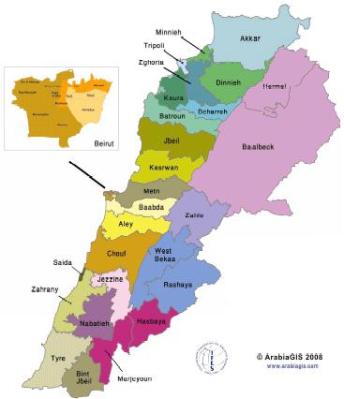
 I recently read an interesting profile of ex-Minister of the Interior Ziad Baroud in Al-Akhbar English (which, by the way, you should all be reading on a daily basis). The last two paragraphs, in particular, caught my eye:
As part of his interest in electoral law, Baroud is in contact with Bahij Tabbara, a former Lebanese minister. Together they are preparing a proposal on proportional representation, an electoral system many believe would undermine the current sectarian structure governing Lebanon. Baroud says their proposal “is not about a political party, tendency, movement or coalition,” but simply a campaign calling for proportional representation and hoping to raise awareness about the issue. Baroud confirms that they have not gone into the project’s details, but he feels that Tabbara is an intelligent person who will help move the project forward.
Although Baroud hopes to see proportional representation implemented in Lebanon, he is pessimistic about its acceptance among Lebanon’s political elite. He predicts that the prevailing political groups will never agree to such electoral reforms, because their direct or indirect interest are heavily vested in the status quo.
Is this true? Baroud is right that many of the bigger parties have no interest in changing the existing majoritarian system, but I think that a few important players would be far better served by proportional representation (PR), while at least one major party is probably agnostic on the issue.
In particular, Prime Minister Mikati would stand a much better chance of increasing the size of his legislative bloc if majoritarianism were to be replaced by a proportional scheme for the 2013 elections. With Hariri’s political relevance being depleted by the day, in fact, all of Lebanon’s “independent” Sunni politicians (particularly Mikati and Safadi) would seem to have a good shot at making inroads into Mustaqbal’s share of Parliament under a PR system.
On the other hand, any party that anticipates winning its seats by a margin short of a landslide is probably going to be against PR. This applies not only to Hariri’s Future Movement but also to Aoun’s Free Patriotic Movement and the rest of the Christian parties. All of these groups (as I argued in an article from a couple years ago) won their seats in the 2009 elections by decent margins (in the 55%-65% range) but not by total landslides. This means that under a PR system, they would likely lose seats in those same districts to their opponents. (See also this post for more reading on electoral districting in Lebanon and PR).
Meanwhile, if Hizbullah’s support in 2013 is anything like it was in 2009, they would have very little to lose from a PR system. In fact, they might even gain seats under this scheme, by running resistance-friendly candidates against Hariri’s people in the districts that the latter won by a narrow margin.
(Note: the same could be said of Aoun. While losing seats in districts like Jbeil and Kisrawan, the FPM might pick up seats in Beirut and elsewhere, particularly given all the new political capital that has accrued to the party as a result of its visible successes in the areas of telecommunications and energy.)
In sum, I’m not particularly optimistic that PR will be implemented in time for 2013, but my lack of optimism has less to do with the fact of entrenched political interests as it does with political inertia. Still, it would be nice if it happened.


 Qifa Nabki
I don’t think I have to tell you what is my opinion of this.
Posted by dontgetit | September 21, 2011, 10:39 pmI think it is like abolishing sectarism in Lebanon 😉 Even Nabih Berri supports it 😉 LOL…
Posted by guest1 | September 22, 2011, 3:39 amI don’t get it !?
If Egypt is capable of buying 2250 megawatt of additional power from GE at US$300million, why are we paying $1.2billion for 700 ?
http://www.marketwatch.com/story/egypt-selects-ge-technology-for-300-million-in-electricity-contracts-to-power-countrys-growing-needs-2011-09-20
Posted by R2D2 | September 22, 2011, 6:09 am@R2D2
Its simple arithmetic- the remaining $900 million dissappears into the black hole that is called the politicians pockets!
Posted by Enlightened | September 22, 2011, 8:15 amR2D2
Probably the 300M is the cost of the gas turbines only supplied by GE and doesn’t include plants and other machinery?
Posted by IHTDA | September 22, 2011, 8:33 amIf Lebanon adopts proportional representation, March 8 would probably be in power until at least 2021 if the current alliances are maintained.
The current election scheme actually provides March 14 with many more seats in parliament than they would get with proportional representation. Prove me wrong if you don’t agree!
Posted by Murad | September 22, 2011, 12:33 pmR2D2
There is something called engineering constraints. Not all situations are the same. Different kinds of power generation, different topographies, different designs, different equipment, those all lead to different costs. Also GE’s low price could be a product of US “aid” if you know what I mean. Lebanon doesn’t qualify for that aid because it has a people’s government (whether you want to agree with that last part, or not, doesn’t matter, still true).
Posted by Murad | September 22, 2011, 12:41 pmMurad,
Even if GE’s price (low or not, I’m no expert!) is financed by USAID, it reflects GE’s “real” price. The program is intended to spur exports for US based manufacturing companies and GE gets the funds for the order from the US government, which will be repaid by the Egyptian Energy Ministry at very low interest to USAID.
What picked my interest is the extensive difference in cost per megawatt of gas produced power that we are paying in comparison to Egypt.
Posted by R2D2 | September 22, 2011, 1:06 pmMurad,
It is hard to “prove you wrong” because the argument is not an analytical one but an empirical one, if you know what I mean. Whether or not M8 or M14 benefits from PR depends on many different factors, including:
1) the size and shape of the districts
2) the kind of the PR system adopted
3) the vicissitudes of public opinion
Having said that, I do think that M14’s support has generally been eroded more than M8’s (largely as a result of their absence from power and the successes of the Mikati govt). Under a majoritarian system, a loss of 10% of your support base in any given district would not be a serious obstacle, as long as you don’t dip below the 50% margin. Under a PR system, though, that 10% loss could be the difference between winning all the seats in a district and all the seats minus one.
So, I do agree with you that PR probably favors M8, for the time being.
Posted by Qifa Nabki | September 22, 2011, 1:12 pmPeople’s government????
Best joke of the week, right here. The people of Lebanon have not had a say in government in well over 30 years, regardless of which “faction” has been in power at a given time.
People’s government! HAHAHAHAHAHAHAHA!
Posted by Bad Vilbel | September 22, 2011, 1:16 pmAnd Murad,
All Lebanese qualify for USAID. In fact quite a few have benefitted from it in Lebanon.
There are some on this blog that can attest to that much better than I.
Posted by R2D2 | September 22, 2011, 2:15 pmQN,
Qu’est que ca veux deux .. representation proportionnel ?
Merci.
Posted by R2D2 | September 22, 2011, 2:32 pmI think a move to proportional representation would be positive, provided it doesn’t contain any “exception” in certain areas to favor this politician or that one. I don’t think at all it is certain that proportional representation would be favorable to March 8 or to Hezbollah. Actually, I think it would be a very risky move for Hezbollah and I don’t expect the party to seriously push for it, anyway certainly not in the immediate future. I think it will wait as long as possible before taking any decision, because it cannot be sure of the local and regional circumstances in which the elections will be held. It already happened that the electoral law that March 8 obtained as spoils of the May 7 mini-war resulted in its defeat. They certainly don’t want to repeat that, and it is far too early to know exactly what law would be the most favorable to the Hezb’s interest. There is a significant risk for Hezbollah to create a Shia third force in the South, that of course would be small initially, but that could grow to be a significant rival in the future, and it is unknown what impact PR will have on Aoun.
Posted by Shiwa7ad | September 22, 2011, 2:40 pmWho does a capitalist atheist vote for in PR and how?
Posted by R2D2 | September 22, 2011, 2:51 pmR2D2
I wasn’t talking about USAID. I was talking about US “aid” where they provide covert aid to puppet governments for certain payback. If you don’t understand the importance of Egypt’s near-future decisions to the US, then you’re illiterate in regional politics. If you look around Wikileaks documents, you will find the US government puts a lot of effort into international work contracts for companies like, namely, GE and Blackwater, so it is not impossible to see GE grant lower prices under USG’s request.
Another factor that can affect pricing is the fact that Egypt is a current exporter of natural gas and much of the needed infrastructure for the project may already be ready, unlike in Lebanon. You cannot compare two projects to each other without understand the logistics involved in each. Yes, $1.2b is much bigger number than $300m, but that really means nothing if you don’t know the particulars of the two projects.
Posted by Murad | September 22, 2011, 4:14 pmR2D2,
A Capitalist can’t be an Atheist; by definition, a capitalist is a religious believer whose “theos” is profit/money/economic development/market forces/etc.
Posted by Parrhesia | September 22, 2011, 4:19 pmQN
A long time ago, in one of his speeches, Nasrallah spoke about PR and even demanded it because he claimed that the election law was rigged to favor certain parties over others. Since then the election law was changed a little but I would still expect that he would be in favor of this move. Only time will tell, but I am convinced that there will be stiff resistance to PR by March 14 parties as well as Jumblatt.
But to me this is still a relatively minor issue. The real change to watch out for is if expatriates are allowed to vote from abroad. That will make things wildly unpredictable and you will see money flying around Lebanese diaspora communities, much like how Hariri’s men were giving Lebanese expatriates free round trip flights to vote for him in 2009 (but this time it would be much cheaper, no need for flights!).
Posted by Murad | September 22, 2011, 4:21 pmMurad,
I don’t … and I appreciate your input.
I have yet to be privileged to the details of the electricity plan in Lebanon and the breakdown of costs and expenses to make my “citizen’s” tax-paying judgement.
I have been able to learn openly on the web that GE is providing 2250 Megawatts of power to Egypt at $300million, vs. an opaque bill to spend $1.2Billion for 700 in Lebanon.
Have tenders been sent out to the local and international community for us to understand the exact costs for the intended project? Who gave our internationally acclaimed Energy Guru and Minister the numbers?
Posted by R2D2 | September 22, 2011, 4:29 pmParrhesia,
So I can’t be an Atheist and Capitalist …. but I can be an Atheist and Jewish?
Posted by R2D2 | September 22, 2011, 4:46 pmAssuming the 2009 results, and proportional representation based on the same districts:
Aoun would pick up seats in Beirut, Batroun, Koura, Zahle, Akkar, Aley, Shouf.
M14 christians would get seats in Kesrouan, Metn, Jbeil, Zgharta (1 out of 3 there).
The independent Sunnis would get some in Tripoli, maybe 1 or 2 in Beirut, West Bekaa, Saida.
Hizballah/Amal would lose maybe one or two of the Shia seats. You never know though, with a proportional system, it might encourage a third force in the long run (especially Baaback/Hermel)
The biggest loser from a proportional representation law in Lebanon is Walid Jumblatt, who will no longer be the sole voice of the Druze.
The FM would also lose out on a few seats, but nothing serious enough they can’t mend with a few alliances. It would also encourage them to broaden their activities to non-sunni majority districts.
Posted by W | September 22, 2011, 4:58 pmI’m not quite sure if I get it, but is PR another term for federalism?
Posted by R2D2 | September 22, 2011, 5:10 pmMurad,
While I agree with your overall comment, I have to point out that Hariri was not the only one providing “free flights” to expats in the previous elections.
There’s a pretty big Christian expat population in France/Canada/USA which you can bet the FPM and LF will try to capitalize on.
There’s also a pretty big shia expat population in Africa. And HA is not shy when it comes to throwing money around.
Your overall point still stands though.
Personally, I’m all for PR. But as you all pointed out, there is very little to gain for the established political class (on both sides) in implementing PR, which is why I don’t really see anyone pushing for it by the next elections or anytime soon, for that matter.
Posted by Bad Vilbel | September 22, 2011, 6:57 pmQN,
In my humble opinion you have committed some Fatal errors in the above posts and comments. PR would not change the composition of the Chamber that much since the law is still committed to 64 Christians and 64 Moslems. I know that one can make an argument whether these MPs belong to M14 or M 8 but that does not address sectarianism.
however what is most important is that no one can make any reliable projections about the results of PR elections since, as you have rightly stated in a comment no one knows the shape of the districts or the exact laws that are going to be used to apply PR.
The outcome could favour one party or the other depending on details that have not been revealed yet. As a result all sorts of speculation is still premature.
Posted by Ghassan Karam | September 22, 2011, 7:47 pmR2D2,
Without taking the time to look into the details of the GE-Egypt deal I am willing to speculate that the big difference between that deal and the Lebanese plan is not due to corruption . OI think the difference is that GE is proposing the most efficient electric generating plants for Egypt, those that run on natural gas while Lebanon is still planning to use the single most inefficient, most expensive , most polluting and least used fuel in the world for electricity generation , essentially diesel plants.
Posted by Ghassan Karam | September 22, 2011, 7:53 pmR2D2,
The price Egypt is paying is for six gas turbines.
The cost of the Lebanese plan incorporates much more than new turbines. It includes the cost of upgrading and building new power plants, upgrading and building distributon and delivery infrastructure and includes investment in renewable energy supplies. Although undocumented, it probably also includes the cost of “laying off” the ghost employees so ever present in Lebanons civil staff rosta.
Posted by mo | September 22, 2011, 7:55 pmGK,
While the plan involves continuing to use the diesel plants, all new generators are expexcted to be natural gas (all the more likely since its entirely possible we could be supplying that ourselves).
Posted by mo | September 22, 2011, 7:58 pmIn addition to what GK mentioned, the Egypt project does not include distribution as opposed to Lebanon where the grid needs to be totally overhauled for the additional capacity.
There are no USAID funds going into the Egypt power generation project.
USAID also does not require beneficiaries of development programs to pay anything back these are programs funded and implemented to enhance stability which is a goal of the DOS, much better than DOD run programs for stability 🙂
Posted by Vulcan | September 22, 2011, 8:12 pmmo,
I do not want to make any ‘definitive” statements since I have not had time to look into the details but on the surface it strikes me as bizarre for a country in 2011 that is planning on producing electricity from diesel generators. I think that these are usually the domains of construction projects of a temporary nature where there is no grid available. Anyway, without even doing any research I am willing to suggest that both Algiers and Qatar have a large surplus of LNG that they would love to supply Lebanon with its needs. (Remember that even if Lebanon is to start exploration for natural gas tomorrow it would take at least 4-6 years before the gas is found and is available on the Lebanese soil.
Posted by Ghassan Karam | September 22, 2011, 8:34 pmIf I may, take a step back from the 2 issues here:
1-I wish that QN, or someone else somewhere, addressed the Banana Republic questions: where on earth is every election decided under different rules? and where on frigging earth are the rules decided and announced (and tailored-made) only months before election?
2-I believe that if the same ruling morons make the rules, the same ruling morons will be returned, regardless (OK, maybe plus or minus the usual 2 or 3 gainers or losers)
3-Appalling that to this day, after the whole saga and agreement(?) on electricity NO ONE knows what the hell was the disagreement about and how it was solved, we call all thank our idiot press for that.
Posted by OldHand | September 23, 2011, 3:32 amHezbollah and Amal normally would be the first threatened by a PR law but in the same time nothing is really normal in Lebanon and any shia candidate against them would be so intimated (if not just liquidated physically) along with his family and supporters that he won’t be able to do much.
Concerning Christians, of course if expats are allowed to vote (let’s not dream) that would be severe blow to the Baasi among them and the orangies would certainly be loosing seats. It could also diminish LF and kataeb voice within M14 christians as expats or local educated people would favor a M14 independant figures list.
Posted by Fuziyad | September 23, 2011, 7:42 am1, 2 and 3 above are simply answered as follows:
LACK OF TRANSPARENCY.
When will the Lebanese finally wake up and see that this is not acceptable?
They continue to go along with a style of “government” (if one can call it that) which simply allows others to make decisions, without sharing any information.
In short “Don’t ask questions. Don’t worry about the details. We know what’s best for you.”
Apparently, the typical Lebanese likes being treated like a 5 year old.
Posted by Bad Vilbel | September 23, 2011, 12:13 pmSince there’s not much going on in the news, and nobody picked up on this “Satanist” story… Here’s another link. 🙂
http://nowlebanon.com/NewsArticleDetails.aspx?ID=314675
Now, seriously. Is THIS the best use of the ISF? 15 soldiers storming the home of a heavy metal fan?
Cause we don’t have much bigger problems to address in this stupid freaking country.
And don’t get me started on the completely ridiculous laws in question. “Blasphemy”? Really? That’s against the law?
Oh, and the Nirvana bit is pretty freaking hilarious.
Someone remind me again. Is this Lebanon or Saudi Arabia?
Posted by Bad Vilbel | September 23, 2011, 1:24 pmBV: Is this Lebanon or Saudi Arabia?
I was recently standing in line at some useless ministry, and when I reached the front of the line, I was told “Go back and stand in this other line, this is the women’s line”. (needless to say, I am a guy).
Hop that this (and new liquor restrictions here and there) answers your question.
Posted by OldHand | September 23, 2011, 1:52 pmOld Hand@32 lol…and you thought all women line was more interesting.:P
It is cross dressed woman in Saudi & Iranian style BV.
Posted by danny | September 23, 2011, 2:40 pmThere’s not much going on in the news?
Really?!
Posted by R2D2 | September 23, 2011, 3:02 pmThis must obviously be the Hariri network.
Posted by R2D2 | September 23, 2011, 3:03 pmAl-Akhbar English (which, by the way, you should all be reading on a daily basis).
Are you kidding me?
Posted by theodore Arz | September 23, 2011, 4:34 pmperhaps your lack of optimism is a result of you viewing this through sectarian logic. isn’t the purpose of this electoral reform just one major step in doing away with Lebanon’s sectarian system of politics?
Posted by Ali | September 24, 2011, 8:57 amAli,
It would be hard to find a person that is more in favour ofsecularism than I am and who is also in principle a strong advocate of PR provided it is based on real and true PR.
What makes you so sure that things will be that different in say 4 years from know or even 10 years from know.. The Lebanese Maronite Patriarch will still be in office, the FPM will still be led by the Aoun clan, the LF will still be as fundamentalist Christian as ever, the Phalange will be the fiefdom of the third generation of Gemayels, Jumblats’ son would have taken over the Druze leadership not to mention the purely religius thinking of the Shia and many of the Sunnis.
I have not emphasized the structure of the Moslem political community on purpose. My assumption, is that neither the Shia nor the Sunnis have major objections if sectarianism is to be abolished because of the belief that , at least for the first few electoral rounds most eligible citizens will cast a vote along religious affiliations. The real obstacle to secularism are the Christians who often act as sponsors of equality and democracy but insist on being more equal than others.What is the logic of giving 30-35% of the voters 50% of the elected offices? Make no mistake about it, the Maronite church in addition to each and every Maronite MP believe that they deserve the greater representation because they are more fundamental to the country. The ridicoulous thing about this absurd notion is that no one challenges it, at least not publicly. The idea of Christian/Maronite superiority needs to be challenged head on and in very clear terms. If the Maronites care about Lebanon half as much as they claim then they would raise no objections to a system that permits nonsectarian representation and if they insist on a sectarian system then a truly proportional representation ought to be sought. The Maronite is just as much of a Lebanese with as much of the rights as any other Lebanese be that a Shia, a Sunni or a heretic. .
Posted by Ghassan Karam | September 24, 2011, 2:01 pmDo these parts of Lebanon have the same number of people.? and are they diverse in religion.?
Posted by Norman | September 24, 2011, 10:10 pmA small step in the right direction by a repressive regime:
http://www.nowlebanon.com/NewsArticleDetails.aspx?ID=315148
Posted by danny | September 25, 2011, 8:39 amDanny,
Can we be sure that this is not a tactic to buy time ?:-)
Posted by ghassan Karam | September 25, 2011, 1:10 pmGhassan, I don’t believe you give the citizens of Lebanon enough credit. Yes they vote, breathe, eat, shikh, according to sect, however, this is what is offered to them. Once these scoundrels are stripped of their system, the citizens will react in kind. They will think long and hard about whom they cast their ballot for.
Posted by Ali | September 25, 2011, 3:50 pmI live in the UK, a country where there has been a campaign by the Liberals and now the Lib/Dems to introduce PR for over 40 years without success and that is because the two big parties would loose. If PR is introduced in Lebanon it would trigger a very different type of list constuction by the various parties depending on constituency size. But the main issue is whether parties like Amal and Hizballah could still form joint impenetrable bulldozer lists (ma7daleh), People do not necessarily vote by sect, they are divided politically along very legititmate lines, this applies to every family, village or group. PR can manage this division.
Posted by Nadim Shehadi | September 25, 2011, 7:40 pmThe fact that women will be allowed to vote in any way or form on anything equally with Royal male subjects in Saudi Arabia is … in Donald Trump’s words … HUGE !
Posted by R2D2 | September 25, 2011, 8:15 pmObi Wan … even though your worry may be tactically correct, your refraining from ceasing this immense opportunity isn’t.
I therefore have no other choice.
You’re fired !
Posted by R2D2 | September 25, 2011, 8:21 pmfrom capitulating …
Posted by R2D2 | September 25, 2011, 8:23 pmSorry … am terribly jet lagged trying to get some shut eye.
I haven’t had much time getting into nitty gritty details of this mind boggling info… but it sounds to me like it is “One small step for Arab woman … but one giant leap for (human)kind”
Posted by R2D2 | September 25, 2011, 8:33 pmMaybe it’s time for mankind to turn the purse over to women … and for men to concentrate on what they love doing or imagining they can do best.
Football. (Also known as soccer in the US).
La passion!
Posted by R2D2 | September 25, 2011, 9:07 pmR2D2,
Obviously I am very much in favour of allowing women to exercise their full rights of equality in all fields but the Middle East has taught me to be careful since things are not always what they appear to be. King Abdullah is 87 years old and so he will be 91 when the next round of municipal elections is due. Would he still be in power and if not would his successor go along with his wishes to grant women the franchise? If he really cared that much why didn’t he do this last month so that women will get the chance to run for elections in this round? I sure hope that all goes well and that women get the right to vote and participate as equals in a fields but I reserve the right ,under the current circumstances, to be cautiously optimistic. Have a good nights sleep.
Posted by Ghassan Karam | September 25, 2011, 10:39 pmDoes all this really matters knowing that the Lebanese will still be voting for the same bunch of thieves???
Posted by marillionlb | September 26, 2011, 4:51 amR2D2 #49,
The more jet lagged you are, the better it is… thanks for this. lol
Posted by 3issa | September 26, 2011, 11:58 amAli Comment#43:
You say the Lebanese citizen does not get enough credit, and fall back on the old excuse of blaming the “leaders”.
Your phrasing is interesting “Once these scoundrels are stripped of their system”
yet you do not state who it is that will or should strip these scoundrels of their system.
Who is it that keeps these scoundrels in power?
(I assume by “scoundrels”, you mean the current political elite).
I believe you are looking at it backwards. The political feudal elite is in power because the Lebanese citizens keep them there, time after time. They a reflection of our citizenry, even if you and others want to live in denial about it. Without their “followers” support, these guys would be nothing.
People continue to cast their votes for these ruling clowns time after time, even, and to carry weapons for these clowns and to run headfirst into every demagogical trap that’s laid to them, to the cries of “with our blood we serve you .
And you expect me to believe that it’s because they have no other choice given to them? How about the simple choice of saying “No”?
“No. I will not vote for JumblattGemayelGeageaHariri”?
How about “No. I will not take up arms and shoot at fellow Lebanese, no matter their sects, be it in Tripoli, Beirut, the Bekaa or Dahyeh”?
etc.
Posted by Bad Vilbel | September 26, 2011, 12:23 pmHere’s the credit I give Lebanese citizens, ya Ali #43:
The flip-flops were Halloween-themed, and were decorated with an image of a Dracula mansion surrounded by graves that had crosses on top. The only thing anyone saw was the crosses, because that’s all they wanted to see. It was a huge opportunity to make a victory.
The store happened to be located in the Christian residential area of Furn al-Chebbek. The owner, Ali Fakih, happened to be a Shia. It looked to the mob that demonstrated in front of the store two weeks ago like Hezbollah was humiliating the Christian community and their religion right in the middle of their own neighborhood. Closing the store and forcing the owner to apologize was not enough. Fakih got arrested and is reportedly still being detained at the Baabda Justice Palace, along with the manager of the store, for “instigating sectarian strife.”
Posted by Bad Vilbel | September 26, 2011, 5:00 pmThey are supposed to vote but NOT drive. Is there any more backward and repressive country bar the Taliban?
http://www.thestar.com/news/world/article/1060216–saudi-woman-sentenced-to-10-lashes-for-driving-a-car?bn=1
Posted by danny | September 28, 2011, 9:31 am